
William Whiston and the Apostolic Constitutions
Completing the Reformation
By (author) P.R. Gilliam III
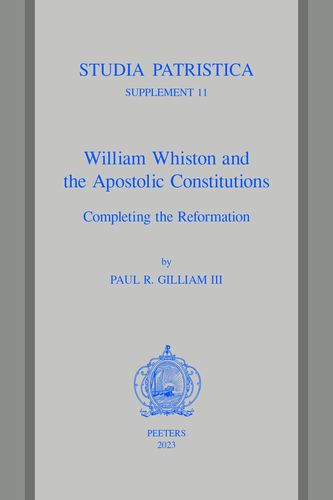
Written in the wake of Maurice Wiles’ Archetypal Heresy: Arianism through the Centuries, this book narrates the gripping account of William Whiston’s outsized affections for the Apostolic Constitutions. The Apostolic Constitutions, a collection of teachings concerning issues such as baptism, the eucharist, proper gender relations, and the ordination of bishops claim to have been given by the resurrected Jesus to his apostles during the forty days before his ascension back into the presence of God. In addition, the Apostolic Constitutions claim to have been gathered by Clement, understood to be the companion of the apostle Paul. Most scholars from Whiston’s seventeenth- and eighteenth-century world concluded that the Apostolic Constitutions was not, in fact, apostolical, no matter its claims. The consensus today, perhaps unanimous even, is of a similar nature: the Apostolic Constitutions consists of church orders emerging from the second and third centuries that were then assembled sometime during the fourth century when the apostles’ names, along with first-person pronouns, were added. William Whiston, however, concluded that the Apostolic Constitutions was the most sacred book of the New Testament. How then did William Whiston who, as the successor to Sir Isaac Newton as the Cambridge University Lucasian Professor of Mathematics, was a member of the intelligentsia of his day, come to such a conclusion? The pages of this book will answer this question. As the narrative unfolds it will become apparent that even though Whiston was wrong about the apostolicity of the Apostolic Constitutions, he nevertheless made important contributions to patristic scholarship as well as, and perhaps most important, religious liberty for all persons. Furthermore, even though Whiston was mistaken about the centerpiece of his project to restore primitive Christianity, some readers will appreciate his sincere desire to bring the reformation work of Martin Luther and others to completion.
- By (author) P.R. Gilliam III
"Paul Gilliam's study offers a glimpse into William Whiston's intellectual importance as an eighteenth-century scholar of early Christian history as well as Whiston's understanding of himself within the flow of ecclesial reform. . . . The greatest service that Gilliam has provided is to offer a fascinating, carefully narrated account of how and why Whiston argued for the authenticity of the Apostolic Constitutions. This story is well grounded in primary sources and especially in citations from the works of Whiston himself. . . . Such detailed work makes this book a model of attentive historical scholarship." Lookadoo, Jonathon, Church History, 19 March 2024
—
Other Titles in this Series


 Un dossier de l’Épistolaire augustinien: la correspondance entre l’Afrique et Rome à propos de l’affaire pélagienne (416-418)
Traduction, commentaire et annotations
Volume 3


 Christian Identity Formation according to Cyril of Jerusalem
Sacramental Theosis as a Means of Constructing Relational Identity
Volume 8


Similar Books

 A Companion to Christianity and Sport in Europe and North America (19th-21st centuries)
Volume 1: Western and Eastern Europe
 A Connecting Polemic in the Medieval Mediterranean
The Correspondence of Leo III and ʿUmar II
Volume 6





 Ars Prophetica
Theology in the Poetry of Twentieth-Century Hebrew Poets Avraham Halfi, Shin Shalom, Amir Gilboa, and T. Carmi
 As Messianism Turns to Heresy
The Regenstein Chair Lectures On Lurianic Kabbalah and Shabbatai Tzevi at Hebrew Union College - Cincinnati


 Creating the Woman in Antiquity
Proceedings of the 16th Melammu Workshop, Innsbruck, 2–3 June 2022
Volume 13
 Cultic Kisses
Fruitful Encounters Between Deities and Humans. Festschrift for Angelika Berlejung on the Occasion of Her 65th Birthday
 De/colonizing Theologies
Glocal Histories, Contemporary Challenges, Theoretical Reflections
Volume 4
 Drunk the Potion, No Whit Charmed
The Doctrine of Pure and Perfect Souls from Iamblichus to Damascius






 Extracanonical Traditions and the Holy Land
Texts, Rituals, and Material Culture in Late Antique Palestine
 Fear, Fear of God, God-Fearers
Philological and Historical Perspectives on the World of Ancient Judaism and Christianity

