
Emporikoí amphoreís apó ten archaía Akantho kai to topikó ergasterío
By (author) Konstantínos Phílis

| The town of Akanthos became an important commercial port and a communication channel between Eastern Greece, the interior of Chalcidice, and Macedonia. In Antiquity, exchanges of consumer goods can be seen through the abundance of transport amphorae found in the area. The products they contained were mainly liquids, most important wine and oil, but they were sometimes used for solid foodstuffs such as cereals, salted fish and meat, olives, fruit, nuts, resin, etc.
The amphorae included in this study come from the workshops of Chios, Klazomenae, Lesbos, Samos, the area of Miletus, the SE Aegean, unidentified workshops of the North Aegean, Mende, Thasos, and from the workshops of South Greece, Attica, Corinth, Laconia, and Corfu. The oldest ones date back to the middle of the 7th century BC and the newest to the first half of the 4th century BC. Transport amphorae were also produced in Akanthos. In particular, the Akanthian amphorae appear to have been made in three basic types, with some variations in their morphological details. At least three different types of clay used in the manufacture of local amphorae by the Akanthians have been identified. The study of the imported amphorae and those of the local workshop contributes to a deeper understanding of trade relations and exchanges that were developed in the specific geographical area of northern Aegean. Both the production and the movement of goods transported by the amphorae depended directly on the demand, needs, and desires to acquire certain basic products. The presence of all these transport amphorae is therefore linked to specific consumption practices developed in the area. This wide variety of amphorae also attests to the close commercial relations that were developed mainly with the area of Eastern Greece and the particular preference of its inhabitants for its products. Several of the transport amphorae date back to Archaic times, but none of them seem to date before the mid-7th century BC, i.e. before the establishment of the colony on Andros. The discovery of all these different amphorae attests also to the increased need of the population of the new colony to import basic agricultural products, such as wine and oil, which they were unable to produce themselves in sufficient quantities, at least until the beginning of the 5th century BC when local production began. The activation of the local workshop for amphora production from the 5th and especially in the 4th century indicates the important role that the town of Akanthos played in the exportation of local wine to the markets of the Aegean and the Black Sea region. |
- By (author) Konstantínos Phílis
Similar Books


 Caesar’s Visions and Impact on the Roman Empire
Revisiting the Archaeological and Historical Record of the 40s BC
Volume 2

 Construction Processes in Historical Western Societies (5th c. BC – 10th c. AD)
Case Studies on Techniques, Models, and Costs


 Etruscan and Roman Hellenistic Anatomical ex votos
Reassessing Popular Religious Expressions in Central Italy
Volume 8




 Invisible Labour in Antiquity
Visualizing Obscure Work in the Ancient Mediterannean and West Asia
Volume 1

 Late Antique villae in the Balkans (3rd–7th c. AD): Current Research Questions and Perspectives
HAEMUS Companion to the Late Antique Balkans 1
Volume 4





 Portraying the Individual in the Roman East
Local–Imperial Entanglements in Sculpture, Mosaics, and Paintings (First–Fourth Centuries AD)
Volume 18


 Roman Copies, Collecting, and Culture in the Bay of Naples and Beyond
Papers in Honor of Eugene J. Dwyer
 Small Worlds and Relational Agencies: Local Societies in Early Medieval Iberia
Pequeños mundos y Agencias relacionales: Sociedades locales altomedievales en la Península Ibérica
 SOMA 2023: Proceedings of the 24th Symposium on Mediterranean Archaeology
Ideas that Travelled by the Sea, Udine, 2-4 February, 2023


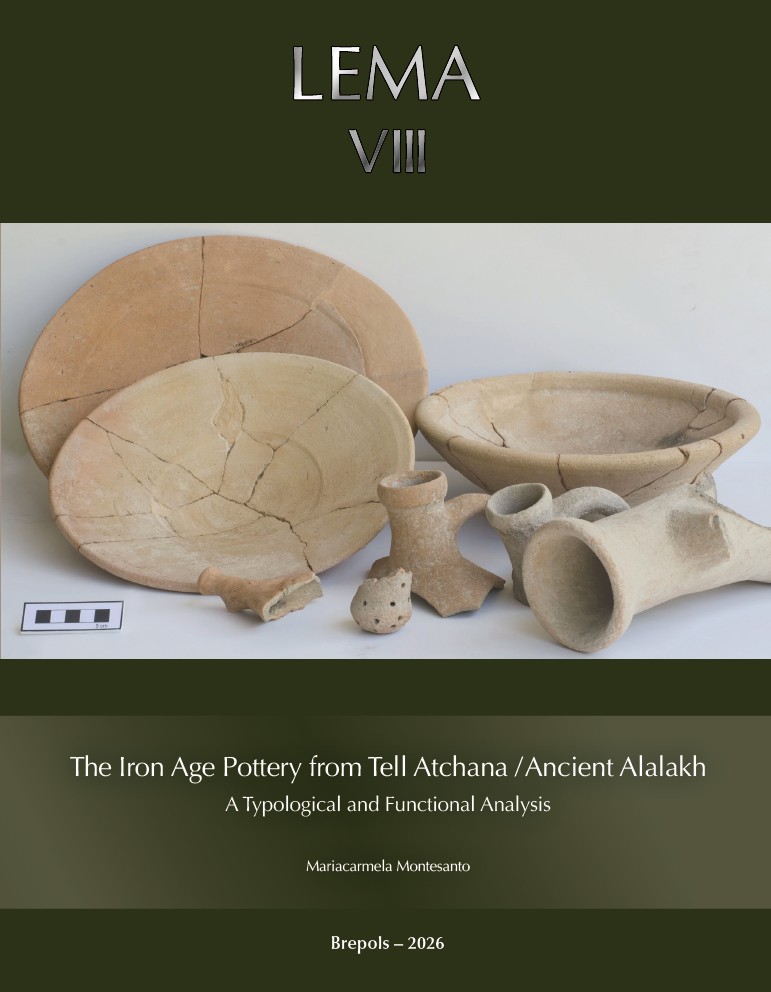 The Iron Age Pottery from Tell Atchana / Ancient Alalakh
A Typological and Functional Analysis
Volume 8


 Writing in the Church of the Nativity in Bethlehem
Inscription and Graffiti in a Multilingual and Multigraphic Perspective
Volume 45
 Zooarchaeology of Ancient Greek Sanctuaries in Southwestern Sicily
Faunal Analysis from Selinus and Akragas as Evidence of Differences in the Treatment of Animals for Ritual Purposes
 Alabaster
An Interdisciplinary Study of the Sources and Uses of Calcite Alabaster in Antiquity
Volume 5

 Echoes from the Past: Traditional Cypriot Pottery
An Exhibition at the Cyprus American Archaeological Research Institute in October 1995