
How to Do Things with Myths
A Performative Theory of Myths and How We Got There
By (author) Ivan Strenski
Paperback (Published)
(June 2025)
ISBN: 9781800504776
6.14 x 9.21 inches
Price: $34.95
In stock
Hardback (Published)
(June 2025)
ISBN: 9781800504769
6.14 x 9.21 inches
Price: $100.00
In stock
This volume assembles a radically updated collection of the author’s oft-cited publications on myth. Together, they tell how theories of myth have changed and led to a novel “performative” theory of myth.
How to Do Things with Myths assembles a radically updated collection of the author’s oft-cited publications on myth. Together, they tell how theories of myth have changed and led to a novel “performative” theory of myth. Beginning from its mid-19th-century foundations with philologist, Friedrich Max Muller, myths had been conceived in textual terms as quasi-biblical, static narratives. Not until the impact of ethnographic studies of traditional societies in the early 20th century did myths come to be regarded in situ as living agents shaping their societies. Leading a movement against Muller’s static, textual view of myths were his French sociological critics, notably Emile Durkheim and his equipe. The Durkheimians felt that myths mattered because of what they “did” by functioning within human societies. Adopting the Durkheimian notion of function was Bronislaw Malinowski. But as a pragmatist and positivist, Malinowski narrowed his conception of myths to utilitarian terms. In place of Malinowski’s utilitarianism, the author proposes a “performative theory” of myths – a theory freeing myths for a wider range of agency in culture, unrestricted by Malinowski’s behaviorism and positivism. Conceived as “important stories,” myths can thus “do things” in many, often subtle and unquantifiable, ways, depending upon a given culture’s own value system. Conceptually and theoretically, a performative theory situates itself with respect to the efforts of some of the most popular contemporary myth theorists — Bruce Lincoln, Mircea Eliade, Claude Levi-Strauss, Georges Dumezil, Robert A. Segal and Jonathan Z. Smith.
Chapter 1. Introduction: Myths, Performatives, Performances and Performers 1-15
Chapter 2. “Sola Scriptura”: Max Müller’s Theory of Myths 16-38
Chapter 3. French Connections: Durkheimian Ritualism Replaces Müller’s Hegemony of Myth 39-53
Chapter 4. Henri Hubert: Durkheim’s Mythologist 54-67
Chapter 5. What Lévi-Strauss May or May Not Owe to Henri Hubert 68-87
Chapter 6. Müller’s Legacy, Broken: Malinowski and the Pragmatist Concept and Theory of Myths 88-119
Chapter 7. Taking Responsibility for the Concept and Theory of Myth 120-145
Chapter 8. Conceptual Problems for Robert A. Segal and Jonathan Z. Smith 146-172
Chapter 9. Henri Hubert Undoes Aryanist Political Myths 173-187
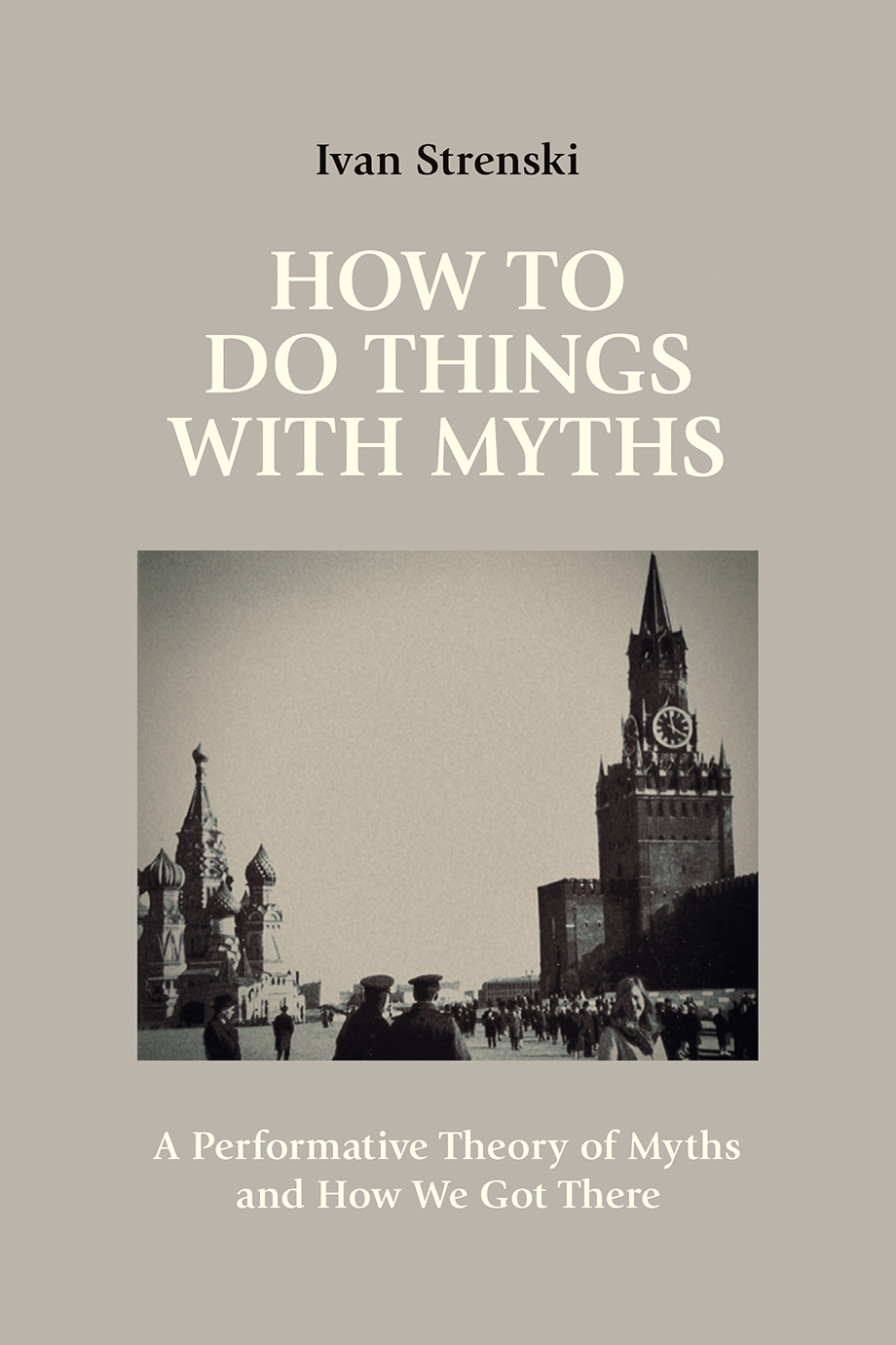
Chapter 10. The Myth of Moscow, Third Rome: What It Seeks to Do 188-206
End Matter
Notes 207-234
Bibliography 235-251
Index252-255
- By (author) Ivan Strenski
Similar Books

 A Companion to Christianity and Sport in Europe and North America (19th-21st centuries)
Volume 1: Western and Eastern Europe
 A Connecting Polemic in the Medieval Mediterranean
The Correspondence of Leo III and ʿUmar II
Volume 6





 Ars Prophetica
Theology in the Poetry of Twentieth-Century Hebrew Poets Avraham Halfi, Shin Shalom, Amir Gilboa, and T. Carmi
 As Messianism Turns to Heresy
The Regenstein Chair Lectures On Lurianic Kabbalah and Shabbatai Tzevi at Hebrew Union College - Cincinnati


 Creating the Woman in Antiquity
Proceedings of the 16th Melammu Workshop, Innsbruck, 2–3 June 2022
Volume 13
 Cultic Kisses
Fruitful Encounters Between Deities and Humans. Festschrift for Angelika Berlejung on the Occasion of Her 65th Birthday
 De/colonizing Theologies
Glocal Histories, Contemporary Challenges, Theoretical Reflections
Volume 4
 Drunk the Potion, No Whit Charmed
The Doctrine of Pure and Perfect Souls from Iamblichus to Damascius






 Extracanonical Traditions and the Holy Land
Texts, Rituals, and Material Culture in Late Antique Palestine
 Fear, Fear of God, God-Fearers
Philological and Historical Perspectives on the World of Ancient Judaism and Christianity


 Gender and Iconography in Antiquity
Femininities, Masculinities, Ambiguities, and Beyond in the Ancient Levant, Near East, and Mediterranean