
Ermant III
Les vestiges au nom d'Hadrien
By (author) Christophe Thiers

This volume deals with a set of stones bearing the name of the Roman pharaoh Hadrian. It consists of some blocks discovered in 2011-2013, related to those brought from Armant in 1842 by Count Louis de Saint-Ferriol and exhibited in the Grenoble Museum. Hadrian, however, had long been associated with the site of Armant, thanks to the testimonies of some Europeans who visited Egypt in the first decades of the 19th century. Four reports by learned travelers (Hector Horeau, Nestor L’Hote, Louis de Saint-Ferriol, and Jean-Jacques Ampere) and the testimony of an Egyptologist (Karl Richard Lepsius) provide valuable information about the temple remains uncovered in a quarry in the 1840s. These blocks, although modest, are the only remains of Hadrian’s activities in the temple of Montu-Re. They were part of a “procession de soubassement” associated with a colonnade. Their publication raises more questions than it answers, whether a question of their arrangement or their origin.
This volume deals with a set of stones bearing the name of the Roman pharaoh Hadrian. It consists of some blocks discovered in 2011-2013, related to those brought from Armant in 1842 by Count Louis de Saint-Ferriol and exhibited in the Grenoble Museum. Hadrian, however, had long been associated with the site of Armant, thanks to the testimonies of some Europeans who visited Egypt in the first decades of the 19th century. Four reports by learned travelers (Hector Horeau, Nestor L’Hote, Louis de Saint-Ferriol, and Jean-Jacques Ampere) and the testimony of an Egyptologist (Karl Richard Lepsius) provide valuable information about the temple remains uncovered in a quarry in the 1840s. These blocks, although modest, are the only remains of Hadrian’s activities in the temple of Montu-Re. They were part of a “procession de soubassement” associated with a colonnade. Their publication raises more questions than it answers, whether a question of their arrangement or their origin.
- By (author) Christophe Thiers
Other Titles in this Series



 Les textes de la pyramide de la reine Ankhesenpepy II
Edition, description, analyse et traductions
Volume 152




Similar Books


 Caesar’s Visions and Impact on the Roman Empire
Revisiting the Archaeological and Historical Record of the 40s BC
Volume 2

 Construction Processes in Historical Western Societies (5th c. BC – 10th c. AD)
Case Studies on Techniques, Models, and Costs


 Etruscan and Roman Hellenistic Anatomical ex votos
Reassessing Popular Religious Expressions in Central Italy
Volume 8




 Invisible Labour in Antiquity
Visualizing Obscure Work in the Ancient Mediterannean and West Asia
Volume 1

 Late Antique villae in the Balkans (3rd–7th c. AD): Current Research Questions and Perspectives
HAEMUS Companion to the Late Antique Balkans 1
Volume 4





 Portraying the Individual in the Roman East
Local–Imperial Entanglements in Sculpture, Mosaics, and Paintings (First–Fourth Centuries AD)
Volume 18


 Roman Copies, Collecting, and Culture in the Bay of Naples and Beyond
Papers in Honor of Eugene J. Dwyer
 Small Worlds and Relational Agencies: Local Societies in Early Medieval Iberia
Pequeños mundos y Agencias relacionales: Sociedades locales altomedievales en la Península Ibérica
 SOMA 2023: Proceedings of the 24th Symposium on Mediterranean Archaeology
Ideas that Travelled by the Sea, Udine, 2-4 February, 2023


 The Iron Age Pottery from Tell Atchana / Ancient Alalakh
A Typological and Functional Analysis
Volume 8



 Writing in the Church of the Nativity in Bethlehem
Inscription and Graffiti in a Multilingual and Multigraphic Perspective
Volume 45
 Zooarchaeology of Ancient Greek Sanctuaries in Southwestern Sicily
Faunal Analysis from Selinus and Akragas as Evidence of Differences in the Treatment of Animals for Ritual Purposes
 Alabaster
An Interdisciplinary Study of the Sources and Uses of Calcite Alabaster in Antiquity
Volume 5

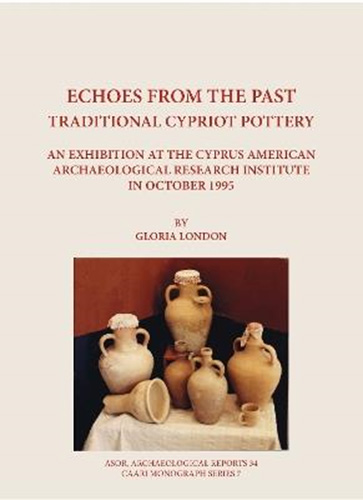 Echoes from the Past: Traditional Cypriot Pottery
An Exhibition at the Cyprus American Archaeological Research Institute in October 1995