
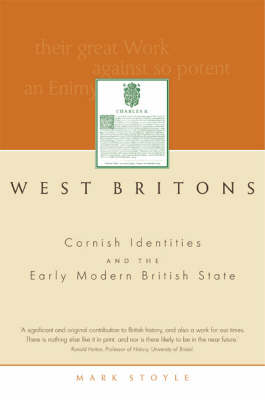
West Britons
Cornish Identities and the Early Modern British State
By (author) Mark Stoyle
Paperback (Published)
(October 2002)
ISBN: 9780859896887
6.14 x 9.21 inches
Price: $30.00
In stock
Hardback (Published)
(February 2002)
ISBN: 9780859896870
6.14 x 9.21 inches
Price: $112.00
On back order
West Britons provides a fresh interpretation of the bloodiest, most devastating years in Cornwall’s history and a wholly new perspective on the history of the far South West of Britain. The book also includes transcriptions of a number of previously unpublished documents, and a list of some 300 Cornish Royalist officers.
West Britons provides a fresh interpretation of the bloodiest, most devastating years in Cornwall’s history and a wholly new perspective on the history of the far South West of Britain. The book explores the unprecedented series of rebellions which took place in Cornwall between 1497 and 1648, traces the connections which existed between those revolts and the contemporary Cornish perception of themselves as a separate ‘people’, and argues that Cornish history must be viewed within a ‘British’, rather than a purely English context. West Britons will be required reading for all those who are engaged in the contemporary political and historical debate over ‘Britishness’. The book also includes transcriptions of a number of previously unpublished documents, useful to teachers and their students, and a list of some 300 Cornish Royalist officers, of special interest to Civil War enthusiasts and genealogists.
Contents: "
The Dissidence of Despair"
- rebellion and identity in early modern Cornwall
"
Knowest Thou My Brood?"
- locating the Cornish in Tudor and Stuart England
"
England No England But Babel"
- English nationalism and the English Civil War
"
Pagans or Paragons?"
- images of the Cornish during the English Civil War
"
The Last Refuge of a Scoundrel"
- Sir Richard Grenville and Cornish particularism
"
The Gear Rout"
- the Cornish Rising of 1648 and the Second Civil War
William Scawen - a 17th-century Cornish patriot
"
A Monument of Honour"
- the Cornish Royalist tradition after 1660. Appendices: "
A Gratulacion to Cornish Men"
, October 1642
the Parliamentarian summons to Cornwall, September 1645
the King's Cornish Regiments, 1642-1646
extracts from William Scawen's "
Antiquities Cornu-Britannic"
,
Contents: "The Dissidence of Despair" - rebellion and identity in early modern Cornwall; "Knowest Thou My Brood?" - locating the Cornish in Tudor and Stuart England; "England No England But Babel" - English nationalism and the English Civil War; "Pagans or Paragons?" - images of the Cornish during the English Civil War; "The Last Refuge of a Scoundrel" - Sir Richard Grenville and Cornish particularism; "The Gear Rout" - the Cornish Rising of 1648 and the Second Civil War; William Scawen - a 17th-century Cornish patriot; "A Monument of Honour" - the Cornish Royalist tradition after 1660. Appendices: "A Gratulacion to Cornish Men", October 1642; the Parliamentarian summons to Cornwall, September 1645; the King's Cornish Regiments, 1642-1646; extracts from William Scawen's "Antiquities Cornu-Britannic".
Mark Stoyle is Professor of early modern history at the University of Southampton. He specialises in early modern British history, with particular research interests in the ‘British crisis’ of the 1640s; cultural, ethnic and religious identity in Wales and Cornwall between 1450 and 1700; and popular memory of the English Civil War from 1660 to the present day.
- By (author) Mark Stoyle
"A major contribution both to the history of Cornwall and the south-west and more generally to our understanding of the early modern period and in particular what must now be regarded as the British Civil War. And the book is as enjoyable to read as it is scholarly." Devon Historian, Oct 2002 "A coherent body of essays on the peculiar nature of the Cornish experience during the turbulent years on both sides of the Tamar during the two early modern centuries." Cromwelliana, 2000 "A significant and original contribution to British history, and also a work for our times. There is nothing else like it in print, and nor is there likely to be in the near future. It makes full and sophisticated reference to current academic debate. At the same time, it is written in a lively, lucid, compelling even-furious style-which will make it easy and attractive to a large public audience." Ronald Hutton, Professor of History, University of Bristol "Stoyle has now a well-established reputation both as a distinguished historian of Cornwall and as a scholar who can relate the history of Cornwall to the history of Britain." John Morrill, Professor of British and Irish History, Selwyn College, Cambridge "This book contributes brilliantly to the new British historiography, establishing Cornwall incontrovertibly as one of the component territories and the Cornish as one of the constituent peoples of the 'Atlantic Archipelago'." Philip Payton, Professor of Cornish Studies, University of Exeter "Stimulating and provocative." English Historical Review, Vol. 117, No. 473, Sept 2002 "well-researched and crisply written book" BBC History, June 2003 "This exceptionally well-written volume is a robust and generally convincing defence of the rights of the Cornish to be considered as active participants in the socio-political travails of the peoples who occupied the Atlantic archipelago in early modern times... The author deserves high praise for rescuing the descendants of Corineus from the marginalizing effects of anglocentric historiography and it is a measure of his achievement that no self-respecting early modernist can afford any longer to ignore the contribution of one of the component territories and one of the constituent people of the British Isles to the current debate on 'Britishness'." History, Vol. 88, Issue 2, No. 290, April 2003 "This is a carefully-researched, lavishly-referenced and well-written book, which presents many challenging ideas. As well as being a major contribution to Cornish history, it is relevant to the current debate on the importance of ethnic 'nations' which together form the modern Britain." The Local Historian, Vol. 33, No. 2, May 2003 "must be considered when assessing the events of the 1640s. He has tackled this daunting task in a readable and entertaining style and it is to be hoped that this will not be his last book on the subject." The Society for Army Historical Research Journal, Vol. IXXXI, no. 327, Autumn 2003 "In a stimulating and provocative book that is a timely contribution to current concerns about the 'Atlantic Archipelago' Stoyle has certainly put Cornwall on the map" Albion, Vol. 35, Issue 2, Summer 2003 "Stoyle's account of Cornish exceptionalism is an important study of separateness, of the pressures at the margin of the state, and of a very distinctive county." Devon and Cornwall Notes and Queries, Spring 2003 "his enthusiasm, knowledge of the archival material, and his ability to communicate... the best speaker they had had in living memory. And for members of these history societies, living memory is a long time indeed... Stoyle is a versatile and gifted historian, not just a writer. His work is of a high academic standard, rigorous and insightful... an inspired historian... This is a brilliantly conceptualised and clearly written book... this is essential reading for anyone concerned with Cornwall, regional identity, or allegiances during the Civil War, and an excellent example of historical writing." The Sixteenth Century Journal, Vol. XXXIV, no. 2, Summer 2003 "a highly original study... The discussion is perceptive and challenging, the text written in a readable, often spirited style... An important contribution to the study of regional and national identity." Northern History XL "This well-researched and crisply written book should be required reading for New Labour, who wish to create a Brussels-blueprinted, bland and meaningless 'South-West Region', from the Scillies to Swindon." D M Thomas, BBC History Magazine
—
“A major contribution both to the history of Cornwall and the south-west and more generally to our understanding of the early modern period and in particular what must now be regarded as the British Civil War. And the book is as enjoyable to read as it is scholarly.” (Devon Historian, Oct 2002) “A coherent body of essays on the peculiar nature of the Cornish experience during the turbulent years on both sides of the Tamar during the two early modern centuries.” (Cromwelliana, 2000) “A significant and original contribution to British history, and also a work for our times. There is nothing else like it in print, and nor is there likely to be in the near future. It makes full and sophisticated reference to current academic debate. At the same time, it is written in a lively, lucid, compelling even—furious style—which will make it easy and attractive to a large public audience.” (Ronald Hutton, Professor of History, University of Bristol) “Stoyle has now a well-established reputation both as a distinguished historian of Cornwall and as a scholar who can relate the history of Cornwall to the history of Britain.” (John Morrill, Professor of British and Irish History, Selwyn College, Cambridge) “This book contributes brilliantly to the new British historiography, establishing Cornwall incontrovertibly as one of the component territories and the Cornish as one of the constituent peoples of the ‘Atlantic Archipelago’.” (Philip Payton, Professor of Cornish Studies, University of Exeter) “Stimulating and provocative.” (English Historical Review, Vol. 117, No. 473, Sept 2002) “well-researched and crisply written book” (BBC History, June 2003) “This exceptionally well-written volume is a robust and generally convincing defence of the rights of the Cornish to be considered as active participants in the socio-political travails of the peoples who occupied the Atlantic archipelago in early modern times… The author deserves high praise for rescuing the descendants of Corineus from the marginalizing effects of anglocentric historiography and it is a measure of his achievement that no self-respecting early modernist can afford any longer to ignore the contribution of one of the component territories and one of the constituent people of the British Isles to the current debate on ‘Britishness’.’ (History, Vol. 88, Issue 2, No. 290, April 2003) “This is a carefully-researched, lavishly-referenced and well-written book, which presents many challenging ideas. As well as being a major contribution to Cornish history, it is relevant to the current debate on the importance of ethnic ‘nations’ which together form the modern Britain.” (The Local Historian, Vol. 33, No. 2, May 2003) “must be considered when assessing the events of the 1640s. He has tackled this daunting task in a readable and entertaining style and it is to be hoped that this will not be his last book on the subject.” (The Society for Army Historical Research Journal, Vol. IXXXI, no. 327, Autumn 2003) “In a stimulating and provocative book that is a timely contribution to current concerns about the “Atlantic Archipelago” Stoyle has certainly put Cornwall on the map” (Albion, Vol. 35, Issue 2, Summer 2003) “Stoyle’s account of Cornish exceptionalism is an important study of separateness, of the pressures at the margin of the state, and of a very distinctive county.” (Devon and Cornwall Notes and Queries, Spring 2003) “his enthusiasm, knowledge of the archival material, and his ability to communicate… the best speaker they had had in living memory. And for members of these history societies, living memory is a long time indeed… Stoyle is a versatile and gifted historian, not just a writer. His work is of a high academic standard, rigorous and insightful… an inspired historian… This is a brilliantly conceptualised and clearly written book… this is essential reading for anyone concerned with Cornwall, regional identity, or allegiances during the Civil War, and an excellent example of historical writing.” (The Sixteenth Century Journal, Vol. XXXIV, no. 2, Summer 2003) “a highly original study… The discussion is perceptive and challenging, the text written in a readable, often spirited style… An important contribution to the study of regional and national identity.” (Northern History XL) “This well-researched and crisply written book should be required reading for New Labour, who wish to create a Brussels-blueprinted, bland and meaningless ‘South-West Region’, from the Scillies to Swindon.” (D M Thomas, BBC History Magazine)
—
Similar Books


 Balthasar Caymox of Nuremberg
Early Modern German Print Publishers: Popular Prints of the Seventeenth Century


 Beyond Sovereign Courts
Agents and Practices in Early Modern Spanish and Habsburg Diplomacy
Volume 3

 Circulation, Use, Impact
The Consumption of Architectural Books in the Early Modern Eastern Adriatic
Volume 1


 Councils, Conflicts, Correspondence
Urban Diplomacy in Reval (Tallinn) and Lübeck (c. 1470–1570)
Volume 67


 Homo-Politicus in the Balkans
Early Modern Southeast European History in Imperial and Regional Context

 Innovationes Lovanienses: Arts, Law and Theology at the University of Louvain (1425–1797)
Studium Lovaniense: Learning across Borders, 2
Volume 18
 Legal Visuality
Exegesis, Ambiguity, and Dissimulation of the Donation of Constantine in the Early Modern Period

 Naples as Laboratory / Laboratorium Neapel
Style Options, Artistic Rivalry and Self Fashioning in Neapolitan Baroque Painting / Plurale Stilbildung, Kunstlerkonkurrenz und Self Fashioning in der neapolitanischen Barockmalerei

 Power and Women in Southeast and Central Europe in Late Medieval and Early Modern Period (1300-1600)
Volume 10



 Staging the Spectacle of Majesty
Ceremonial, Courtly Space, and Collecting under the Spanish Habsburgs
Volume 9
 Students, Scholars and Their Books at the University of Louvain (1425-1797)
Studium Lovaniense: Learning across Borders, 1
Volume 17


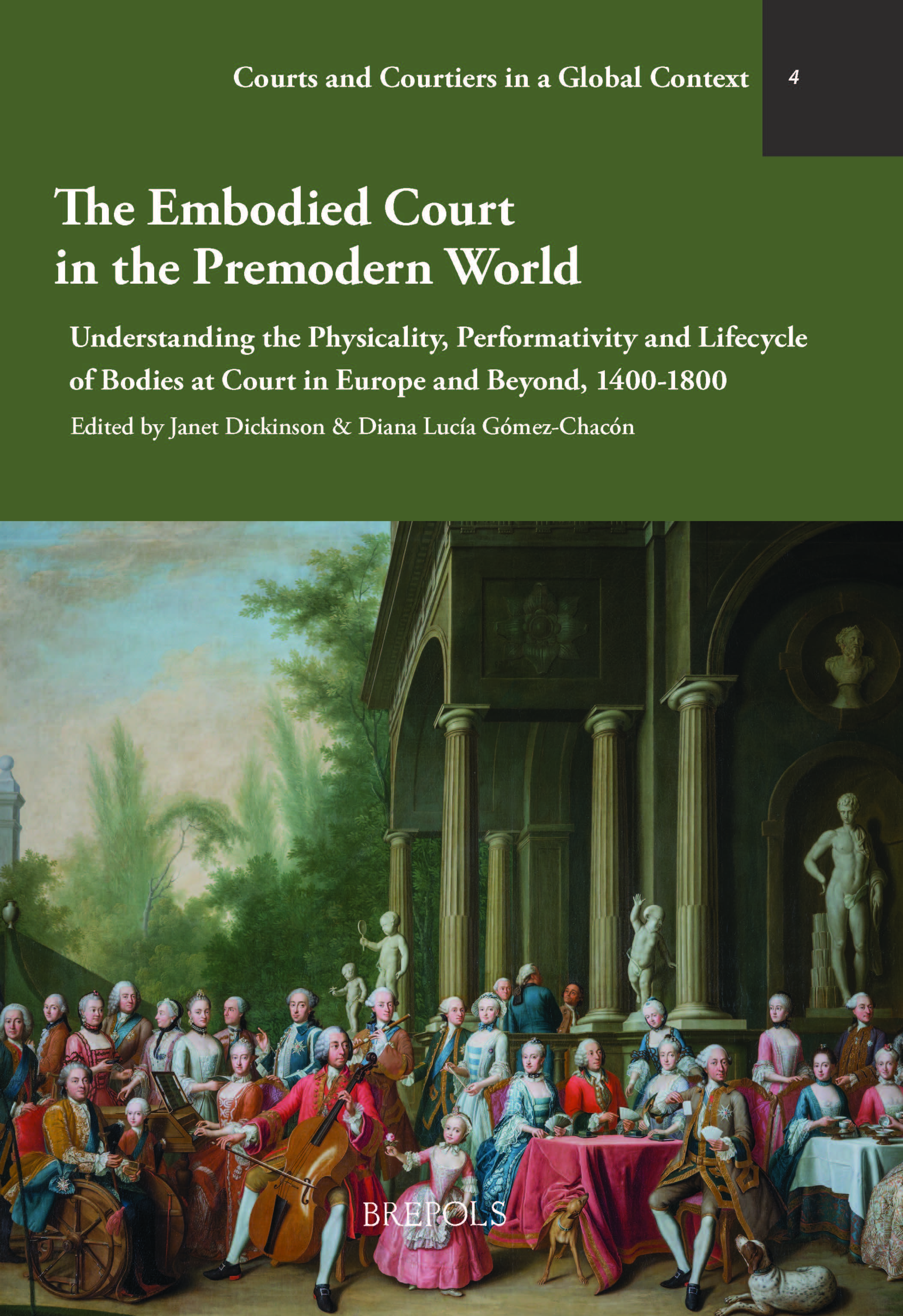 The Embodied Court in the Premodern World
Understanding the Physicality, Performativity and Lifecycle of Bodies at Court in Europe and Beyond, 1400-1800
Volume 4
 The Sacred and the Secular in Renaissance Florence
Vallombrosan Exorcisms and the Rise of Observant Mendicancy
Volume 31
 Tradition, Interpretation, and Change
Developments in the Liturgy of Medieval and Early Modern Ashkenaz

 wunder in Serie
 À la recherche des normes de traduction
Textes spécialisés dans le monde hispanophone et francophone (1450–1850)