
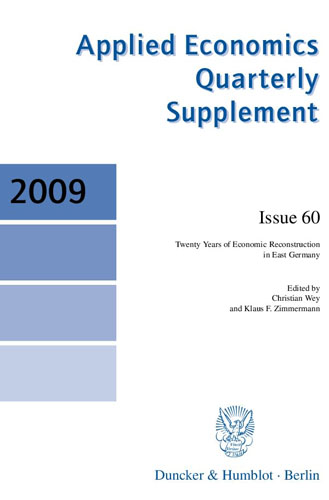
Twenty Years of Economic Reconstruction in East Germany.
Edited by Christian Wey Edited by Klaus F. Zimmermann
Paperback (Published)
(November 2009)
ISBN: 9783428132577
6.18 x 9.17 inches
Price: $116.00
In stock
This year marks the 20th anniversary of German reunification. The events of autumn 1989 revealed that the GDR was not just politically but also economically bankrupt. Given the large-scale emigration to the West after the fall of the Wall, the D-Mark was introduced quickly, despite widespread rejection of this measure by the leading economist of the time. Rapid wage increases intensified the pressure on businesses, and the adjustment shock made it necessary to rebuild the foundations of the economy at a rapid pace and an extremely high cost. With the creation of the economic and currency union, a dynamic process of growth and development was launched in many areas of society.
Twenty years later, the questions arise: Where do we stand today, what implications can be derived for the future, and what remains to be done in the policy realm? This AEQ Supplement addresses the following issues:
– Structural convergence and regional development: Should policy makers really attempt to counteract convergence? How far is East Germany currently lagging behind? What strategic decisions do policy makers need to make?
– Old-age poverty: Is there an increasing risk of old-age poverty in East Germany? What are the results of societal aging in East Germany?
– Returns to education for full-time employees: The East has caught up
– Dramatic demographic changes in Thuringia: Will Thuringia face a shortage of skilled labor up to 2015?
- Edited by Christian Wey
- Edited by Klaus F. Zimmermann
Other Titles in this Series
 The Economy, Crises, and the Labor Market.
Can Institutions Serve as a Protective Shield for Employment?
Volume 61

 Globalisation: the End of National Economic Policy?
New Forms of International Business Cycle Linkages.
Volume 54
Similar Books



 European Review of Service Economics and Management
De nouveaux horizons pour l’innovation dans les services ? IA, inclusion et responsabilité
Volume 21
 Friedlicher Handel oder umkämpfte Geschäfte?
Handel und Handelsrecht in der Vormoderne zwischen Krieg und Frieden

 Global Gulf
Geo-Economic, Geo-Political, and Geo-Technological Transformation in Saudi Arabia, the United Arab Emirates, and Qatar
 Invisible Labour in Antiquity
Visualizing Obscure Work in the Ancient Mediterannean and West Asia
Volume 1

 Socio-économie du travail
La dégradation du travail au XXIe siècle ? Lectures contemporaines de Harry Braverman
Volume 17
 Socio-économie du travail
Le sens du travail, concept scientifique ou instrument du capitalisme ? Volume 1
Volume 18




 Obsidian and the Sea
Evidence, Concepts and Social Implications of its Maritime Transportation
Volume 22

 Socio-économie du travail
Le sens du travail, concept scientifique ou instrument du capitalisme ? Volume 2
Volume 19


 Décarboner sans détruire les profits
Comment les entreprises peuvent allier performance économique et impact climatique
Volume 3

 Der politische Streik im deutschen Arbeitskampfrecht
Dogmatische Entwicklungslinien von 1869 bis in die 1980er Jahre
Volume 393

 Der Sales-Leadership-Code
Wie du mit Klarheit und Haltung leichter verkaufst und wirksamer führst - Eine Business-Story

 Die 10 Regeln der hocheffektiven Preisgestaltung
Wie Sie Ihr Preismanagement umgestalten und Ihre Gewinne steigern

 Die Konjunkturkomponente des Grundgesetzes
Die konjunkturbedingte Kreditaufnahme im System der Kreditermächtigungen, europarechtlichen und gesamtwirtschaftlichen Verpflichtungen der Finanzverfassung
 Die Masterclass für den Geist
Erfolgreiche Selbstführung mit dem Besten aus westlicher und östlicher Philosophie






 Financial Wellbeing
Wie Sie mit finanzieller Bildung für Ihre Beschäftigten den Unternehmenserfolg steigern