
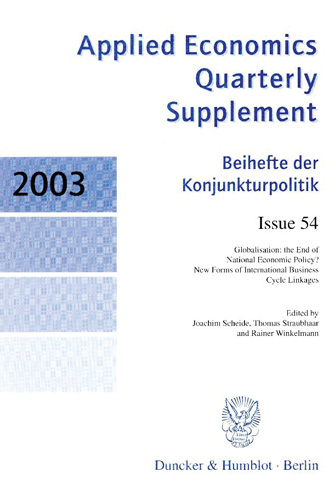
Globalisation: the End of National Economic Policy?
New Forms of International Business Cycle Linkages.
Edited by Rainer Winkelmann Edited by Thomas Straubhaar Edited by Joachim Scheide
Paperback (Published)
(September 2003)
ISBN: 9783428113033
6.18 x 9.17 inches
Price: $131.00
On back order
In recent years, the integration of goods, capital and financial markets has progressed on a global scale. The 66th annual meeting of the Association of German Economics Research Institutes (ARGE) focused on the question of national macroeconomic policies in an environment of increasingly interdependent business cycles.
In the first paper of the volume, Koll gives a general introduction to the history of business cycles co-movement. Koll also highlights the responsibility of national governments as global players.
The first section deals with the evolution of business cycle synchronization. Flaig, Sturm and Woitek conclude that, while the oil shocks of the 70s induced strong co-movements in business cycles, German unification led to a divergence of national cycles. The paper by Fichtner concentrates not only on business cycle synchronization over time but introduces an analysis on the transmission mechanisms at work. Fichtner finds that common shocks and technology spillovers account for most of the co-movement in output.
The second section explains some of the individual transmission mechanisms in greater detail. Horn examines how business confidence carries over from one country to another and finds evidence that positive expectations in the US strengthen German confidence and that this relationship has become stronger over time. Schröder quantifies the role of the transmission of stock market investors’ confidence in the relationship between US and German GDP. He distinguishes between the pure investor expectation effect and the direct influence of stock markets on real GDP and finds a direct causal impact.
The third section concentrates on economic policy and its implications. Kuhn analyzes the transmission of monetary policy shocks and finds the transmission mechanism via interest rate co-movements to be more important than that via trade and the exchange rate mechanism. Middendorf and Radmacher-Nottelmann explore the importance of multinationals in the transmission of economic business cycles. Macro evidence suggests a synchronization of investment behavior. Micro evidence, however, reveals only a weak impact of multinationals on business cycle synchronization.
This AEQ supplement should be essential reading for anyone, whether academic or practitioner, with an interest in future macroeconomic policy options in an increasingly integrated economic environment.
- Edited by Rainer Winkelmann
- Edited by Thomas Straubhaar
- Edited by Joachim Scheide
Other Titles in this Series
 The Economy, Crises, and the Labor Market.
Can Institutions Serve as a Protective Shield for Employment?
Volume 61

Similar Books



 European Review of Service Economics and Management
De nouveaux horizons pour l’innovation dans les services ? IA, inclusion et responsabilité
Volume 21
 Friedlicher Handel oder umkämpfte Geschäfte?
Handel und Handelsrecht in der Vormoderne zwischen Krieg und Frieden

 Global Gulf
Geo-Economic, Geo-Political, and Geo-Technological Transformation in Saudi Arabia, the United Arab Emirates, and Qatar
 Invisible Labour in Antiquity
Visualizing Obscure Work in the Ancient Mediterannean and West Asia
Volume 1

 Socio-économie du travail
La dégradation du travail au XXIe siècle ? Lectures contemporaines de Harry Braverman
Volume 17
 Socio-économie du travail
Le sens du travail, concept scientifique ou instrument du capitalisme ? Volume 1
Volume 18




 Obsidian and the Sea
Evidence, Concepts and Social Implications of its Maritime Transportation
Volume 22

 Socio-économie du travail
Le sens du travail, concept scientifique ou instrument du capitalisme ? Volume 2
Volume 19


 Décarboner sans détruire les profits
Comment les entreprises peuvent allier performance économique et impact climatique
Volume 3

 Der politische Streik im deutschen Arbeitskampfrecht
Dogmatische Entwicklungslinien von 1869 bis in die 1980er Jahre
Volume 393

 Der Sales-Leadership-Code
Wie du mit Klarheit und Haltung leichter verkaufst und wirksamer führst - Eine Business-Story

 Die 10 Regeln der hocheffektiven Preisgestaltung
Wie Sie Ihr Preismanagement umgestalten und Ihre Gewinne steigern

 Die Konjunkturkomponente des Grundgesetzes
Die konjunkturbedingte Kreditaufnahme im System der Kreditermächtigungen, europarechtlichen und gesamtwirtschaftlichen Verpflichtungen der Finanzverfassung
 Die Masterclass für den Geist
Erfolgreiche Selbstführung mit dem Besten aus westlicher und östlicher Philosophie







 Financial Wellbeing
Wie Sie mit finanzieller Bildung für Ihre Beschäftigten den Unternehmenserfolg steigern