
My Dear Daughter
Rabbi Benjamin Slonik and the Education of Jewish Women in Sixteenth-Century Poland
by Edward Fram

Hardback (Out of print)
(June 2007)
ISBN: 9780878204595
Price: $39.95
On back order
This volume makes available the 1585 edition of the Seder mitzvot hanashim, in Yiddish and English. The book was intended to teach Jewish women in sixteenth-century Poland the rules, rituals, and customs pertaining to the sexual life of couples within the context of marriage. Edward Fram sets the work in its bibliographical and historical contexts.
How did Jewish women in sixteenth-century Poland learn all the rules, rituals, and customs pertaining to the sexual life of couples within the context of marriage? As in other areas of ritual life that concerned the household, it would seem that the primary source for the education of Jewish women was other women. But rabbinic law dictates that Jewish women who experience uterine bleeding are prohibited from having physical contact of any kind with their husbands, and the intricate laws of niddah (enforced separation) spell out exactly when and under what circumstances physical marital relations, even simple touching, can be resumed. Particularly difficult issues could be addressed only by rabbis or other learned men, since women rarely, if ever, attained the level of rabbinic scholarship necessary to pare the details of these complicated laws. To educate both men and women, but particularly women, in a more systematic and impersonal manner, the young rabbi Benjamin Slonik (ca. 1550-after 1620), who later became one of the leading rabbinic authorities in eastern Europe, harnessed the relatively new technology of printing and published a how-to book for women in the Yiddish vernacular. Seder mitzvot hanashim (The Order of Women’s Commandments) illuminates the history of Yiddish printing and public education. But it is also a rare remnant of a direct interface between a member of the rabbinic elite and the laity, especially women. Slonik’s text also sheds light on the history of Jewish law, particularly the reception of the Shulhan Arukh, an important legal code that had just been published. This volume makes available the 1585 edition of the Seder mitzvot hanashim in Yiddish and English. Fram sets Slonik’s work in its bibliographical and historical contexts, demonstrating its relationship with the Shulhan Arukh, exploring how rabbis opposed formal education for women, considering how upheavals accompanying geographic shifts in the Ashkenazic community help explain how the women’s commandments texts came to be used in Poland, and offering a treasure trove of information on the place and roles of women in Polish-Jewish society. Fram thus creates a composite picture of how Slonik, along with other men of his time, perceived the main audience for his work and sought to connect it to contemporary texts.
- By (author) Edward Fram
Other Titles in this Series

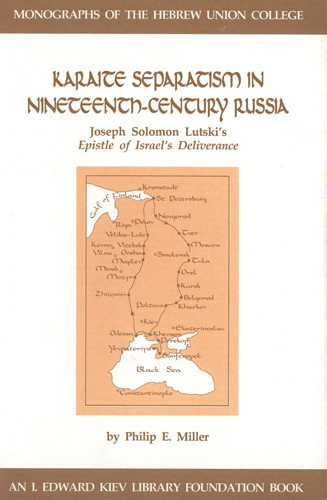 Karaite Separatism in Nineteenth-Century Russia
Joseph Solomon Lutski's Epistle of Israel's Deliverance
Volume 16
 Remember Amalek!
Vengeance, Zealotry, and Group Destruction in the Bible according to Philo, Pseudo-Philo, and Josephus
Volume 31





 Modernism and Cultural Transfer
Gabriel Preil and the Tradition of Jewish Literary Bilingualism
Volume 10




Similar Books


 Ars Prophetica
Theology in the Poetry of Twentieth-Century Hebrew Poets Avraham Halfi, Shin Shalom, Amir Gilboa, and T. Carmi
 As Messianism Turns to Heresy
The Regenstein Chair Lectures On Lurianic Kabbalah and Shabbatai Tzevi at Hebrew Union College - Cincinnati
 Balthasar Caymox of Nuremberg
Early Modern German Print Publishers: Popular Prints of the Seventeenth Century


 Beyond Sovereign Courts
Agents and Practices in Early Modern Spanish and Habsburg Diplomacy
Volume 3


 Circulation, Use, Impact
The Consumption of Architectural Books in the Early Modern Eastern Adriatic
Volume 1

 Councils, Conflicts, Correspondence
Urban Diplomacy in Reval (Tallinn) and Lübeck (c. 1470–1570)
Volume 67


 Extracanonical Traditions and the Holy Land
Texts, Rituals, and Material Culture in Late Antique Palestine


 Homo-Politicus in the Balkans
Early Modern Southeast European History in Imperial and Regional Context

 Innovationes Lovanienses: Arts, Law and Theology at the University of Louvain (1425–1797)
Studium Lovaniense: Learning across Borders, 2
Volume 18


 Kulturelles Erbe und gesellschaftliche Identität
Das Akademienprojekt „Corpus Vitrearum Medii Aevi“ im Einsatz für den Kulturgutschutz in der Ukraine
 Legal Visuality
Exegesis, Ambiguity, and Dissimulation of the Donation of Constantine in the Early Modern Period

 Linguistic and Media Studies Perspectives on Research into Social and Political Polarisation
The Case of Poland
 Lobbying for Equality
Jacques Godard and the Struggle for Jewish Equality during the French Revolution


 Naples as Laboratory / Laboratorium Neapel
Style Options, Artistic Rivalry and Self Fashioning in Neapolitan Baroque Painting / Plurale Stilbildung, Kunstlerkonkurrenz und Self Fashioning in der neapolitanischen Barockmalerei
