The World of a Renaissance Jew
The Life and Thought of Abraham Ben Mordecai Farissol
by David B. Ruderman

Within the Italian city states of the fifteenth and sixteenth centuries, a relatively high degree of mutual tolerance and tranquility existed between the enlightened Christian majority and the small Jewish minority. With the prevalence of favorable political, social, and economic circumstances for Jewish life in Italy, a considerable number of Jews participated freely in Renaissance culture while upholding an intense awareness of their own particular identity. This work is a study of the life and thought of one such Jew, Abraham b. Mordecai Farissol (1452-ca. 1528). While born in Avignon, Farissol spent most of his life in Italy close to the cultural centers of Renaissance society, primarily in Ferrara, but also in Mantua, Florence, and other Italian cities. As scribe, educator, cantor, communal leader, polemicist, Biblical exegete, and geographer, Farissol developed variegated interests and associations which provide exciting vantage points from which to view his cultural and social world. As one of the first comprehensive studies of any Italian Jewish figure of the period, this book represents an important contribution to an understanding of Jewish society and culture. But the significance of this study of Farissol’s life extends beyond what can be learned about the man and his immediate community of co-religionists. Utilizing the life and thought of one person, it explores and explicates the dialogue between Judaism and the culture of the Italian Renaissance. Despite its intrinsic interest, Jewish intellectual history in the Renaissance has remained an underdeveloped field. Many sources still remain unexamined; monographs on specific themes and figures have yet to be written. David Ruderman’s study breaks new ground by making use of extensive, yet previously unpublished sources on Farissol and his society and by integrating them into the broader context of Jewish and Renaissance culture. The work is of particular interest to historians of the Jews and of Renaissance Italy. It also offers the general reader an excellent case study of the symbiotic relationship between Western culture and its Jewish minority in one of the most fertile periods of European civilization. In dramatic fashion it illustrates how Jews not only survived but creatively flourished in a pluralistic setting by appropriating from the outside new forms and ideas which they integrated into their own vital cultural experience.
- By (author) David B. Ruderman
Other Titles in this Series
 Modernism and Cultural Transfer
Gabriel Preil and the Tradition of Jewish Literary Bilingualism
Volume 10




 My Dear Daughter
Rabbi Benjamin Slonik and the Education of Jewish Women in Sixteenth-Century Poland
Volume 33


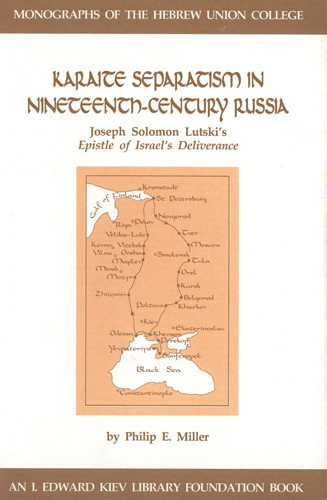 Karaite Separatism in Nineteenth-Century Russia
Joseph Solomon Lutski's Epistle of Israel's Deliverance
Volume 16


 Remember Amalek!
Vengeance, Zealotry, and Group Destruction in the Bible according to Philo, Pseudo-Philo, and Josephus
Volume 31




Similar Books


 Ars Prophetica
Theology in the Poetry of Twentieth-Century Hebrew Poets Avraham Halfi, Shin Shalom, Amir Gilboa, and T. Carmi
 As Messianism Turns to Heresy
The Regenstein Chair Lectures On Lurianic Kabbalah and Shabbatai Tzevi at Hebrew Union College - Cincinnati
 Balthasar Caymox of Nuremberg
Early Modern German Print Publishers: Popular Prints of the Seventeenth Century


 Beyond Sovereign Courts
Agents and Practices in Early Modern Spanish and Habsburg Diplomacy
Volume 3


 Circulation, Use, Impact
The Consumption of Architectural Books in the Early Modern Eastern Adriatic
Volume 1

 Councils, Conflicts, Correspondence
Urban Diplomacy in Reval (Tallinn) and Lübeck (c. 1470–1570)
Volume 67


 Extracanonical Traditions and the Holy Land
Texts, Rituals, and Material Culture in Late Antique Palestine
 Homo-Politicus in the Balkans
Early Modern Southeast European History in Imperial and Regional Context

 Innovationes Lovanienses: Arts, Law and Theology at the University of Louvain (1425–1797)
Studium Lovaniense: Learning across Borders, 2
Volume 18
 Legal Visuality
Exegesis, Ambiguity, and Dissimulation of the Donation of Constantine in the Early Modern Period

 Lobbying for Equality
Jacques Godard and the Struggle for Jewish Equality during the French Revolution


 Naples as Laboratory / Laboratorium Neapel
Style Options, Artistic Rivalry and Self Fashioning in Neapolitan Baroque Painting / Plurale Stilbildung, Kunstlerkonkurrenz und Self Fashioning in der neapolitanischen Barockmalerei