
Methods for the Study of Religious Change
From Religious Studies to Worldview Studies
edited by Andre Droogers and Anton van Harskamp
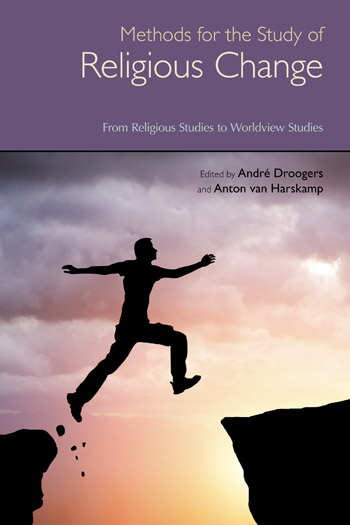
Methods for the Study of Religious Change aims to redefine the study of religion as the study of worldviews, of ideas which are active in shaping the world. It argues that the study of religion should focus on people’s worldview-making capacities and should contribute to the critical analysis of global problems and the promotion of cultural and spiritual respect across religions. Survey chapters on theory and method outline this new approach while case-study chapters illustrate these ideas with innovative ethnographies of ritual, experience, language, morals and identity.
“This is a highly imaginiative contribution to the study of worldviews.” – Grace Davie, University of Exeter The world of religious experience is changing much faster than the discipline which claims to study it. Religious studies still uses Christianity as its measure, still frames the world through the model of five world religions, still largely avoids analysis of key issues around power, poverty, violence, pollution, science, and social conflict, and still looks to highlight differences rather than commonalities. Methods for the Study of Religious Change aims to redefine the study of religion as the study of worldviews, of ideas which are active in shaping the world. It argues that the study of religion should focus on people’s worldview-making capacities and should contribute to the critical analysis of global problems and the promotion of cultural and spiritual respect across religions. Survey chapters on theory and method outline this new approach while case-study chapters illustrate these ideas with innovative ethnographies of ritual, experience, language, morals and identity.The world of religious experience is changing much faster than the discipline which claims to study it. Religious studies still uses Christianity as its measure, still frames the world through the model of five world religions, still largely avoids analysis of key issues around power, poverty, violence, pollution, science, and social conflict, and still looks to highlight differences rather than commonalities. Methods for the Study of Religious Change aims to redefine the study of religion as the study of worldviews, of ideas which are active in shaping the world. It argues that the study of religion should focus on people’s worldview-making capacities and should contribute to the critical analysis of global problems and the promotion of cultural and spiritual respect across religions. Survey chapters on theory and method outline this new approach while case-study chapters illustrate these ideas with innovative ethnographies of ritual, experience, language, morals and identity.
- Edited by Andre Droogers
- Edited by Anton van Harskamp
"...Methods for the Study of Religious Change will appeal to scholars as well as students of religious studies just as it will be an additional literature to the existing ones on research methods. The book is therefore recommended for religious scholars, research fellows, and students across all disciplines." --Adetunbi Richard Ogenleye, Reviews in Religion and Theology, 2017/April
—
Similar Books

 A Companion to Christianity and Sport in Europe and North America (19th-21st centuries)
Volume 1: Western and Eastern Europe
 A Connecting Polemic in the Medieval Mediterranean
The Correspondence of Leo III and ʿUmar II
Volume 6





 Ars Prophetica
Theology in the Poetry of Twentieth-Century Hebrew Poets Avraham Halfi, Shin Shalom, Amir Gilboa, and T. Carmi
 As Messianism Turns to Heresy
The Regenstein Chair Lectures On Lurianic Kabbalah and Shabbatai Tzevi at Hebrew Union College - Cincinnati


 Creating the Woman in Antiquity
Proceedings of the 16th Melammu Workshop, Innsbruck, 2–3 June 2022
Volume 13
 Cultic Kisses
Fruitful Encounters Between Deities and Humans. Festschrift for Angelika Berlejung on the Occasion of Her 65th Birthday
 De/colonizing Theologies
Glocal Histories, Contemporary Challenges, Theoretical Reflections
Volume 4
 Drunk the Potion, No Whit Charmed
The Doctrine of Pure and Perfect Souls from Iamblichus to Damascius






 Extracanonical Traditions and the Holy Land
Texts, Rituals, and Material Culture in Late Antique Palestine
 Fear, Fear of God, God-Fearers
Philological and Historical Perspectives on the World of Ancient Judaism and Christianity


 Gender and Iconography in Antiquity
Femininities, Masculinities, Ambiguities, and Beyond in the Ancient Levant, Near East, and Mediterranean