
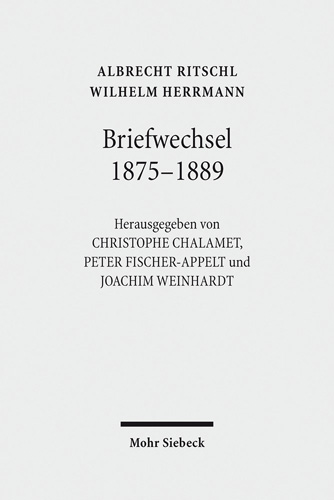
Briefwechsel 1875 – 1889
by Wilhelm Herrmann, Albrecht Ritschl and edited by Christophe Chalamet, Peter Fischer-Appelt and Theodor Mahlmann
English summary: In a very personal way, the correspondence begun by Wilhelm Herrmann, a private lecturer from Halle, sheds new light on the controversial impact of Albrecht Ritschl’s theology of the kingdom of God during the Wilhelminian era. The message of revelation is the reconciliation of humanity with God, not of God with humanity. This insight, new from an exegetical standpoint, set a precedent, since it made it possible to see the advent of the kingdom of God, a pivotal feature in the proclamation of Jesus, as an incentive for freedom in the moral (and societal) realm of life. This letter exchange reveals the enthusiasm with which a young Wilhelm Herrmann welcomed this approach. At first loyal to Ritschl, Herrmann insisted on the universality of the Christian worldview, but eventually the problem of certainty in religion led him to abandon Ritschl’s community-oriented approach to focus on questions related to individual existence. German description: Auf einer sehr personlichen Ebene beschreibt der von dem Hallenser Privatdozenten Wilhelm Herrmann begonnene Briefwechsel die kontroversen Wirkungen, die der Gottinger Theologe Albrecht Ritschl in der Grunderzeit mit seiner Reich-Gottes-Theologie ausloste. Versohnung der Menschheit, nicht Versohnung Gottes ist die Botschaft der Offenbarung. Diese exegetisch neue Einsicht machte Schule, denn so liess sich der in der Verkundigung Jesu zentrale Anbruch des Reichs Gottes als ein Impuls der Freiheit zur sittlichen (eigentlich auch zur demokratischen) Gestaltung der Lebensordnungen verstehen. Der Briefwechsel zeigt den Enthusiasmus, mit dem der junge Wilhelm Herrmann dieser Fundierung des sich weitenden Weltbewusstseins Bahn brach. In unbezweifelbarer Loyalitat zu Ritschl bestand er zunachst auf der Universalitat der christlichen Weltanschauung, doch fuhrte ihn das Gewissheitsproblem der Religion dazu, den Gemeindeansatz Ritschls auf das Wahrwerden der individuellen Existenz auszurichten.
Wilhelm Herrmann, war Professor fur Systematische Theologie in Marburg.Albrecht Ritschl, ist Professor an der London School of Economics, Economic History Department.Christophe Chalamet, Geboren 1972; 2002 Promotion; Professeur associe fur Systematische Theologie an der Faculte autonome de theologie protestante, Universitat Genf.Peter Fischer-Appelt, Geboren 1932; 1961-70 wissenschaftlicher Assistent an der Universitat Bonn; 1970-91 erster Prasident der Universitat Hamburg; lehrt Systematische Theologie an der Universitat Hamburg.
- By (author) Wilhelm Herrmann
- By (author) Albrecht Ritschl
- Edited by Christophe Chalamet
- Edited by Peter Fischer-Appelt
- Edited by Theodor Mahlmann
Similar Books

 A Companion to Christianity and Sport in Europe and North America (19th-21st centuries)
Volume 1: Western and Eastern Europe
 A Connecting Polemic in the Medieval Mediterranean
The Correspondence of Leo III and ʿUmar II
Volume 6





 Ars Prophetica
Theology in the Poetry of Twentieth-Century Hebrew Poets Avraham Halfi, Shin Shalom, Amir Gilboa, and T. Carmi
 As Messianism Turns to Heresy
The Regenstein Chair Lectures On Lurianic Kabbalah and Shabbatai Tzevi at Hebrew Union College - Cincinnati


 Creating the Woman in Antiquity
Proceedings of the 16th Melammu Workshop, Innsbruck, 2–3 June 2022
Volume 13
 Cultic Kisses
Fruitful Encounters Between Deities and Humans. Festschrift for Angelika Berlejung on the Occasion of Her 65th Birthday
 De/colonizing Theologies
Glocal Histories, Contemporary Challenges, Theoretical Reflections
Volume 4
 Drunk the Potion, No Whit Charmed
The Doctrine of Pure and Perfect Souls from Iamblichus to Damascius






 Extracanonical Traditions and the Holy Land
Texts, Rituals, and Material Culture in Late Antique Palestine
 Fear, Fear of God, God-Fearers
Philological and Historical Perspectives on the World of Ancient Judaism and Christianity


 Gender and Iconography in Antiquity
Femininities, Masculinities, Ambiguities, and Beyond in the Ancient Levant, Near East, and Mediterranean