
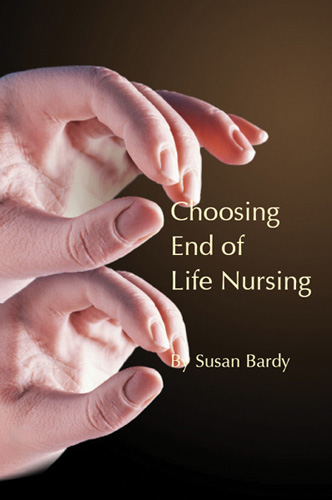
Choosing end of life nursing
by Susan Bardy
Paperback (Published)
(September 2016)
ISBN: 9781925309256
5.94 x 9.09 inches
Price: $31.95
In stock
Hardback (Published)
(September 2016)
ISBN: 9781925309263
5.94 x 9.09 inches
Price: $43.95
In stock
‘Death is inevitable–none of us will escape it. Ending life with a terminal illness is a slow and rather lonely process. I am interested in the question of why some nurses choose to work in the field of palliative care. I am one who willingly stepped into the role of being with patients at their most vulnerable time ?when death became inevitable. My nursing history has spanned fifty years, of which the last twenty were in palliative care of terminally ill and dying patients. What was it that influenced me to move from a curing model to comfort caring only? My work is an account of how I discovered palliative care nursing after thirty years in the acute-care setting. I migrated to Australia at the age of seventeen after the violence of World War II and the death of my father in a refugee camp. It seemed that taking on nursing was the best way to settle into a new life. I was happy with general nursing but had a feeling that there was more I could contribute to my patient care. My mother’s unexpected death with cancer was responsible for showing the way. She died in the hospice unit of the hospital where I was employed. Sitting by her side showed me another aspect of nursing that attracted me to a career change. I transferred to the Hospice after mother died and remained there for twenty years. Naturally I wondered why this change of direction happened.’ – Susan Bardy
‘Death is inevitable–none of us will escape it. Ending life with a terminal illness is a slow and rather lonely process. I am interested in the question of why some nurses choose to work in the field of palliative care. I am one who willingly stepped into the role of being with patients at their most vulnerable time ?when death became inevitable. My nursing history has spanned fifty years, of which the last twenty were in palliative care of terminally ill and dying patients. What was it that influenced me to move from a curing model to comfort caring only? My work is an account of how I discovered palliative care nursing after thirty years in the acute-care setting. I migrated to Australia at the age of seventeen after the violence of World War II and the death of my father in a refugee camp. It seemed that taking on nursing was the best way to settle into a new life. I was happy with general nursing but had a feeling that there was more I could contribute to my patient care. My mother’s unexpected death with cancer was responsible for showing the way. She died in the hospice unit of the hospital where I was employed. Sitting by her side showed me another aspect of nursing that attracted me to a career change. I transferred to the Hospice after mother died and remained there for twenty years. Naturally I wondered why this change of direction happened.’ – Susan Bardy
- By (author) Susan Bardy
Other Titles in this Series

Similar Books

 A Companion to Christianity and Sport in Europe and North America (19th-21st centuries)
Volume 1: Western and Eastern Europe
 A Connecting Polemic in the Medieval Mediterranean
The Correspondence of Leo III and ʿUmar II
Volume 6





 Ars Prophetica
Theology in the Poetry of Twentieth-Century Hebrew Poets Avraham Halfi, Shin Shalom, Amir Gilboa, and T. Carmi
 As Messianism Turns to Heresy
The Regenstein Chair Lectures On Lurianic Kabbalah and Shabbatai Tzevi at Hebrew Union College - Cincinnati


 Creating the Woman in Antiquity
Proceedings of the 16th Melammu Workshop, Innsbruck, 2–3 June 2022
Volume 13
 Cultic Kisses
Fruitful Encounters Between Deities and Humans. Festschrift for Angelika Berlejung on the Occasion of Her 65th Birthday
 De/colonizing Theologies
Glocal Histories, Contemporary Challenges, Theoretical Reflections
Volume 4
 Drunk the Potion, No Whit Charmed
The Doctrine of Pure and Perfect Souls from Iamblichus to Damascius






 Extracanonical Traditions and the Holy Land
Texts, Rituals, and Material Culture in Late Antique Palestine
 Fear, Fear of God, God-Fearers
Philological and Historical Perspectives on the World of Ancient Judaism and Christianity


 Gender and Iconography in Antiquity
Femininities, Masculinities, Ambiguities, and Beyond in the Ancient Levant, Near East, and Mediterranean