
Vatican II Notebook
by Marie-Dominique Chenu and MD Chenu
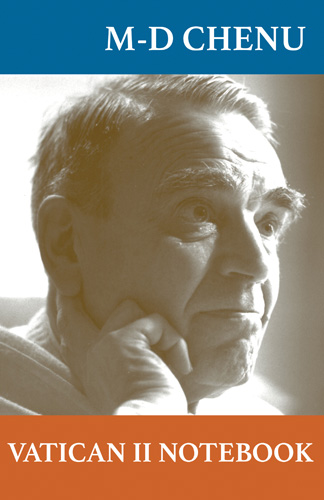
Chenu was a French Dominican friar, a renowned historian, and a theologian with extraordinary creative insight. He shaped the Dominican study center, Le Saulchoir, as its director and as an influential professor from the late 1920s until he was removed by the Vatican in 1942 (for writing a theological program for the school that sounded much like the future Pastoral Constitution on the Church in the Modern World). He influenced two generations of scholars with his rare combination of scientific excellence and pastoral wisdom. Fifty years after Vatican II, historians are still discovering documents and letters that offer important insights into the Council’s meaning. This brief journal written by Marie-Dominique Chenu, masterfully edited by Alberto Melloni, is such a document. It reveals the decisive role Chenu played in several initiatives that shaped the Council’s character; but, more importantly, it brings to light the dynamic networking of bishops and theologians that lay behind the Council’s achievement of so much in so few years. Covering the years 1962-1963, Chenu’s Notebook allows readers to feel the drama of the Council’s opening period. At the Council, he promoted and drafted its great Message to the World that was the Council’s first published statement. In it, many of Chenu’s key intuitions became part of an official church statement about its hope for the future: attention to the ‘signs of the times’, the integration of science and technology into the Church’s pastoral message, and commitment to justice and the care of the poor. His Vatican II Notebook is an exciting peek into great moments in a great man’s life.
Chenu was a French Dominican friar, a renowned historian, and a theologian with extraordinary creative insight. He shaped the Dominican study center, Le Saulchoir, as its director and as an influential professor from the late 1920s until he was removed by the Vatican in 1942 (for writing a theological program for the school that sounded much like the future Pastoral Constitution on the Church in the Modern World). He influenced two generations of scholars with his rare combination of scientific excellence and pastoral wisdom. Fifty years after Vatican II, historians are still discovering documents and letters that offer important insights into the Council’s meaning. This brief journal written by Marie-Dominique Chenu, masterfully edited by Alberto Melloni, is such a document. It reveals the decisive role Chenu played in several initiatives that shaped the Council’s character; but, more importantly, it brings to light the dynamic networking of bishops and theologians that lay behind the Council’s achievement of so much in so few years. Covering the years 1962-1963, Chenu’s Notebook allows readers to feel the drama of the Council’s opening period. At the Council, he promoted and drafted its great Message to the World that was the Council’s first published statement. In it, many of Chenu’s key intuitions became part of an official church statement about its hope for the future: attention to the ‘signs of the times’, the integration of science and technology into the Church’s pastoral message, and commitment to justice and the care of the poor. His Vatican II Notebook is an exciting peek into great moments in a great man’s life.
- By (author) Marie-Dominique Chenu
- By (author) MD Chenu
Similar Books

 A Companion to Christianity and Sport in Europe and North America (19th-21st centuries)
Volume 1: Western and Eastern Europe
 A Connecting Polemic in the Medieval Mediterranean
The Correspondence of Leo III and ʿUmar II
Volume 6





 Ars Prophetica
Theology in the Poetry of Twentieth-Century Hebrew Poets Avraham Halfi, Shin Shalom, Amir Gilboa, and T. Carmi
 As Messianism Turns to Heresy
The Regenstein Chair Lectures On Lurianic Kabbalah and Shabbatai Tzevi at Hebrew Union College - Cincinnati


 Creating the Woman in Antiquity
Proceedings of the 16th Melammu Workshop, Innsbruck, 2–3 June 2022
Volume 13
 Cultic Kisses
Fruitful Encounters Between Deities and Humans. Festschrift for Angelika Berlejung on the Occasion of Her 65th Birthday
 De/colonizing Theologies
Glocal Histories, Contemporary Challenges, Theoretical Reflections
Volume 4
 Drunk the Potion, No Whit Charmed
The Doctrine of Pure and Perfect Souls from Iamblichus to Damascius






 Extracanonical Traditions and the Holy Land
Texts, Rituals, and Material Culture in Late Antique Palestine
 Fear, Fear of God, God-Fearers
Philological and Historical Perspectives on the World of Ancient Judaism and Christianity


 Gender and Iconography in Antiquity
Femininities, Masculinities, Ambiguities, and Beyond in the Ancient Levant, Near East, and Mediterranean