
Die Esra-Apokalypse
Edited by Bonifatia Gesche Translated by Bonifatia Gesche
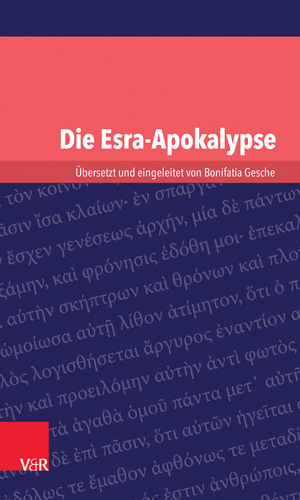
Paperback (Published)
(September 2015)
ISBN: 9783525534625
4.84 x 8.07 inches
Price: $19.00
In stock
Warum lässt Gott das Leid in der Welt zu?
English summary: The apocalypse of Ezra was written as response to the desperate situation of the Jewish people after the destruction of the temple in Jerusalem (70 AD) around 100 AD. The writer projected the story to the Babylonian exile in the year 597 BC and thus demonstrated that distress and burden are universal for all mankind. The experience of the suffering of the righteous raises the question why a good God permits evil in the world. In his despair, the protagonist addresses God in a daring way, looking for understanding. He seeks answers why God acts apparently unjustly towards his people. In three episodes he debates this problem with an angel who was sent by God. The four following episodes are arranged as visions, in which the events before the eschatological judgment are revealed. Rise and decline of the last kingdoms are foreshadowed, the coming of the Messiah prophesied, and eventually it is promised that the righteous will be saved on account of his faith and his trust in the almighty God. German description: Die Esra-Apokalypse wurde um das Jahr 100 n.Chr. in einem judischen Umfeld in einer Zeit der hochsten Not geschrieben. Nach der Zerstorung des Jerusalemer Tempels im Jahr 70 n.Chr. schien es kaum eine Zukunft fur das verzweifelte Volk zu geben. Aus dieser Situation heraus schreibt ein judischer Gelehrter den vorliegenden Text. Er projiziert die Ereignisse seiner Zeit in die Zeit des Babylonischen Exils (nach 597 v.Chr.), in der das Volk schon einmal vor dem Untergang stand und Rettung aussichtslos schien. Die bedruckende Lage der Besiegten ist somit nicht einzigartig, sondern es zeigt sich deutlich, dass wir es mit grundlegenden Fragen der Menschen zu tun haben, die zeitlos sind und folglich ebenso fur unsere heutige Zeit gelten. Beharrlich stellt der Protagonist der Erzahlung einem Engel, der als Gesandter Gottes auftritt, die Frage, wie das Bose in die Welt gekommen ist und warum die Gerechten zu leiden haben, wahrend die Bosen im Gluck leben. Gottes Handeln erscheint so offensichtlich als ungerecht, dass er immer wieder auf Antworten drangt, Erklarungen fordert und um Einsicht ringt. Nachdem diese Fragen zunachst in drei Episoden diskutiert werden, werden ihm in den vier darauf folgenden Visionen die Ereignisse vor dem endzeitlichen Gericht Gottes offenbart. Bildhaft werden Aufstieg und Niedergang der letzten Reiche angedeutet, das Kommen des Messias vorhergesagt und schliesslich die Verheissung gegeben, dass der Gerechte, der sein Vertrauen auf Gott setzt, gerettet wird.
Dr. Bonifatia Gesche ist Mitarbeiterin im Vetus-Latina-Institut in Beuron.
- Edited by Bonifatia Gesche
- Translated by Bonifatia Gesche
Similar Books

 A Companion to Christianity and Sport in Europe and North America (19th-21st centuries)
Volume 1: Western and Eastern Europe
 A Connecting Polemic in the Medieval Mediterranean
The Correspondence of Leo III and ʿUmar II
Volume 6





 Ars Prophetica
Theology in the Poetry of Twentieth-Century Hebrew Poets Avraham Halfi, Shin Shalom, Amir Gilboa, and T. Carmi
 As Messianism Turns to Heresy
The Regenstein Chair Lectures On Lurianic Kabbalah and Shabbatai Tzevi at Hebrew Union College - Cincinnati


 Creating the Woman in Antiquity
Proceedings of the 16th Melammu Workshop, Innsbruck, 2–3 June 2022
Volume 13
 Cultic Kisses
Fruitful Encounters Between Deities and Humans. Festschrift for Angelika Berlejung on the Occasion of Her 65th Birthday
 De/colonizing Theologies
Glocal Histories, Contemporary Challenges, Theoretical Reflections
Volume 4
 Drunk the Potion, No Whit Charmed
The Doctrine of Pure and Perfect Souls from Iamblichus to Damascius






 Extracanonical Traditions and the Holy Land
Texts, Rituals, and Material Culture in Late Antique Palestine
 Fear, Fear of God, God-Fearers
Philological and Historical Perspectives on the World of Ancient Judaism and Christianity

