
Jewish Culture in Early Modern Europe
Essays in Honor of David B. Ruderman edited by Richard I. Cohen, Natalie B. Dohrmann, Adam Shear and Elchanan Reiner
Edited by Richard I. Cohen Edited by Natalie B. Dohrmann Edited by Elchanan Reiner Edited by Adam Shear
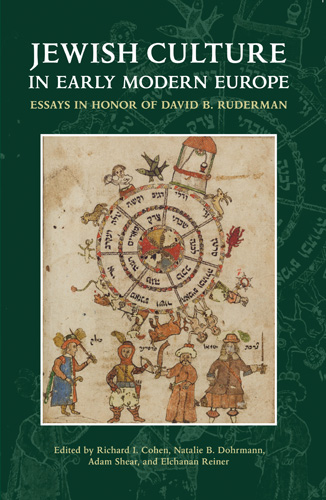
David B. Ruderman’s groundbreaking studies of Jewish intellectuals as they engaged with Renaissance humanism, the Scientific Revolution, and the Enlightenment have set the agenda for a distinctive historiographical approach to Jewish culture in early modern Europe, from 1500 to 1800. From his initial studies of Italy to his later work on eighteenth-century English, German, and Polish Jews, Ruderman has emphasized the individual as a representative or exemplary figure through whose life and career the problems of a period and cultural context are revealed. Thirty-one leading scholars celebrate Ruderman’s stellar career in essays that bring new insight into Jewish culture as it is intertwined in Jewish, European, Ottoman, and American history. The volume presents probing historical snapshots that advance, refine, and challenge how we understand the early modern period and spark further inquiry. Key elements explored include those inspired by Ruderman’s own work: the role of print, the significance of networks and mobility among Jewish intellectuals, the value of extraordinary individuals who absorbed and translated so-called external traditions into a Jewish idiom, and the interaction between cultures through texts and personal encounters of Jewish and Christian intellectuals. While these elements can be found in earlier periods of Jewish history, Ruderman and his colleagues point to an intensification of mobility, the dissemination of knowledge, and the blurring of boundaries in the early modern period. These studies present a rich and nuanced portrait of a Jewish culture that is both a contributing member and a product of early modern Europe and the Ottoman Empire. As director of the Herbert D. Katz Center for Advanced Judaic Studies at the University of Pennsylvania, Ruderman has fostered a community of scholars from Europe, North America, and Israel who work in the widest range of areas that touch on Jewish culture. He has worked to make Jewish studies an essential element of mainstream humanities. The essays in this volume are a testament to the haven he has fostered for scholars, which has and continues to generate important works of scholarship across the entire spectrum of Jewish history.
- Edited by Richard I. Cohen
- Edited by Natalie B. Dohrmann
- Edited by Elchanan Reiner
- Edited by Adam Shear
Similar Books


 Ars Prophetica
Theology in the Poetry of Twentieth-Century Hebrew Poets Avraham Halfi, Shin Shalom, Amir Gilboa, and T. Carmi
 As Messianism Turns to Heresy
The Regenstein Chair Lectures On Lurianic Kabbalah and Shabbatai Tzevi at Hebrew Union College - Cincinnati


 Extracanonical Traditions and the Holy Land
Texts, Rituals, and Material Culture in Late Antique Palestine

 Lobbying for Equality
Jacques Godard and the Struggle for Jewish Equality during the French Revolution


 The Biblical Tale of Judah and Tamar in Fourteenth-Century Iran
A Judeo-Persian Versified Account by Shāhīn with Scholarly Edition, Annotated Translation and Persian Transliteration
Volume 94, 951


 The Therapeutae as the Best Paradigm for the Contemplative Life
A Contextual Reading of Philo of Alexandria's De Vita Contemplativa


 Tradition, Interpretation, and Change
Developments in the Liturgy of Medieval and Early Modern Ashkenaz

 Judaïsme ancien – Ancient Judaism, 13, 2025
Daniel Boyarin et la notion de judaïsme dans l’histoire / Daniel Boyarin and the Notion of Judaism in History (Judaism: The Genealogy of the Modern Notion)
 Christlich-jüdische Beziehungen in Aschkenas während des 13. und 14. Jahrhunderts
Neue Einsichten in die vielfältige Quellenüberlieferung
 Das Weisheitsbuch Ben Sira / Jesus Sirach
Synopse der hebräischen, griechischen, lateinischen und syrischen Texttraditionen mit deutscher Übersetzung

 Der anwesende Abwesende
Das Verhältnis Judentum-Christentum in Schulbuch und Unterricht der Fächer Religion und Ethik


 Essen
Ethische Perspektiven zum Speisen in Antike und Gegenwart. Kontexte und Normen neutestamentlicher Ethik XV

