
Unico Wilhelm van Wassenaer. Sei Concerti armonici. Individual Parts
edited by Albert Dunning

The critical edition of the Sei Concerti armonici by the ‘amateur’ musician Count Unico Wilhelm van Wassenaer (Twickel, [Delden, Holland] 1692 – Den Haag, 1766) can be seen as the final stage of a long sequence of studies undertaken by the eminent Dutch musicologist Albert Dunning: studies that aimed first to identify the work’s composer, then to consolidate its text by means of rigorous scholarly reconstruction. The enigma of the attribution of the Concertos dates back to 1740, when the editio princeps was printed, for on its title-page we read: VI Concerti Armonici a quattro violini obligati, alto viola, violoncello obligato e basso continuo. Dedicati all’illustrissimo Signore, il Signore Conte di Bentinck […] dal suo humilissimo servitore, C. Ricciotti, detto Bacciccia, e stampati a sue spese, alla Haye, in Hollanda. No composer is mentioned, therefore: only the publisher Carlo Ricciotti, the undistinguished director of a French opera company operating in The Hague, and the dedicatee Willem Bentinck, a friend of Van Wassenaer. The mystery is merely increased by the dedicatory letter accompanying the volume, in which Ricciotti declares: Mi restringo sol dunque a / suplicarla d’accettar tanto piu volontieri questo / lavoro che e parto d’un Illustre mano, che V. S. / Illustrissima stima, ed honora […]. (I limit myself thus merely to / begging you to accept even more willingly this / work, since it is the creation of an Illustrious hand that Your Lordship / respects and honours, and if I owe this work to this personage, / that is thanks to your intercession.) The situation is then confused further in the following edition, published by Walsh (London, 1755). There the title-page reads: VI Concerti Armonici […] Composti da Carlo Bacciccia Ricciotti, hence unduly elevating Ricciotti to the rank of composer. After yet more false attributions, which cannot be listed here, we finally end up with the name of Pergolesi, inscribed on an early 19th-century manuscript preserved in the Library of Congress of Washington. Its title-page reads: 6 Concertini per 4 Violini. Alto. Violoncello e Basso continuo in partizione. Pergolesi. It is with this title and attribution, therefore, that the musicological and musical world became acquainted with the Concerti armonici, at least until the 1980s, when Albert Dunning unearthed a manuscript score of the Concertos, this time back in Holland in the castle of Twickel. Here the work is introduced as follows: Partition de mes concerts, gravez par le Sr. Ricciotti, surnomme Bachiche. Ces concerts ont ete composez en differens tems entre les annees 1725 et 1740. A mesure qu’ils furent faits, je les portai au concert etabli a la Haije, entre Messrs Bentincq, moij et quelques Seigneurs etrangers […]. The handwriting was indeed that of un Illustre mano (an Illustrious hand): that of Unico Wilhelm van Wassenaer. The new critical edition of the Concerti armonici offers a text that comes closest to this ‘newly discovered’ composer’s final conceptions. It thereby aims to disseminate some splendid works that even impressed a composer as distinguished as Stravinsky, who based the Tarantella of his Pulcinella on the last movement of Concerto armonico II.
The critical edition of the Sei Concerti armonici by the ‘amateur’ musician Count Unico Wilhelm van Wassenaer (Twickel, [Delden, Holland] 1692 – Den Haag, 1766) can be seen as the final stage of a long sequence of studies undertaken by the eminent Dutch musicologist Albert Dunning: studies that aimed first to identify the work’s composer, then to consolidate its text by means of rigorous scholarly reconstruction. The enigma of the attribution of the Concertos dates back to 1740, when the editio princeps was printed, for on its title-page we read: VI Concerti Armonici a quattro violini obligati, alto viola, violoncello obligato e basso continuo. Dedicati all’illustrissimo Signore, il Signore Conte di Bentinck […] dal suo humilissimo servitore, C. Ricciotti, detto Bacciccia, e stampati a sue spese, alla Haye, in Hollanda. No composer is mentioned, therefore: only the publisher Carlo Ricciotti, the undistinguished director of a French opera company operating in The Hague, and the dedicatee Willem Bentinck, a friend of Van Wassenaer. The mystery is merely increased by the dedicatory letter accompanying the volume, in which Ricciotti declares: Mi restringo sol dunque a / suplicarla d’accettar tanto piu volontieri questo / lavoro che e parto d’un Illustre mano, che V. S. / Illustrissima stima, ed honora […]. (I limit myself thus merely to / begging you to accept even more willingly this / work, since it is the creation of an Illustrious hand that Your Lordship / respects and honours, and if I owe this work to this personage, / that is thanks to your intercession.) The situation is then confused further in the following edition, published by Walsh (London, 1755). There the title-page reads: VI Concerti Armonici […] Composti da Carlo Bacciccia Ricciotti, hence unduly elevating Ricciotti to the rank of composer. After yet more false attributions, which cannot be listed here, we finally end up with the name of Pergolesi, inscribed on an early 19th-century manuscript preserved in the Library of Congress of Washington. Its title-page reads: 6 Concertini per 4 Violini. Alto. Violoncello e Basso continuo in partizione. Pergolesi. It is with this title and attribution, therefore, that the musicological and musical world became acquainted with the Concerti armonici, at least until the 1980s, when Albert Dunning unearthed a manuscript score of the Concertos, this time back in Holland in the castle of Twickel. Here the work is introduced as follows: Partition de mes concerts, gravez par le Sr. Ricciotti, surnomme Bachiche. Ces concerts ont ete composez en differens tems entre les annees 1725 et 1740. A mesure qu’ils furent faits, je les portai au concert etabli a la Haije, entre Messrs Bentincq, moij et quelques Seigneurs etrangers […]. The handwriting was indeed that of un Illustre mano (an Illustrious hand): that of Unico Wilhelm van Wassenaer. The new critical edition of the Concerti armonici offers a text that comes closest to this ‘newly discovered’ composer’s final conceptions. It thereby aims to disseminate some splendid works that even impressed a composer as distinguished as Stravinsky, who based the Tarantella of his Pulcinella on the last movement of Concerto armonico II.
- Edited by Albert Dunning
Similar Books


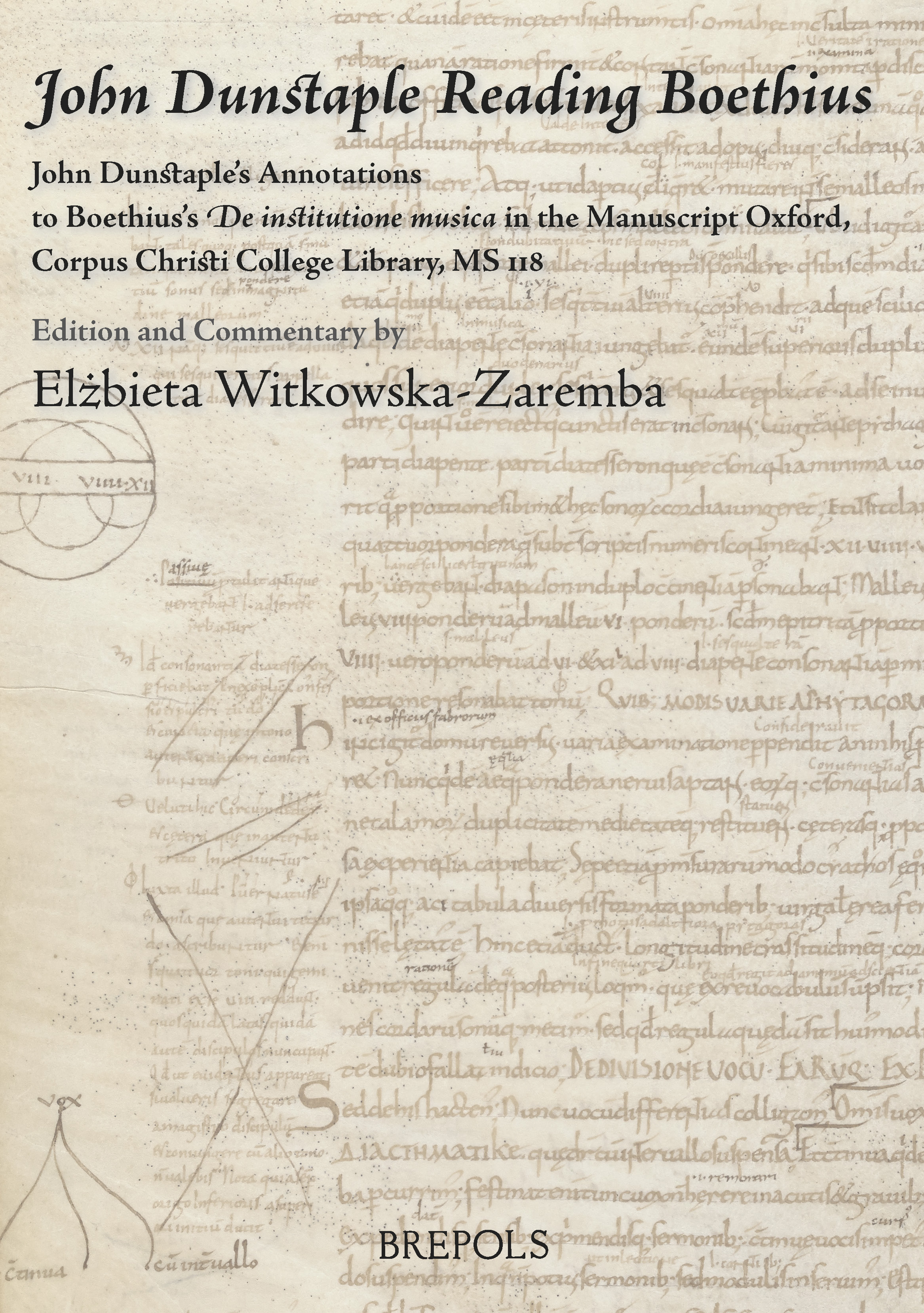 John Dunstaple Reading Boethius
John Dunstaple’s Annotations to Boethius’s “De institutione musica” in the Manuscript Oxford, Corpus Christi College Library, MS 118
 Music and Colonialism in Fascist Italy
Identity, Propaganda, and Ethnographic Representation
Volume 13






 Jüdische Musikerziehung im Preußen des 19. Jahrhunderts
Gesangunterricht an jüdischen Reformschulen als Facette bürgerlicher Akkulturation
Volume 21
 Künstlervertragsmodelle in der Musikwirtschaft
Rechtliche Grenzen der künstlerbezogenen Nebenrechteverwertung im Erlös-, Vermittlungs-, Options- und Leistungsmodell


