
Trésors de monnaies antiques trouvés en Albanie (Ve-Ier siècle av. J.-C.)
By (author) S. Gjongecaj-Vangjeli
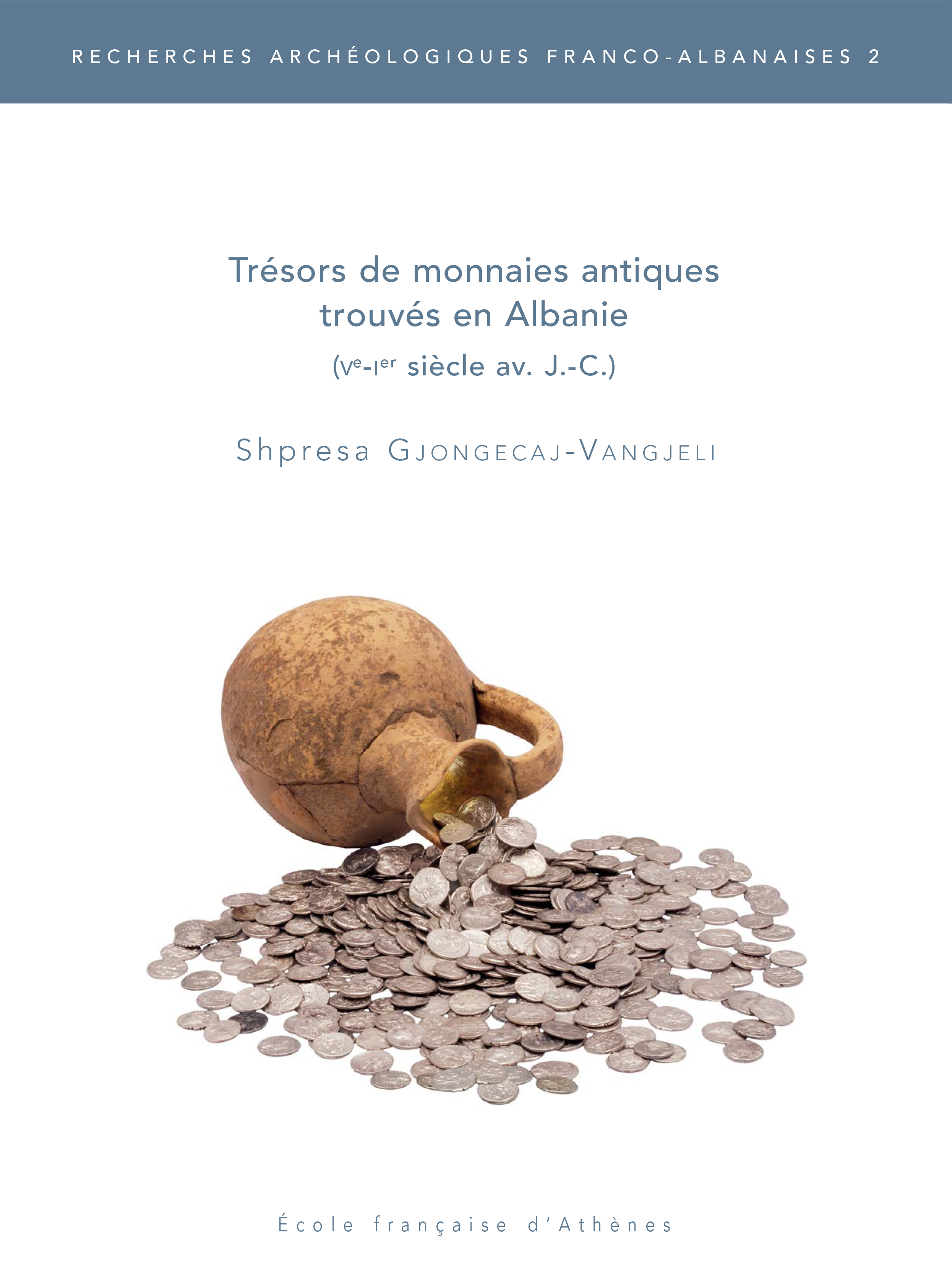
Albania, located in the southern part of ancient Illyria, is home to twenty-seven “hoards” of coins dating from the middle of the fifth century BC to the reign of Augustus. The two cities founded by Corinth, Apollonia and Dyrrachion (also called Epidamne), began to coin money in the fourth century, but this form of wealth had already come to the attention of the Illyrians and the currency of the two cities quickly established itself as the financial tool of the region, used by both the Illyrians and the Greeks. Illyria is a little-known country, only mentioned by Greek and Latin authors in connection with the wars that involved its neighbors from Greece or Italy. For the modern historian, the hoards are the best source of information on the history of the country, and the great events which transformed the local currency, attracted foreign currencies and armies. It is this story that Shpresa Gjongecaj-Vangjeli reconstructed through these hoards.
Albania, located in the southern part of ancient Illyria, is home to these twenty-seven “hoards” of coins dating from the middle of the fifth century BC to the reign of Augustus: the word hoard refers as much to a considerable sum won in war as to the capital accumulated by a warlord during campaigns overseas, but also to much smaller sums collected to fund a project that did not come to fruition, or a set of bronze coins that have lost their value following a currency change. The two cities founded by Corinth, Apollonia and Dyrrachion (also called Epidamne), began to coin money in the fourth century, but this form of wealth had already come to the attention of the Illyrians and the currency of the two cities quickly established itself as the financial tool of the region, used by both the Illyrians and the Greeks. Illyria is a little-known country, only mentioned by Greek and Latin authors in connection with the wars that involved its neighbours from Greece or Italy. For the modern historian, the hoards are the best source of information on the history of the country, and the great events which transformed the local currency, attracted foreign currencies and armies. It is this story that Shpresa Gjongecaj-Vangjeli reconstructed through these hoards.
- By (author) S. Gjongecaj-Vangjeli
Other Titles in this Series
 Populations et interactions culturelles en aire illyro-épirote du VIIe au IIIe siècle av. J.-C.
Volume 6
 Sovjan, village préhistorique lacustre d’Albanie sud-orientale, I
Le site dans son environnement
Volume 5

Similar Books



 Contesting Labeled Identities
The Sociology of Gentilics in Biblical and Northwest Semitic Literature

 Denarii beyond the Empire
Political and Cultural Perspectives on Roman Silver Coins in Barbaricum
Volume 17
 Drunk the Potion, No Whit Charmed
The Doctrine of Pure and Perfect Souls from Iamblichus to Damascius

 Epigraphic “Shades” from Hellenistic Thrace
Contextualizing Inscriptions in Greek from Thracian Tombs

 Epiphanies of the Divine in the Septuagint and the New Testament
Fifth International Symposium of the Corpus Judaeo-Hellenisticum Novi Testamenti (CJHNT), 14-17 May 2015, Nottingham


 Gold, Silver and Glass: Power Networks, Cultural Identities, Technology Transfers and Agency across the Old World (7th Century BC – 1st Century AD)
Proceedings of a Conference Held at the British Museum, 16–18 June 2023
 Language and Power in the Roman Empire and Early India
Hierarchy, Ambiguity, and the Art of Reading the Signs in Cosmopolitan Cultures
 Late Antique villae in the Balkans (3rd–7th c. AD): Current Research Questions and Perspectives
HAEMUS Companion to the Late Antique Balkans 1
Volume 4


 Nurturing the Elite
Representations of Drinking, Eating, and Religious Vessels in Palmyrene Funerary Iconography
Volume 13





 Roman Copies, Collecting, and Culture in the Bay of Naples and Beyond
Papers in Honor of Eugene J. Dwyer



 The Compositional History of the Book of Kings
An Analysis of the Evaluative Frameworks in 1 Kings 14–2 Kings 25


