Thomas Hoccleve, The Regiment of Princes
By (author) Thomas Hoccleve Edited by Charles R. Blyth

Paperback (Published)
(November 1999)
ISBN: 9781580440233
7.01 x 10 inches
Price: $24.95
On back order
Thomas Hoccleve was born in 1367 and entered government service as clerk in the office of the Privy Seal in 1387, an office that he held until his death in 1426. His earliest datable poem (the Epistle of Cupid, a free translation of Christine de Pisan’s Epistre au Dieu d’Amour) was completed about 1402. The Regiment of Princes, written about 1410-11, was composed at a time when England was still feeling the consequences of the deposition of Richard II. Essentially it is addressed to a prince on the subject of his governance, but it exhibits considerable generic instability and thus raises fundamental questions about how we should understand the tone of considerable portions of the poem. For all the problems it presents, The Regiment shows that Hoccleve has strengths as a poet. At times he could be a very talented prosodist. In autobiographical sections of the poem he creates a most interesting early-modern subjectivity. He has distinctive observations to make about his time, and, in his self-critical awareness, probes the limits of what is means to be a poet writing in the wake of Chaucer.
Acknowledgements Introduction Select Bibliography The Regiment of Princes Explanatory Notes Textual Notes Glossary, Acknowledgements
Introduction
Select Bibliography
Textual Notes
Glossary
- By (author) Thomas Hoccleve
- Edited by Charles R. Blyth
Other Titles in this Series


 The English Apocalypse
A Fourteenth-Century Translation of the Book of Revelation from Columbia University, MS Plimpton Add. 03


 The Assembly of Gods
Le Assemble de Dyeus, or Banquet of Gods and Goddesses, with the Discourse of Reason and Sensuality


Similar Books
 A Collaborative Tapestry in Honour of Shirley Ann Brown / Une fresque brodée en l’honneur de Shirley Ann Brown
The Bayeux Tapestry Seen by her Colleagues and Friends / La Tapisserie de Bayeux vue par ses collègues et amis


 Ars Prophetica
Theology in the Poetry of Twentieth-Century Hebrew Poets Avraham Halfi, Shin Shalom, Amir Gilboa, and T. Carmi
 Behind the Scenes of Medieval Roofs
An Overview of the Roofing Systems of Italian Churches
Volume 90


 Cahiers de littérature française
Les Métamorphoses du texte. Enjeux intertextuels et transpositions visuelles
Volume 25






 European Drama and Performance Studies
Dramatisations politiques. Théâtre, politique et idéologie au XIXe siècle (1806-1914)
Volume 27


 Innovation and Medieval Communities
The Circulation of Ideas and Practices in and out of the Town (1200-1500)
Volume 63
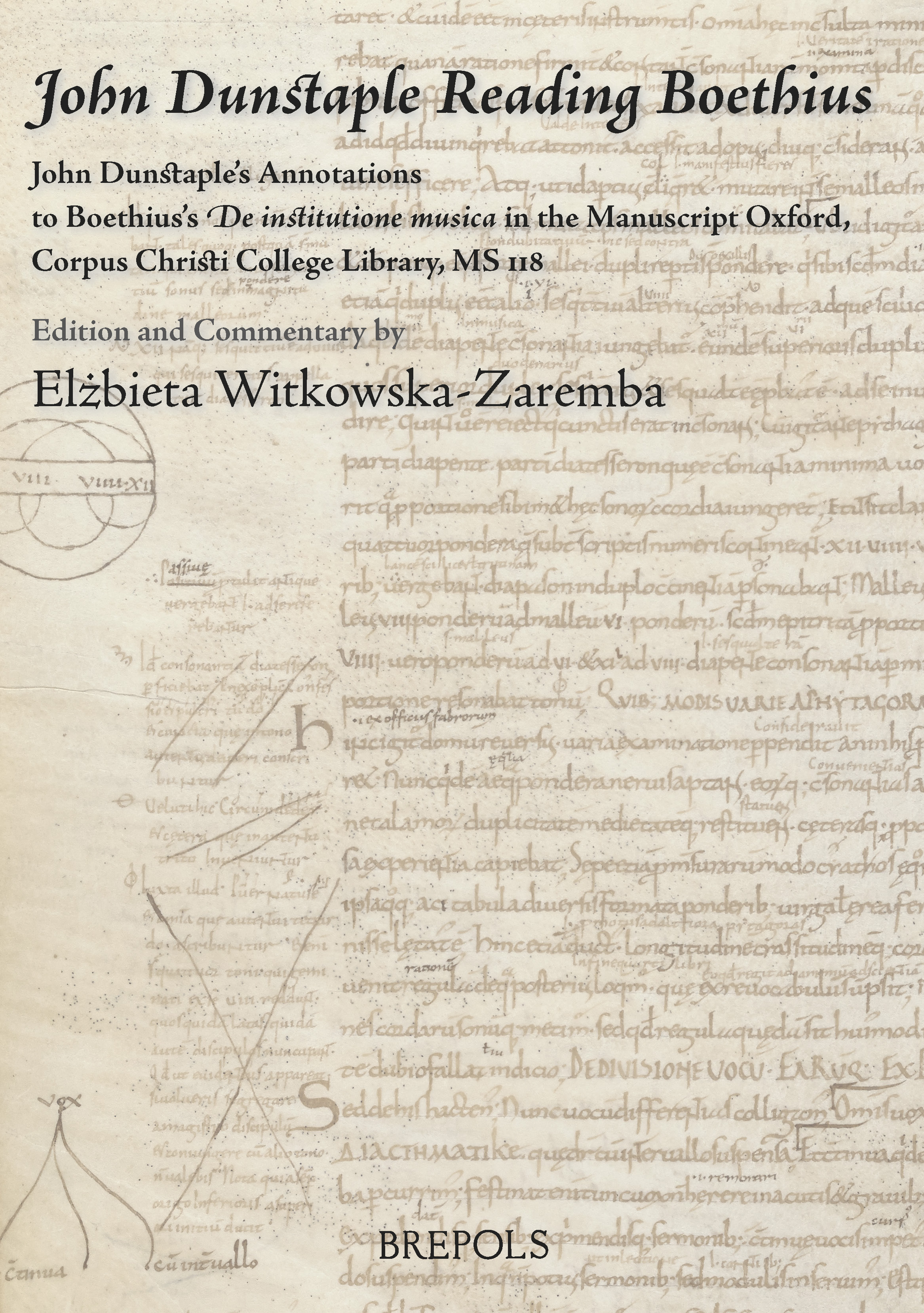 John Dunstaple Reading Boethius
John Dunstaple’s Annotations to Boethius’s “De institutione musica” in the Manuscript Oxford, Corpus Christi College Library, MS 118


 LiCArC
Trauma et création artistique : l’engagement des artistes arabes dans des dynamiques de résiliences
Volume 14

 Linguistic and Cultural Dynamics in a Frontier Society
New Perspectives on Northeastern Bavaria and Western Bohemia in the Early Middle Ages
Volume 9