
The Weeping Rock
Revisiting Niobe through 'Paragone', 'Pathosformel' and Petrification
By (author) B. Baert
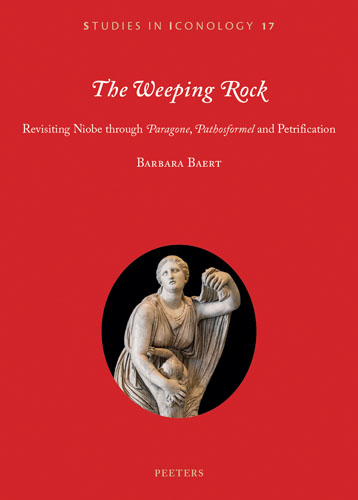
Publius Ovid (43 BC-17/18 AD) describes in his Metamorphoses Niobe’s transformation into a weeping rock. Niobe’s transformation incorporates the form and matter of the medium of sculpture. According to the humanist paragone debate, painting and sculpture struggle to be the medium with the highest qualities of virtuosity. Aby Warburg (1866-1929) refers to the Niobe motif’s Nachleben in his Tafel 5: Beraubte Mutter. (Niobe, Flucht und Schrecken). This displays the images of both the bereaved mother (Niobe) and the murderous mother (Medea). The montage also introduces the theme of the descent to the underworld. It becomes clear how the cluster of motifs around the figure of Niobe – hybris, lamentatio and the chthonic substrate – functions as a direct entry to a bipolar hermeneutics of the visual medium: the ‘historical psychology of human expression’ that navigates between Apollo and Dionysus. The ‘weeping rock’ that according to legend still stands on Mount Sipylus in Turkey, draws upon deeper anthropological patterns. Petrification indicates inertia, frigidity and a Medusan psychosis of fear. In nature, stones and rocks have a ‘slumbering insistence’ that can be captivating. Stones are after all visible but impenetrable, they index an irrevocable absence in their presence, and ‘have abode’ in an otherworldly region of utter blindness and silence. From a psychoanalytical perspective, Niobe’s petrifaction symbolises the straitening of her life and the loss of anima within a culture divorced from authentic feeling, nature, and instinct. Here Niobe meets Echo.
Publius Ovid (43 BC-17/18 AD) describes in his Metamorphoses Niobe’s transformation into a weeping rock. Niobe’s transformation incorporates the form and matter of the medium of sculpture. According to the humanist paragone debate, painting and sculpture struggle to be the medium with the highest qualities of virtuosity. Aby Warburg (1866-1929) refers to the Niobe motif’s Nachleben in his Tafel 5: Beraubte Mutter. (Niobe, Flucht und Schrecken). This displays the images of both the bereaved mother (Niobe) and the murderous mother (Medea). The montage also introduces the theme of the descent to the underworld. It becomes clear how the cluster of motifs around the figure of Niobe – hybris, lamentatio and the chthonic substrate – functions as a direct entry to a bipolar hermeneutics of the visual medium: the ‘historical psychology of human expression’ that navigates between Apollo and Dionysus. The ‘weeping rock’ that according to legend still stands on Mount Sipylus in Turkey, draws upon deeper anthropological patterns. Petrification indicates inertia, frigidity and a Medusan psychosis of fear. In nature, stones and rocks have a ‘slumbering insistence’ that can be captivating. Stones are after all visible but impenetrable, they index an irrevocable absence in their presence, and ‘have abode’ in an otherworldly region of utter blindness and silence. From a psychoanalytical perspective, Niobe’s petrifaction symbolises the straitening of her life and the loss of anima within a culture divorced from authentic feeling, nature, and instinct. Here Niobe meets Echo.
- By (author) B. Baert
Other Titles in this Series

 Late Medieval Enclosed Gardens of the Low Countries
Contributions to Gender and Artistic Expression
Volume 2
 The Right Moment
Essays Offered to Barbara Baert, Laureate of the 2016 Francqui Prize in Human Sciences, on the Occasion of the Celebratory Symposium at the Francqui Foundation, Brussels, 18-19 October 2018
Volume 20






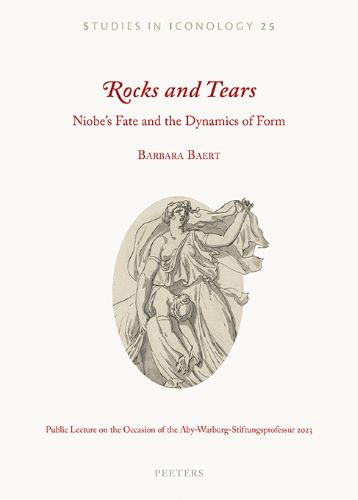 Rocks and Tears
Niobe's Fate and the Dynamics of Form. Lecture on the Occasion of the Aby-Warburg-Stiftungsprofessur 2023
Volume 25
 Nymph. Motif, Phantom, Affect. Part II
Aby Warburg's (1866-1929) Butterflies as Art Historical Paradigms
Volume 4

 In Response to Echo
Beyond Mimesis or Dissolution as Scopic Regime (with Special Attention to Camouflage)
Volume 6

 Signed ‘PAN’
Erwin Panofsky's (1892-1968) "The History of Art as a Humanistic Discipline" (Princeton, 1938)
Volume 18

Similar Books
 A Collaborative Tapestry in Honour of Shirley Ann Brown / Une fresque brodée en l’honneur de Shirley Ann Brown
The Bayeux Tapestry Seen by her Colleagues and Friends / La Tapisserie de Bayeux vue par ses collègues et amis



 Balthasar Caymox of Nuremberg
Early Modern German Print Publishers: Popular Prints of the Seventeenth Century




 Contesting Labeled Identities
The Sociology of Gentilics in Biblical and Northwest Semitic Literature


 Drunk the Potion, No Whit Charmed
The Doctrine of Pure and Perfect Souls from Iamblichus to Damascius

 ENTANGLED AFRICA
Intra-African Relations Between Rain Forest and Mediterranean from Around 4,000 BCE to 1,500 CE
 Epigraphic “Shades” from Hellenistic Thrace
Contextualizing Inscriptions in Greek from Thracian Tombs

 Epiphanies of the Divine in the Septuagint and the New Testament
Fifth International Symposium of the Corpus Judaeo-Hellenisticum Novi Testamenti (CJHNT), 14-17 May 2015, Nottingham


 Gold, Silver and Glass: Power Networks, Cultural Identities, Technology Transfers and Agency across the Old World (7th Century BC – 1st Century AD)
Proceedings of a Conference Held at the British Museum, 16–18 June 2023


 Language and Power in the Roman Empire and Early India
Hierarchy, Ambiguity, and the Art of Reading the Signs in Cosmopolitan Cultures
 Late Antique villae in the Balkans (3rd–7th c. AD): Current Research Questions and Perspectives
HAEMUS Companion to the Late Antique Balkans 1
Volume 4
 Legal Visuality
Exegesis, Ambiguity, and Dissimulation of the Donation of Constantine in the Early Modern Period
 Listening to the Swan Song
More-than-Human Beings and Sounds in Literature and Culture Through the Ages


 Monastic Manuscripts from the Eastern Mediterranean (Sinai, Jerusalem, Antioch)
Production, Use, and Contexts


