
The Knife
Temporal Ruptures in Revelation and Transformation
by L. Tack
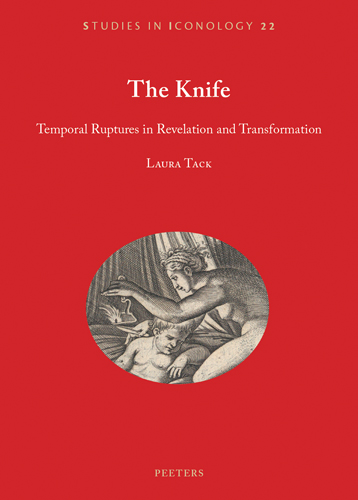
The Greek sculptor Lysippos of Sicyon (fourth century BCE) represented Kairos carrying a razor in his left hand. According to the epigram dedicated to this statue by Posidippus of Pella (mid-third-century BCE), the Greek divinity of the opportune moment is said to move with a swiftness that is sharper than any razor’s edge. Why does Kairos carry a razor in his hand? And how does the knife relate to opportunity and temporality? This book embarks on a narrative detour to answer these questions. Stories of revelation and transformation are anatomised to discover the moments of the knife pulsating underneath the surface. The sword grasped at the right moment by the Biblical heroine Judith, Abraham’s sacrificial knife, the eucharistic knife from the Castello Sforzesco in Milan, Psyche’s razor, the surgeon’s scalpel, or the apocalyptic double-edged sword each figure as multifaceted imaginations of these kairotic moments. Under the skin of this book lives the question raised by Gotthold Ephraim Lessing (1729-1781) in his Laokoon oder uber die Grenzen der Mahlerey und Poesie (1766). Who is best suited to capture the right moment, the painter, or the poet? At the heart of it all is the disruption of time itself. The moment of the knife is the time of the wound in time. Sudden, sharp, and unexpected this moment pierces deep into the human experience, stirring the soul with a swiftness beyond imagination.
The Greek sculptor Lysippos of Sicyon (fourth century BCE) represented Kairos carrying a razor in his left hand. According to the epigram dedicated to this statue by Posidippus of Pella (mid-third-century BCE), the Greek divinity of the opportune moment is said to move with a swiftness that is sharper than any razor’s edge. Why does Kairos carry a razor in his hand? And how does the knife relate to opportunity and temporality? This book embarks on a narrative detour to answer these questions. Stories of revelation and transformation are anatomised to discover the moments of the knife pulsating underneath the surface. The sword grasped at the right moment by the Biblical heroine Judith, Abraham’s sacrificial knife, the eucharistic knife from the Castello Sforzesco in Milan, Psyche’s razor, the surgeon’s scalpel, or the apocalyptic double-edged sword each figure as multifaceted imaginations of these kairotic moments. Under the skin of this book lives the question raised by Gotthold Ephraim Lessing (1729-1781) in his Laokoon oder uber die Grenzen der Mahlerey und Poesie (1766). Who is best suited to capture the right moment, the painter, or the poet? At the heart of it all is the disruption of time itself. The moment of the knife is the time of the wound in time. Sudden, sharp, and unexpected this moment pierces deep into the human experience, stirring the soul with a swiftness beyond imagination.
- By (author) L Tack
Other Titles in this Series





 Rocks and Tears
Niobe's Fate and the Dynamics of Form. Lecture on the Occasion of the Aby-Warburg-Stiftungsprofessur 2023
Volume 25
 Nymph. Motif, Phantom, Affect. Part II
Aby Warburg's (1866-1929) Butterflies as Art Historical Paradigms
Volume 4

 In Response to Echo
Beyond Mimesis or Dissolution as Scopic Regime (with Special Attention to Camouflage)
Volume 6

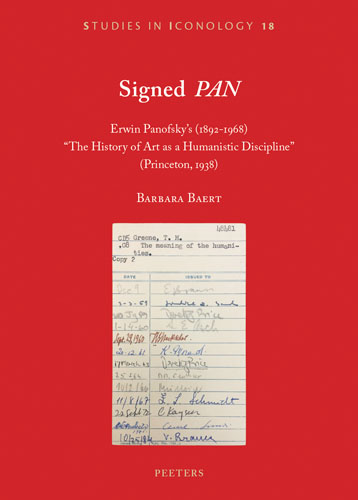 Signed ‘PAN’
Erwin Panofsky's (1892-1968) "The History of Art as a Humanistic Discipline" (Princeton, 1938)
Volume 18


 Late Medieval Enclosed Gardens of the Low Countries
Contributions to Gender and Artistic Expression
Volume 2
 The Right Moment
Essays Offered to Barbara Baert, Laureate of the 2016 Francqui Prize in Human Sciences, on the Occasion of the Celebratory Symposium at the Francqui Foundation, Brussels, 18-19 October 2018
Volume 20


Similar Books
 A Collaborative Tapestry in Honour of Shirley Ann Brown / Une fresque brodée en l’honneur de Shirley Ann Brown
The Bayeux Tapestry Seen by her Colleagues and Friends / La Tapisserie de Bayeux vue par ses collègues et amis



 Balthasar Caymox of Nuremberg
Early Modern German Print Publishers: Popular Prints of the Seventeenth Century


 ENTANGLED AFRICA
Intra-African Relations Between Rain Forest and Mediterranean from Around 4,000 BCE to 1,500 CE


 Gold, Silver and Glass: Power Networks, Cultural Identities, Technology Transfers and Agency across the Old World (7th Century BC – 1st Century AD)
Proceedings of a Conference Held at the British Museum, 16–18 June 2023


 Legal Visuality
Exegesis, Ambiguity, and Dissimulation of the Donation of Constantine in the Early Modern Period
 Listening to the Swan Song
More-than-Human Beings and Sounds in Literature and Culture Through the Ages


 Monastic Manuscripts from the Eastern Mediterranean (Sinai, Jerusalem, Antioch)
Production, Use, and Contexts

 Naples as Laboratory / Laboratorium Neapel
Style Options, Artistic Rivalry and Self Fashioning in Neapolitan Baroque Painting / Plurale Stilbildung, Kunstlerkonkurrenz und Self Fashioning in der neapolitanischen Barockmalerei

 Nurturing the Elite
Representations of Drinking, Eating, and Religious Vessels in Palmyrene Funerary Iconography
Volume 13


 Portraying the Individual in the Roman East
Local–Imperial Entanglements in Sculpture, Mosaics, and Paintings (First–Fourth Centuries AD)
Volume 18


 Technical Studies of Asian Art
Proceedings of the Seventh Forbes Symposium at the Freer Gallery of Art


