The Tract De unitate minori of Petrus Thome
by E.P. Bos

The notion of unity, or of being one, has a long tradition in the history of philosophy. It is perhaps the notion to which most discussion has been devoted after that of being. It has a wide impact, and presents itself under various and different titles: truth, mind, god/God, goodness, the distinction between general and particular and so on. This holds especially for medieval philosophy. What does unity mean, and to what does it apply? What is its relation to knowledge and naming? And to being? To what extent can being be said to be one? Medieval philosophers were realists in ontology, some to a lesser, some to a greater degree. They all accepted the reality of concrete individual substances, whether existent or not. These entities are singular, and numerically one. However, the views of the medievals differed on the question whether there was another reality, i.e. one beyond the physical reality, on a metaphysical level. If so, what kind of unity is it? To define the nature of it is not easy. John Duns Scot and his pupils, among whom was Petrus Thomae (a Spaniard, born in Catalonia, ca. 1280), accepted such a unity. They accept, of course, the reality of singular concrete things, which numerically are one. However, they posit another reality, which is less than numerical, as they labelled it. This unity is neither general, because generality is a product of the mind, nor is it singular. Pupils and followers of Duns Scotus felt the need to systematise some of their masters’ principal ideas. An example of this is Peter Thomae. With the intention to clarify and systematise, Peter wrote a short tract titled De unitate minori (‘On unity that is less than numerical’), which is edited here. This volume of the Bibliotheca is a first critical edition of the tract.
- By (author) EP Bos
Other Titles in this Series
 Penser avec Avicenne
De l'héritage grec à la réception latine, en hommage à Jules Janssens
Volume 20
 The Cistercian Hermann Zoest’s Treatise on Leavened and Unleavened Bread (‘De fermento et azimo’)
Oecumenism, Exegesis, and Science at the Council of Basel
Volume 21




 Durand of Saint-Pourcain and His Sentences Commentary
Historical, Philosophical, and Theological Issues
Volume 9


Similar Books
 A Collaborative Tapestry in Honour of Shirley Ann Brown / Une fresque brodée en l’honneur de Shirley Ann Brown
The Bayeux Tapestry Seen by her Colleagues and Friends / La Tapisserie de Bayeux vue par ses collègues et amis

 Behind the Scenes of Medieval Roofs
An Overview of the Roofing Systems of Italian Churches
Volume 90




 Drunk the Potion, No Whit Charmed
The Doctrine of Pure and Perfect Souls from Iamblichus to Damascius



 Innovation and Medieval Communities
The Circulation of Ideas and Practices in and out of the Town (1200-1500)
Volume 63
 John Dunstaple Reading Boethius
John Dunstaple’s Annotations to Boethius’s “De institutione musica” in the Manuscript Oxford, Corpus Christi College Library, MS 118
 Libertinage et philosophie à l’époque classique (XVIe-XVIIIe siècle)
Athéisme, Modernité et Sécularisation / Atheism, Modernity and Secularization
Volume 23
 Linguistic and Cultural Dynamics in a Frontier Society
New Perspectives on Northeastern Bavaria and Western Bohemia in the Early Middle Ages
Volume 9
 Medieval Debates on Foreknowledge: Future Contingents, Prophecy, and Divination
Acts of the XXVII Annual Colloquium of the SIEPM, Trento 12-15 September 2023
Volume 31
 Medieval Yeghegis, Armenia
History, Archaeology, Society. Local Multiplicities and Global Connections of a Rural Centre on the Silk Road(s)



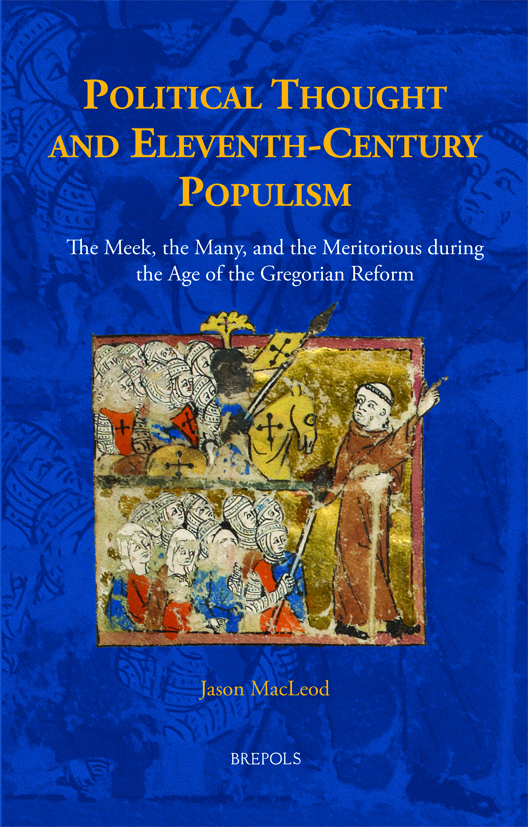 Political Thought and Eleventh-Century Populism
The Meek, the Many, and the Meritorious during the Age of the Gregorian Reform
Volume 38