
The Fools’ Journey. A Myth of Obsession in Northern Renaissance Art
By (author) Yona Pinson
Paperback (Published)
(March 2009)
ISBN: 9782503526126
Price: $120.00
On back order
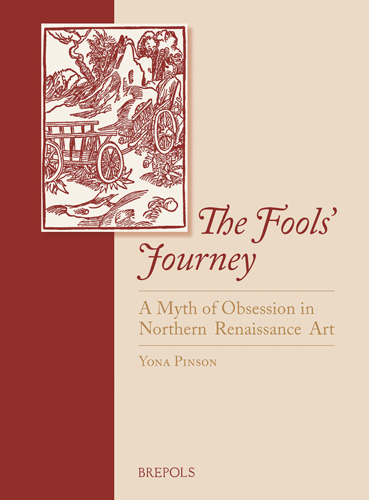
Tracing the evolution of the newly emerging iconographical patterns of fools and folly, this book sheds light on the original and innovative invention that was an exclusive creation of northern Renaissance art and culture. The novel theme of the fools’ journey, as expressed mainly through prints in Germany and later in the Netherlands in the sixteenth century is revealed as an ironical paraphrase, parodying the well established Christian topos, the Pilgrimage of Life or the Pilgrimage of the Human Soul, which offered the believer the opportunity to travel on the road toward redemption. The new mythical image of the fools’ journey, however, confronts the contemporary reader/viewer with the image of the fool on his voyage that leads him, instead, to his doomed fate, thereby reflecting a pessimistic world-view. The newly emerging visual vocabulary is considered in relation to analogical contemporary didactic and satirical theatrical performances such as the rederijkers plays, the sotties, and also carnival processions. Proposing a new reading of Sebastian Brant’s The Ship of Fools (Das Narrenschiff, Basel 1494), a landmark in the new iconography of the allegorical journey, this study recognizes as well the power of the visual image employed in the woodcuts-illustrations accompanying the treatise as a tool of moral teaching, used as a means of influencing the larger urban audience for whom word and image were sometimes interchangeable. Concomitantly, the divergence between verbal expression and visual language may be seen to define the inherent codes of the visual expressions. It is precisely the gap between literary sources and visualization, the very moment when visual vocabulary crystallizes, and image departs from word creating its own autonomous expression and language, that attracts our attention. The range and diversity of visual material related to the fools’ journey topos, addresses a wide spectrum of audiences. This study also takes into consideration the strategies of communicating meanings and values to various publics. Addressing the wider urban public that was not necessarily lettered, notably women, illustrated-books and images were envisaged first of all as didactic tools. In accordance, the painters-engravers attended their public with rather simple visual elaborations that could be easily deciphered. Paintings, drawings, and prints intended for highly cultivated elite circles of urban society, among them works by Albrecht Durer and Hieronymus Bosch, demanded greater intellectual involvement on the part of the beholder, challenging the sophisticated viewer to re-create a meaningful ensemble out of the various scenes and motifs presented within complex compositions.
Tracing the evolution of the newly emerging iconographical patterns of fools and folly, this book sheds light on the original and innovative invention that was an exclusive creation of northern Renaissance art and culture. The novel theme of the fools’ journey, as expressed mainly through prints in Germany and later in the Netherlands in the sixteenth century is revealed as an ironical paraphrase, parodying the well established Christian topos, the Pilgrimage of Life or the Pilgrimage of the Human Soul, which offered the believer the opportunity to travel on the road toward redemption. The new mythical image of the fools’ journey, however, confronts the contemporary reader/viewer with the image of the fool on his voyage that leads him, instead, to his doomed fate, thereby reflecting a pessimistic world-view. The newly emerging visual vocabulary is considered in relation to analogical contemporary didactic and satirical theatrical performances such as the rederijkers plays, the sotties, and also carnival processions. Proposing a new reading of Sebastian Brant’s The Ship of Fools (Das Narrenschiff, Basel 1494), a landmark in the new iconography of the allegorical journey, this study recognizes as well the power of the visual image employed in the woodcuts-illustrations accompanying the treatise as a tool of moral teaching, used as a means of influencing the larger urban audience for whom word and image were sometimes interchangeable. Concomitantly, the divergence between verbal expression and visual language may be seen to define the inherent codes of the visual expressions. It is precisely the gap between literary sources and visualization, the very moment when visual vocabulary crystallizes, and image departs from word creating its own autonomous expression and language, that attracts our attention. The range and diversity of visual material related to the fools’ journey topos, addresses a wide spectrum of audiences. This study also takes into consideration the strategies of communicating meanings and values to various publics. Addressing the wider urban public that was not necessarily lettered, notably women, illustrated-books and images were envisaged first of all as didactic tools. In accordance, the painters-engravers attended their public with rather simple visual elaborations that could be easily deciphered. Paintings, drawings, and prints intended for highly cultivated elite circles of urban society, among them works by Albrecht Durer and Hieronymus Bosch, demanded greater intellectual involvement on the part of the beholder, challenging the sophisticated viewer to re-create a meaningful ensemble out of the various scenes and motifs presented within complex compositions.
- By (author) Yona Pinson
Similar Books
 A Collaborative Tapestry in Honour of Shirley Ann Brown / Une fresque brodée en l’honneur de Shirley Ann Brown
The Bayeux Tapestry Seen by her Colleagues and Friends / La Tapisserie de Bayeux vue par ses collègues et amis





 Balthasar Caymox of Nuremberg
Early Modern German Print Publishers: Popular Prints of the Seventeenth Century


 Beyond Sovereign Courts
Agents and Practices in Early Modern Spanish and Habsburg Diplomacy
Volume 3


 Circulation, Use, Impact
The Consumption of Architectural Books in the Early Modern Eastern Adriatic
Volume 1


 Councils, Conflicts, Correspondence
Urban Diplomacy in Reval (Tallinn) and Lübeck (c. 1470–1570)
Volume 67


 ENTANGLED AFRICA
Intra-African Relations Between Rain Forest and Mediterranean from Around 4,000 BCE to 1,500 CE


 Gold, Silver and Glass: Power Networks, Cultural Identities, Technology Transfers and Agency across the Old World (7th Century BC – 1st Century AD)
Proceedings of a Conference Held at the British Museum, 16–18 June 2023


 Homo-Politicus in the Balkans
Early Modern Southeast European History in Imperial and Regional Context

 Innovationes Lovanienses: Arts, Law and Theology at the University of Louvain (1425–1797)
Studium Lovaniense: Learning across Borders, 2
Volume 18
 Legal Visuality
Exegesis, Ambiguity, and Dissimulation of the Donation of Constantine in the Early Modern Period
 Listening to the Swan Song
More-than-Human Beings and Sounds in Literature and Culture Through the Ages


 Monastic Manuscripts from the Eastern Mediterranean (Sinai, Jerusalem, Antioch)
Production, Use, and Contexts


 Naples as Laboratory / Laboratorium Neapel
Style Options, Artistic Rivalry and Self Fashioning in Neapolitan Baroque Painting / Plurale Stilbildung, Kunstlerkonkurrenz und Self Fashioning in der neapolitanischen Barockmalerei

 Nurturing the Elite
Representations of Drinking, Eating, and Religious Vessels in Palmyrene Funerary Iconography
Volume 13

