
The British Hotel Through the Ages
by Mary Cathcart Borer
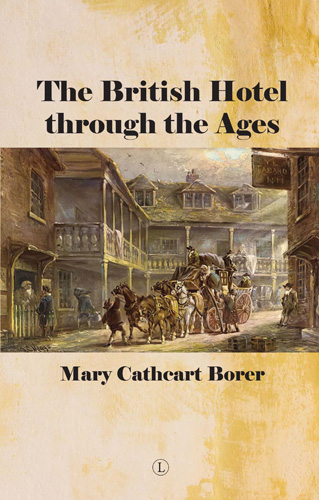
A detailed history of inns and hotels in Britain, first published in 1972.
The first inns in Britain were built by the Romans, for the accommodation of road builders and government officials. Their history since then ranges from pilgrim hostels built by monasteries to coaching inns and palatial railway hotels. Throughout this book runs a rich vein of social history detailing the food, drink, furnishings and costs of British hotels. Travellers’ tales, both British and foreign, from the sixteenth century onwards, are quoted at length, so that the book comes alive with first-hand impressions. We learn how some of the Regency Hotels of London came into being, such as Grillion’s, where Louis XVIII stayed in 1814, and there are accounts of the early railway hotels, and the great provincial hotels of Britain’s coast and countryside. Mary Cathcart Borer’s study still provides a detailed historical perspective of her subject almost fifty years on from its first publication, while at the same time offering a glimpse of contemporary attitudes to the rapidly expanding British hotel trade in the 1970s.
Mary Cathcart Borer (1906-94) was a prolific novelist, playwright and non-fiction author. She worked as a museum curator and archaeologist early on in life, but rose to prominence as a screenwriter for children’s films and television plays in the 1940s and 1950s. After this she focussed on non-fiction writing, covering subjects from King Alfred the Great to the Boer War alongside historical studies of various London boroughs. This is one of several books she wrote on British social history.
- By (author) Mary Cathcart Borer
Similar Books


 Gelebtes Europa
Die innereuropäischen Beziehungen der altkatholischen Kirchen der Utrechter Union 1945 bis 1989




 Military Healthcare and the Early Modern State, 1660–1830
Management – Professionalisation – Shortcomings
 The Color of Choice
The Armenians and the Politics of Race in the United States and Germany (1890–1945)
Volume 2

 The Mobilization at the Periphery
Universal Conscription as A Modernizing Factor of the Habsburg Empire from 1868–1914
 War and Remembrance II
World War II and the Holocaust between Tabooization and Competing Narratives in Post-Socialist Europe
Volume 15
 Bevölkerungsgeschichte eines mitteleuropäischen Übergangsraumes
Tirol – Südtirol – Trentino (1880-2010)
 Der industrialisierte Krieg
Studien zu Unternehmen, Wirtschaft und Forschung im Ersten Weltkrieg
Volume 2

 Die Spanische Grippe und die Habsburgermonarchie
Gesundheitspolitik, multiple Krisen und Staatszerfall

 Erinnerungen einer ungewünschten Generation
Besatzungskinder und ihre Nachkommen auf der Suche nach den eigenen Wurzeln
 Helden eines Landes, das es nicht mehr gibt
Die Transformationen des Gedenkens an gefallene sowjetische Soldaten und Veteranen des Zweiten Weltkriegs in der Ukraine
 Krise, Neubeginn und nationale Konkurrenz
Geschichtsschreibung und Geschichtskultur in Schlesien nach dem Ersten Weltkrieg (1918–1933)


 Pioniere einer Europaarmee
Die Planung integrierter europäischer Streitkräfte im Militärausschuss der EVG-Konferenz März 1951 bis Mai 1952

 Quellenpublikationen der Gesellschaft für Rheinische Geschichtskunde
Rahmenbedingungen, Genese und Rezeption im wissenschaftshistorischen Kontext


 Vermessung einer Zeitenschwelle / Surveying a Time Threshold
Die Bedeutung des Jahres 1918 in osterreichischer, europaischer und globaler Perspektive / The Importance of 1918 in an Austrian, European and Global Perspective. Beitrage des Internationalen Symposiums im November 2018
Volume 9

 Adelspolitik in der späten Habsburgermonarchie
Kulturen des Entscheidens in der Nobilitierungspraxis Kaiser Franz Josephs I. (1848–1916)

 Das lange Gedächtnis des Josef Ackerl
Erinnerte und vergessene ZeitSchichten eines von ZeitGeschichte(n) durchlöcherten Menschenlebens


 Il nemico tra di noi
La sinistra internazionale di fronte alle repressioni sovietiche (1918-1957)
Volume 478
