
Spartan Symmachy in the Sixth and Fifth Centuries BCE
by Aleksander Wolicki
Paperback (Out of print)
(August 2018)
ISBN: 9788323534822
Price: $53.00
On back order
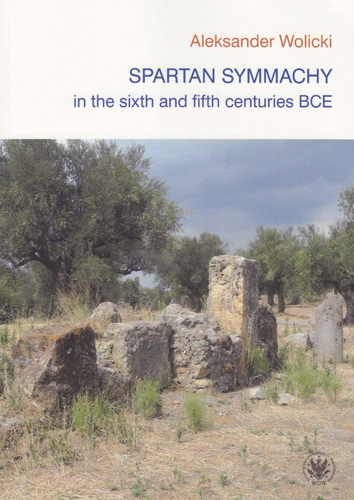
The book contains systematic critique of the traditionalist model”s historiographical assumptions concerning the Spartan alliances in the VI and V century BCE. First chapter is devoted to the critique of the sources. In the second chapter we look at three areas where the original impulse for the creation of a coherent, uniform alliance around Sparta has been sought: Sparta”s helot problem, relations with Argos and finally the alleged Spartan “crusade” against Greek tyrants. In the third chapter the supposed constitution of the Peloponnesian League is tackled. The assumption is that it was shaped in the 450s in reaction to the emergence of the Athenian empire which provoked strong fear. In the fourth chapter the author attempts to buttress this theory by an analysis of a problem that has to date nearly evaded scholarly attention but which is central to any attempt at understanding the Spartan symmachy, namely the history of the term “the Peloponnesians” and its use. The author traces the development of an originally purely geographic designation into a slogan used from the mid-fifth century onwards as propaganda for the Peloponnesian unity against Athenian aggression while cementing the anti-Athenian alliance around Sparta. The history of the word constitutes a crucial argument in the discussion on the time, place and character of the formation of the Peloponnesian League.
The book contains systematic critique of the traditionalist model”s historiographical assumptions concerning the Spartan alliances in the VI and V century BCE. First chapter is devoted to the critique of the sources. In the second chapter we look at three areas where the original impulse for the creation of a coherent, uniform alliance around Sparta has been sought: Sparta”s helot problem, relations with Argos and finally the alleged Spartan “crusade” against Greek tyrants. In the third chapter the supposed constitution of the Peloponnesian League is tackled. The assumption is that it was shaped in the 450s in reaction to the emergence of the Athenian empire which provoked strong fear. In the fourth chapter the author attempts to buttress this theory by an analysis of a problem that has to date nearly evaded scholarly attention but which is central to any attempt at understanding the Spartan symmachy, namely the history of the term “the Peloponnesians” and its use. The author traces the development of an originally purely geographic designation into a slogan used from the mid-fifth century onwards as propaganda for the Peloponnesian unity against Athenian aggression while cementing the anti-Athenian alliance around Sparta. The history of the word constitutes a crucial argument in the discussion on the time, place and character of the formation of the Peloponnesian League.
- By (author) Aleksander Wolicki
Similar Books


 Contesting Labeled Identities
The Sociology of Gentilics in Biblical and Northwest Semitic Literature

 Drunk the Potion, No Whit Charmed
The Doctrine of Pure and Perfect Souls from Iamblichus to Damascius

 Epigraphic “Shades” from Hellenistic Thrace
Contextualizing Inscriptions in Greek from Thracian Tombs

 Epiphanies of the Divine in the Septuagint and the New Testament
Fifth International Symposium of the Corpus Judaeo-Hellenisticum Novi Testamenti (CJHNT), 14-17 May 2015, Nottingham


 Gold, Silver and Glass: Power Networks, Cultural Identities, Technology Transfers and Agency across the Old World (7th Century BC – 1st Century AD)
Proceedings of a Conference Held at the British Museum, 16–18 June 2023
 Language and Power in the Roman Empire and Early India
Hierarchy, Ambiguity, and the Art of Reading the Signs in Cosmopolitan Cultures
 Late Antique villae in the Balkans (3rd–7th c. AD): Current Research Questions and Perspectives
HAEMUS Companion to the Late Antique Balkans 1
Volume 4


 Nurturing the Elite
Representations of Drinking, Eating, and Religious Vessels in Palmyrene Funerary Iconography
Volume 13





 Roman Copies, Collecting, and Culture in the Bay of Naples and Beyond
Papers in Honor of Eugene J. Dwyer



 The Compositional History of the Book of Kings
An Analysis of the Evaluative Frameworks in 1 Kings 14–2 Kings 25




 Zooarchaeology of Ancient Greek Sanctuaries in Southwestern Sicily
Faunal Analysis from Selinus and Akragas as Evidence of Differences in the Treatment of Animals for Ritual Purposes


