
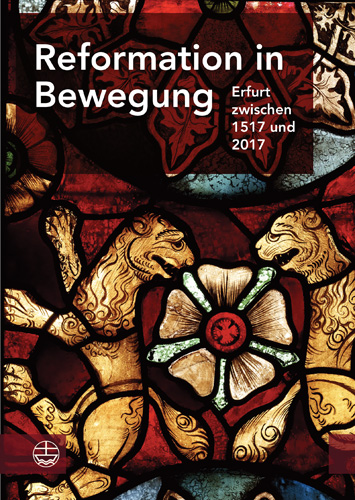
Reformation in Bewegung
Erfurt zwischen 1517 und 2017. Eine Erfurter Festgabe zum 500. Gedenkjahr der Reformation
By (author) Evangelische Verlagsanstalt
Hardback (Published)
(October 2017)
ISBN: 9783374052417
5.31 x 7.44 inches
Price: $31.00
On back order
On November 11, 1517, Martin Luther sends his 95 Theses on the practice of indulgences to Johannes Lang, the prior of the Black Cloister of the Augustinian Hermits in Erfurt. Lang disseminates the theses in the city of Erfurt: students, teachers, citizens, monks and priests fiercely debate them. Protestant Christians experience an increased influx. In 1530, the Compact of Hammelburg is enacted, which enables both newly converted Protestants and those remaining Roman Catholics holding onto the ‘old beliefs’ – who are under the protection of the Archbishop of Mainz – to live out their faith side by side. This has been in effect for 500 years. In this historically very interesting book, the Erfurt Conference of the Evangelical Church in Central Germany opens a door into the current theological thinking of Protestant and Roman Catholic Christians 500 years after Luther’s nailing of the 95 Theses. Historic topics are brought into focus: being a Christian in the time of the Nazi Germany, during the GDR, and after the Peaceful Revolution of 1989. The emphasis of this work is: what does it mean to be a Protestant Christian following in the footsteps of the Erfurt reformers while remaining situated in an ecumenically broad, and at the same time, extremely secularized context. This work invites the reader to discover, affirm, and embark in new directions all under the rubric: ecclesia Christi semper reformanda – the church of Christ always reforming.
On November 11, 1517, Martin Luther sends his 95 Theses on the practice of indulgences to Johannes Lang, the prior of the Black Cloister of the Augustinian Hermits in Erfurt. Lang disseminates the theses in the city of Erfurt: students, teachers, citizens, monks and priests fiercely debate them. Protestant Christians experience an increased influx. In 1530, the Compact of Hammelburg is enacted, which enables both newly converted Protestants and those remaining Roman Catholics holding onto the ‘old beliefs’ – who are under the protection of the Archbishop of Mainz – to live out their faith side by side. This has been in effect for 500 years. In this historically very interesting book, the Erfurt Conference of the Evangelical Church in Central Germany opens a door into the current theological thinking of Protestant and Roman Catholic Christians 500 years after Luther’s nailing of the 95 Theses. Historic topics are brought into focus: being a Christian in the time of the Nazi Germany, during the GDR, and after the Peaceful Revolution of 1989. The emphasis of this work is: what does it mean to be a Protestant Christian following in the footsteps of the Erfurt reformers while remaining situated in an ecumenically broad, and at the same time, extremely secularized context. This work invites the reader to discover, affirm, and embark in new directions all under the rubric: ecclesia Christi semper reformanda – the church of Christ always reforming.
- By (author) Evangelische Verlagsanstalt
Similar Books
 ‘For You I Study, For You I Work, For You I Live, For You I Am Ready To Even Give My Life’
Essays in Honour of Francis (Frank) J Moloney, SDB
 A Connecting Polemic in the Medieval Mediterranean
The Correspondence of Leo III and ʿUmar II
Volume 6





 Ars Prophetica
Theology in the Poetry of Twentieth-Century Hebrew Poets Avraham Halfi, Shin Shalom, Amir Gilboa, and T. Carmi
 As Messianism Turns to Heresy
The Regenstein Chair Lectures On Lurianic Kabbalah and Shabbatai Tzevi at Hebrew Union College - Cincinnati


 Creating the Woman in Antiquity
Proceedings of the 16th Melammu Workshop, Innsbruck, 2–3 June 2022
Volume 13

 Drunk the Potion, No Whit Charmed
The Doctrine of Pure and Perfect Souls from Iamblichus to Damascius






 Extracanonical Traditions and the Holy Land
Texts, Rituals, and Material Culture in Late Antique Palestine
 Fear, Fear of God, God-Fearers
Philological and Historical Perspectives on the World of Ancient Judaism and Christianity




 Legal Visuality
Exegesis, Ambiguity, and Dissimulation of the Donation of Constantine in the Early Modern Period
 Liturgia semper reformanda
Adaptations and accommodations in the liturgy in light of canon 838 of the Code of Canon Law