
Pisidian Antioch
The Site and its Monuments
by Stephen Mitchell and Marc Waelkens
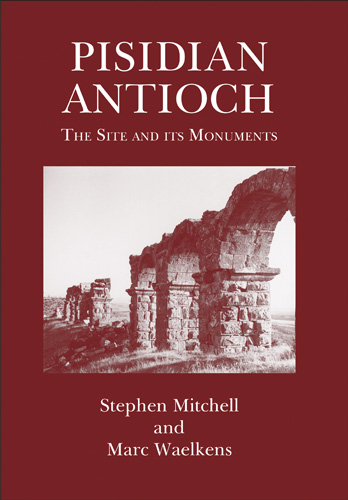
The city of Pisidian Antioch was founded in the hellenistic period by the Seleucids, in what is now south-west Turkey. Under the emperor Augustus it became the most important Roman colony of the eastern empire. The city flourished until the sixth century AD. It has left dramatic and extensive ruins. This comprehensive and fully-illustrated study, a sequel to Mitchell’s Cremna in Pisidia, is based on a new survey of the site. It also includes the results of the most recent Turkish field work as well as detailed information from the important but unpublished 1924 excavation by the University of Michigan.
List of figures List of plates Preface 1. Geographical and historical introduction - S. Mitchell 2. The discovery of Antioch: travellers, epigraphers and archaeologists - S. Mitchell 3. The sanctuary of Men Askaenos - S. Mitchell, M. Waelkens 4. The plan and development of the Roman colony: walls, gates, streets and the theatre - M. Waelkens 5. The Augustan imperial sanctuary - M. Waelkens, S. Mitchell 6. The aqueduct, nymphaeum and bath house - J. Burdy, M. Taslialan, M. Waelkens, S. Mitchell 7. Three churches at Antioch - J. Ozturk, S. Mitchell Appendix 1: Epigraphic and numismatic evidence for buildings - S. Mitchell Appendix 2: Archival material relating to Pisidian Antioch - M. Byrne, S. Mitchell Abbreviations Bibliography Index
Stephen Mitchell is author of Anatolia. Land, Men and Gods in Asia Minor (2 vols., 1993) and of Cremna in Pisidia. An Ancient City in Peace and in War (CPW/Duckworth 1995). He directed the Pisidian survey between 1982 and 1996. Marc Waelkens is the author of numerous books and articles on the archaeology of Asia Minor and since 1990 has been director of the Belgian excavations at Sagalassus in Pisidia – currently the largest classical excavation project in Turkey.
- By (author) Stephen Mitchell
- By (author) Marc Waelkens
Other Titles in this Series

Similar Books


 Caesar’s Visions and Impact on the Roman Empire
Revisiting the Archaeological and Historical Record of the 40s BC
Volume 2

 Construction Processes in Historical Western Societies (5th c. BC – 10th c. AD)
Case Studies on Techniques, Models, and Costs


 Etruscan and Roman Hellenistic Anatomical ex votos
Reassessing Popular Religious Expressions in Central Italy
Volume 8




 Invisible Labour in Antiquity
Visualizing Obscure Work in the Ancient Mediterannean and West Asia
Volume 1

 Late Antique villae in the Balkans (3rd–7th c. AD): Current Research Questions and Perspectives
HAEMUS Companion to the Late Antique Balkans 1
Volume 4





 Portraying the Individual in the Roman East
Local–Imperial Entanglements in Sculpture, Mosaics, and Paintings (First–Fourth Centuries AD)
Volume 18


 Roman Copies, Collecting, and Culture in the Bay of Naples and Beyond
Papers in Honor of Eugene J. Dwyer

 Small Worlds and Relational Agencies: Local Societies in Early Medieval Iberia
Pequeños mundos y Agencias relacionales: Sociedades locales altomedievales en la Península Ibérica
 SOMA 2023: Proceedings of the 24th Symposium on Mediterranean Archaeology
Ideas that Travelled by the Sea, Udine, 2-4 February, 2023


 The Iron Age Pottery from Tell Atchana / Ancient Alalakh
A Typological and Functional Analysis
Volume 8



 Writing in the Church of the Nativity in Bethlehem
Inscription and Graffiti in a Multilingual and Multigraphic Perspective
Volume 45
 Zooarchaeology of Ancient Greek Sanctuaries in Southwestern Sicily
Faunal Analysis from Selinus and Akragas as Evidence of Differences in the Treatment of Animals for Ritual Purposes
 Alabaster
An Interdisciplinary Study of the Sources and Uses of Calcite Alabaster in Antiquity
Volume 5