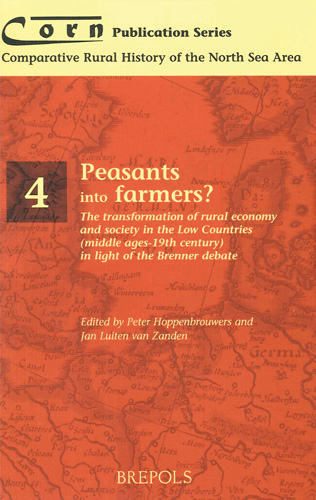
Peasants into Farmers?
The Transformation of Rural Economy and Society in the Low Countries (Middle Ages - 19th Century) in Light of the Brenner Debate
edited by P. Hoppenbrouwers and J. Luiten van Zanden
Paperback (Out of print)
(March 2001)
ISBN: 9782503510064
Price: $83.00
On back order
Since his pioneering article in 1976 the American historian Robert P. Brenner has tried to come to terms with an issue that has puzzled historians for generations: how can we explain the differences in growth-patterns of North Western European countries in the transition from feudalism to capitalism. In a frontal attack on both the ‘(homeostatic) demographic’ and ‘commercialization’ models, Brenner traced the roots of the divergent evolutions back to rural and feudal ‘social-property relations’. In the debate that immediately followed Brenner’s first article, and in subsequent exchanges, the Low Countries were sorely neglected, although areas such as Flanders and Holland played a decisive role in the economic development of Europe. This was partly due to a lack of publications on Dutch rural history in foreign languages. This volume aims to fill this lacuna. It draws upon substantial research, and confronts the Brenner thesis with new results and hypotheses; and it contains a powerful and detailed response by Brenner himself. The editors. Peter Hoppenbrouwers (1954) is professor of medieval history at the University of Amsterdam. Jan Luiten van Zanden (1955) is part-time professor of economic and social history at the University of Utrecht, research fellow at the International Institute for Social History (IISG) in Amsterdam, and general secretary of the International Association of Economic History.
Since his pioneering article in 1976 the American historian Robert P. Brenner has tried to come to terms with an issue that has puzzled historians for generations: how can we explain the differences in growth-patterns of North Western European countries in the transition from feudalism to capitalism. In a frontal attack on both the ‘(homeostatic) demographic’ and ‘commercialization’ models, Brenner traced the roots of the divergent evolutions back to rural and feudal ‘social-property relations’. In the debate that immediately followed Brenner’s first article, and in subsequent exchanges, the Low Countries were sorely neglected, although areas such as Flanders and Holland played a decisive role in the economic development of Europe. This was partly due to a lack of publications on Dutch rural history in foreign languages. This volume aims to fill this lacuna. It draws upon substantial research, and confronts the Brenner thesis with new results and hypotheses; and it contains a powerful and detailed response by Brenner himself. The editors. Peter Hoppenbrouwers (1954) is professor of medieval history at the University of Amsterdam. Jan Luiten van Zanden (1955) is part-time professor of economic and social history at the University of Utrecht, research fellow at the International Institute for Social History (IISG) in Amsterdam, and general secretary of the International Association of Economic History.
- Edited by P Hoppenbrouwers
- Edited by J Luiten van Zanden
Other Titles in this Series
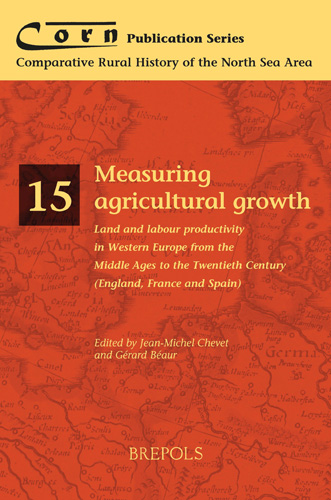 Measuring Agricultural Growth
Land and Labour Productivity in Western Europe from the Middle Ages to the Twentieth Century (England, France and Spain)
Volume 15
 Landscapes or seascapes?
The history of the coastal environment in the North Sea area reconsidered
Volume 13

 Food supply, demand and trade
Aspects of the economic relationship between town and countryside (Middle Ages - 19th century)
Volume 14




 Rural history in the North Sea area
An overview of recent research (Middle Ages - beginning twentieth century)
Volume 1
 When the Potato Failed
Causes and Effects of the Last European Subsistence Crisis, 1845-1850
Volume 9
Similar Books
 A Collaborative Tapestry in Honour of Shirley Ann Brown / Une fresque brodée en l’honneur de Shirley Ann Brown
The Bayeux Tapestry Seen by her Colleagues and Friends / La Tapisserie de Bayeux vue par ses collègues et amis



 Behind the Scenes of Medieval Roofs
An Overview of the Roofing Systems of Italian Churches
Volume 90










 European Drama and Performance Studies
Dramatisations politiques. Théâtre, politique et idéologie au XIXe siècle (1806-1914)
Volume 27


 Innovation and Medieval Communities
The Circulation of Ideas and Practices in and out of the Town (1200-1500)
Volume 63

 John Dunstaple Reading Boethius
John Dunstaple’s Annotations to Boethius’s “De institutione musica” in the Manuscript Oxford, Corpus Christi College Library, MS 118
 Linguistic and Cultural Dynamics in a Frontier Society
New Perspectives on Northeastern Bavaria and Western Bohemia in the Early Middle Ages
Volume 9


 Medieval Debates on Foreknowledge: Future Contingents, Prophecy, and Divination
Acts of the XXVII Annual Colloquium of the SIEPM, Trento 12-15 September 2023
Volume 31
 Medieval Yeghegis, Armenia
History, Archaeology, Society. Local Multiplicities and Global Connections of a Rural Centre on the Silk Road(s)
 Modernization, Crises, Cultural Revolutions
Yugoslavia’s 1960s and 1970s through the amateur film lens