
Marokkanisch-Arabisch
Ein Lehrbuch zum Selbststudium und Unterricht
By (author) Jan Hoogland Translated by Heidar Müller
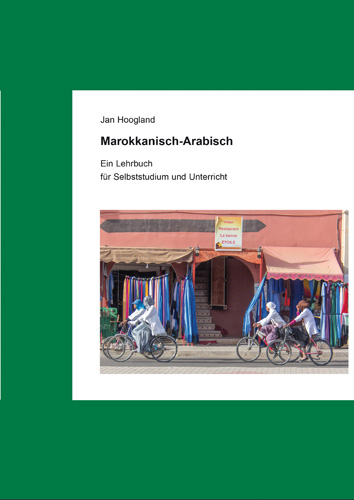
Paperback (Published)
(April 2016)
ISBN: 9783954901357
6.69 x 9.49 inches
Price: $92.00
In stock
With this text book anyone can learn to speak and understand Moroccan Arabic. No foreknowledge of Arabic is needed, just the motivation to learn the language. The course aims at practical communication skills. After finishing this course the learner will be able to have simple conversations about everyday life with speakers of Moroccan Arabic.
This book is a basic course of Moroccan Arabic. Moroccan Arabic is the language used in Morocco for every day communication, but it is understood very well in Algeria as well. With this text book anyone can learn to speak and understand Moroccan Arabic. No prior knowledge of Arabic is needed, just the motivation to learn the language. The course aims at practical communication skills. After finishing this course the learner will be able to have simple conversations about everyday life with speakers of Moroccan Arabic. All explanations are very explicit with many examples, so a teacher is not absolutely necessary. With the help of a native speaker for pronunciation and conversation, any experienced language learner should be able to reach a certain level of communicative competency without taking formal lessons in an institution. This course is based on a grammatical approach and a notional functional approach. Grammar explanations and exercises are necessary because of the big difference in the grammatical system of Arabic as a Semitic language and German as a Indo-European Germanic language. A notional functional approach leads to learning results that are practically applicable since they aim at language use in everyday life. The vocabulary presented in this course is also aiming at practical topics like food, housing, family life, work environment etc. Moroccan Arabic in this course is written in an easy to learn transliteration, so the learner does not have to invest many hours in learning the Arabic script. Given the fact that Moroccan Arabic is only a spoken language, learning the Arabic script would be a loss of time. There are pedagogical reasons for this too. These are mentioned in the book. However, the listening texts in the course are also printed in Arabic script in the last part of the book. This course contains a huge number of exercises. Almost all of these exercises have a communicational component, in addition to the grammatical or notional/functional component and for almost every exercise there is an on line available recorded sound file with all the dialogues, interactions and sentences. The course is based on the following principles: Communication is the main learning goal. No foreknowledge of Arabic is needed It is a self study course It contains many exercises sound files available on line
Jan Hoogland was born in 1957 in Rotterdam, the Netherlands. Between 1976 and 1983 he studied Arabic language and literature at Utrecht University. In 1984 he became associate professor of Arabic at Radboud University, Nijmegen, the Netherlands.<br/><br/>Between 2009 and 2015 he was director of the Netherlands Academic Institute (NIMAR) in Rabat, Morocco.<br/><br/>He has published articles on Arabic linguistics, and a dictionary of Modern Standard Arabic and Dutch (which formed the basis of the 2014 Oxford Arabic English Dictionary).<br/><br/>In 1997 he published the Dutch edition of a text book to learn Moroccan Arabic. In 2016 the German translation of this book appeared.<br/><br/>Research conducted by Jan Hoogland concentrates on the following themes: Lexicography of Arabic, Moroccan Arabic (Darija) in all its aspects, the linguistic situation of Morocco.
- By (author) Jan Hoogland
- Translated by Heidar Müller
Similar Books

 Deutsch als Fremdsprache nach Englisch an chinesischen Hochschulen
Eine empirische Forschung über Lernstrategien zum Wortschatzlernen


 Lectori vago. Manuscripts, Libraries, and Classical Scholarship from the Middle Ages to the Early Modern Period
Liber amicorum Luc Deitz
Volume 43


 Ein Schatzhaus indischer Erzählkunst –– Die Erzählliteratur der Jainas
Band 2: Ein „Lesebuch“ originalsprachlicher Texte zur jainistischen „Universalgeschichte“ samt eines Jaina-Māhārāṣṭrī-Wörterbuchs zu allen Text- und Lesestücken.
 Grimm Gotha Paris
Eine europaische Konstellation zur Zeit der Aufklarung / Une constellation europeenne au temps des Lumieres


 Conceptualisation as a Biocognitive Phenomenon and Part of the Faculty of Language
Cross-linguistic Evidence from the Preposition Category




 Language Assessment Across Cultures
From Intercultural Communicative Competence to Artificial Intelligence
 Linguistic Fragmentation and Cultural Inclusion in the Middle Ages
Translation, Plurilingualism, Multilingualism
Volume 22
 Love and the Danish Worldview
A Cognitive Ethnolinguistic Study of the Concept of Kærlighed ‘Love’ in Danish
 LSP Teaching / Fachbezogener Fremdsprachenunterricht
Practices, Innovations, Technology / Praxis, Innovation, Technologie


 Strategic Perspectives on the Reconstruction and Diachronic Interpretation of Stereotypical Theolinguistic Matrices in Religious-Popular Discourse
Insights from English, German, and Ukrainian within Indo-European and Nostratic Frameworks

 Translation – Didactics of Translation – Pedagogical Translation / Translation – Translationsdidaktik – Pädagogische Translation
Theoretical Concepts and Practical Suggestions / Theoretische Ansätze und Vorschläge für die Praxis
 Varietate delectamur
Multifarious Approaches to Synchronic and Diachronic Variation in Latin: Selected Papers from the 14th International Colloquium on Late and Vulgar Latin (Ghent, 2022)
Volume 1

 Aspektmarkierung im Mittelhochdeutschen
Untersuchungen zur prafixgesteuerten Perfektivierung und verbalen Paarigkeit

 Das Bild des Flüchtlings im Deutschen und im Polnischen
Lexikographische Erfassung und Presseberichterstattung 2016–2017
 Der spatmittelalterliche Kanzleibrief in Nurnberg
Zur Beschreibung von historischem Textmusterwissen


 Die Sprache(n) der Wissenschaft
Eine empirische Studie unter Wissenschaftlerinnen und Wissenschaftlern in Osterreich vor dem Hintergrund sprach- und kommunikationswissenschaftlicher Befunde
Volume 941

 Grammatische Kategorien und ihre Funktionen
Ein Beitrag zur Synchronie, Diachronie und Genealogie des Formensystems der deutschen Sprache

