
Luther: Katholizitat und Reform
Wurzel - Wege - Wirkungen
edited by Wolfgang Thonissen and Josef Freitag
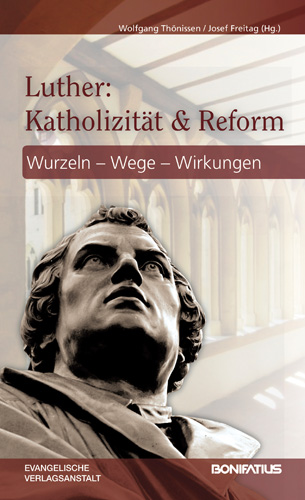
Hardback (Published)
(December 2016)
ISBN: 9783374040919
4.88 x 8.03 inches
Price: $24.00
In stock
English summary: Being a Reform Catholic Martin Luther is rooted in a permanent way in his church, the Latin Church. Shaped by the monastic tradition, Luther developed his theology in discussion with the scholastic theology of his day. It is a fact of effective history that the Wittenberg reform movement led to the establishment of an independent confessional church. That is, at the same time, the great ecumenical challenge which this book, as a fruit of the great ecumenical Luther symposium in Erfurt 2014, is willing to meet. German description: Als Reformkatholik ist Martin Luther in seiner Kirche, der lateinischen Kirche, bleibend verwurzelt. Gepragt durch die monastische Tradition, die er in seinem Orden kennen lernt, entfaltet Luther seine Theologie in Auseinandersetzung mit der scholastischen Theologie seiner Zeit. In seinem Anliegen, die reformbedurftige Kirche seiner Zeit zu erneuern, beschreitet er zugleich neue Wege. Dass sich die Wittenberger Reformbewegung zu einer eigenstandigen Konfessionskirche entwickelt, ist ein wirkungsgeschichtliches Faktum. Darin liegt aber auch die okumenische Herausforderung, der sich dieses Buch als Frucht des grossen okumenischen Luthersymposiums, das im Herbst 2014 in Erfurt stattfand, stellen will.
English summary: Being a Reform Catholic Martin Luther is rooted in a permanent way in his church, the Latin Church. Shaped by the monastic tradition, Luther developed his theology in discussion with the scholastic theology of his day. It is a fact of effective history that the Wittenberg reform movement led to the establishment of an independent confessional church. That is, at the same time, the great ecumenical challenge which this book, as a fruit of the great ecumenical Luther symposium in Erfurt 2014, is willing to meet. German description: Als Reformkatholik ist Martin Luther in seiner Kirche, der lateinischen Kirche, bleibend verwurzelt. Gepragt durch die monastische Tradition, die er in seinem Orden kennen lernt, entfaltet Luther seine Theologie in Auseinandersetzung mit der scholastischen Theologie seiner Zeit. In seinem Anliegen, die reformbedurftige Kirche seiner Zeit zu erneuern, beschreitet er zugleich neue Wege. Dass sich die Wittenberger Reformbewegung zu einer eigenstandigen Konfessionskirche entwickelt, ist ein wirkungsgeschichtliches Faktum. Darin liegt aber auch die okumenische Herausforderung, der sich dieses Buch als Frucht des grossen okumenischen Luthersymposiums, das im Herbst 2014 in Erfurt stattfand, stellen will.
- Edited by Josef Freitag
- Edited by Wolfgang Thonissen
Similar Books
 ‘For You I Study, For You I Work, For You I Live, For You I Am Ready To Even Give My Life’
Essays in Honour of Francis (Frank) J Moloney, SDB
 A Connecting Polemic in the Medieval Mediterranean
The Correspondence of Leo III and ʿUmar II
Volume 6





 Ars Prophetica
Theology in the Poetry of Twentieth-Century Hebrew Poets Avraham Halfi, Shin Shalom, Amir Gilboa, and T. Carmi
 As Messianism Turns to Heresy
The Regenstein Chair Lectures On Lurianic Kabbalah and Shabbatai Tzevi at Hebrew Union College - Cincinnati


 Creating the Woman in Antiquity
Proceedings of the 16th Melammu Workshop, Innsbruck, 2–3 June 2022
Volume 13

 Drunk the Potion, No Whit Charmed
The Doctrine of Pure and Perfect Souls from Iamblichus to Damascius






 Extracanonical Traditions and the Holy Land
Texts, Rituals, and Material Culture in Late Antique Palestine
 Fear, Fear of God, God-Fearers
Philological and Historical Perspectives on the World of Ancient Judaism and Christianity




 Legal Visuality
Exegesis, Ambiguity, and Dissimulation of the Donation of Constantine in the Early Modern Period
 Liturgia semper reformanda
Adaptations and accommodations in the liturgy in light of canon 838 of the Code of Canon Law