
L’Artémision. Tome I
L'histoire des fouilles et le temple hellénistique
By (author) J.-C. Moretti By (author) P. Fraisse By (author) C. Llinas

The main sanctuary of Artemis at Delos is associated with that of Apollo. In 1878, Th. Homolle undertook excavations there, unearthing two overlapping temples, an altar, an L-shaped portico and a collection of ancient sculptures including a number of korai. Homolle’s work was carried on by F. Courby, who understood that the ancient temple was preserved within the Hellenistic temple, and by R. Vallois, who was the first to outline the boundaries of the Artemision, and to rule out the edifice which was later identified as the Pythion. R. Vallois also discovered exceptional material that dates from between the Mycenian era and the second half of the 8th century in the Hellenistic Temple’s Pronaos. This book describes the main phases of the exploration of the Artemision, which continues today, and also contains the corpus of the literary and epigraphic testimonia related to the sanctuary, as well as a presentation of all of its components. The second part is devoted to the Hellenistic Temple. It begins with a description of the foundations and the euthynteria that remain in place, and goes on to describe the various remains that can be attributed to the elevation. The crepidoma, the toichobate, the columns, the antae, the walls, the entablature, the pediments and the roof are all presented one after the other. Their analysis forms the basis for the restitution of the monument, a hexastyle, prostyle, ionic edifice that was built in Cycladic marble. The interior of the naos was most likely decorated with engaged columns. The construction process, which took place mainly between 190 and 180 BC, was hampered by the monuments that adjoined the new temple and by the attempts, during the first phase of the construction process, to preserve the naos of the ancient temple, incorporated into the Hellenistic building. The edifice is very much in line with the Athenian ionic, prostyle, hexastyle temples and the koine Hellenistic style that emerged at the start of the 2nd century, and to a certain extent, took over from the specific style developed by the Delians that emerged at the end of the 4th and went on until the end of the 3rd century BC.
- By (author) J.-C. Moretti
- By (author) P. Fraisse
- By (author) C. Llinas
Other Titles in this Series


 Le paysage portuaire de la Délos antique
Recherches sur les installations maritimes, commerciales et urbaines du littoral délien
Volume 39
Similar Books

 Caesar’s Visions and Impact on the Roman Empire
Revisiting the Archaeological and Historical Record of the 40s BC
Volume 2


 Drunk the Potion, No Whit Charmed
The Doctrine of Pure and Perfect Souls from Iamblichus to Damascius

 Epiphanies of the Divine in the Septuagint and the New Testament
Fifth International Symposium of the Corpus Judaeo-Hellenisticum Novi Testamenti (CJHNT), 14-17 May 2015, Nottingham


 Etruscan and Roman Hellenistic Anatomical ex votos
Reassessing Popular Religious Expressions in Central Italy
Volume 8




 Invisible Labour in Antiquity
Visualizing Obscure Work in the Ancient Mediterannean and West Asia
Volume 1
 Language and Power in the Roman Empire and Early India
Hierarchy, Ambiguity, and the Art of Reading the Signs in Cosmopolitan Cultures
 Late Antique villae in the Balkans (3rd–7th c. AD): Current Research Questions and Perspectives
HAEMUS Companion to the Late Antique Balkans 1
Volume 4

 Nurturing the Elite
Representations of Drinking, Eating, and Religious Vessels in Palmyrene Funerary Iconography
Volume 13


 Portraying the Individual in the Roman East
Local–Imperial Entanglements in Sculpture, Mosaics, and Paintings (First–Fourth Centuries AD)
Volume 18

 Small Worlds and Relational Agencies: Local Societies in Early Medieval Iberia
Pequeños mundos y Agencias relacionales: Sociedades locales altomedievales en la Península Ibérica
 The Compositional History of the Book of Kings
An Analysis of the Evaluative Frameworks in 1 Kings 14–2 Kings 25

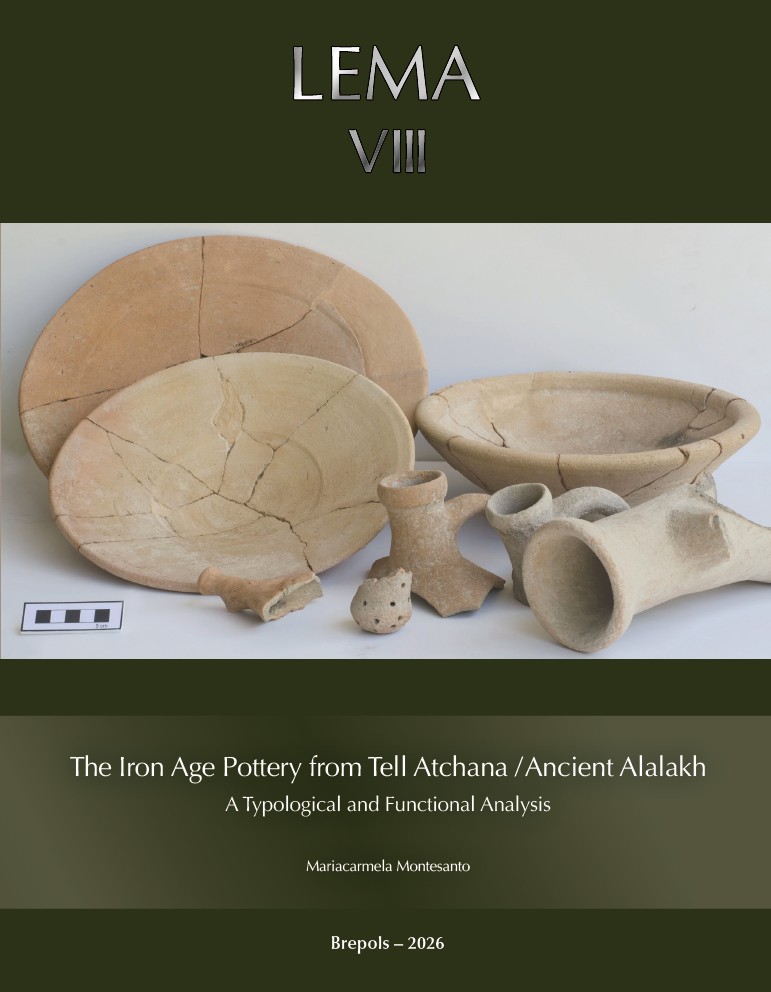 The Iron Age Pottery from Tell Atchana / Ancient Alalakh
A Typological and Functional Analysis
Volume 8


 Writing in the Church of the Nativity in Bethlehem
Inscription and Graffiti in a Multilingual and Multigraphic Perspective
Volume 45
 Contesting Labeled Identities
The Sociology of Gentilics in Biblical and Northwest Semitic Literature


 After Life in Roman Paganism. L’Égypte des astrologues. Les Mages hellénisés
Introductions historiographiques
Volume 7

 Atlante tematico di topografia antica 36-2026
Urbanistica e monumenti, porti, Roma. Ricerche sui monti Aurunci
Volume 36
 Cerámica común romana y ciclo haliéutico
Análisis de los contextos de las cetariae de Iulia Traducta


 Diodor über den ersten Sklavenaufstand auf Sizilien
Ein philologischer und historischer Kommentar
Volume 67