
Italian Foreign Policy, 1947–1951
Alcide De Gasperi and Carlo Sforza between Atlanticism and Europeanism
By (author) Giulia Prati Series edited by Dittmar Dahlmann Series edited by Christian Hacke Series edited by Klaus Hildebrand Series edited by Christian Hillgruber Series edited by Joachim Scholtyseck

Hardback (Published)
(June 2006)
ISBN: 9783899713015
6.54 x 9.49 inches
Price: $94.00
In stock
Since the birth of the Italian Republic, Italian foreign policy has been based on two main pillars: the Atlantic alliance and the process of European integration. In particular, throughout the Cold War and beyond, Atlanticism and Europeanism have concurred in producing a two-fold influence on the definition of the Italian national interest. Similarly, Italian foreign policy has been internally influenced by contending supranational and national definitions of its interest. The present study examines and delineates the foreign policy of the Italian Republic between 1947 and 1951 in terms of the changing nature and content of Italy’s national interest as defined by Prime Minister Alcide De Gasperi and Minister of Foreign Affairs Carlo Sforza. The focus is placed on their contribution to Italy’s role, relevance, and influence on the Atlantic alliance and the process of European integration.
Dr. Giulia Prati works as an academic collaborator at the chair of Prof. Christian Hacke, Institute for Political Science and Sociology of the University of Bonn.
- By (author) Giulia Prati
- Series edited by Dittmar Dahlmann
- Series edited by Christian Hacke
- Series edited by Klaus Hildebrand
- Series edited by Christian Hillgruber
- Series edited by Joachim Scholtyseck
Other Titles in this Series

 Moralische Eroberungen als Instrumente der Diplomatie
Die Informations- und Pressepolitik des Auswärtigen Amts 1902–1914
 Kriegerische Tauben
Liberale und linksliberale Interventionisten vom 19. Jahrhundert bis in die Gegenwart

 How the South was won and the nation lost
The roots and repercussions of the Republican Party’s Southernization and Evangelicalization
 Die Alexander von Humboldt-Stiftung und das Ausländerstudium in Deutschland 1925–1945
Von der »geräuschlosen Propaganda« zur Ausbildung der »geistigen Wehr« des »Neuen Europa«
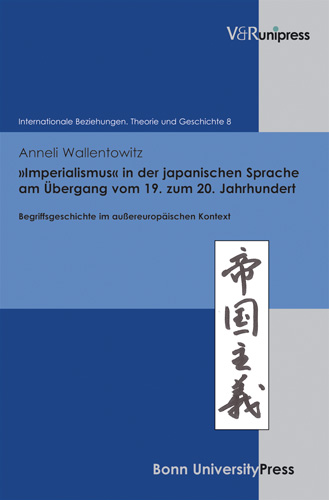 »Imperialismus« in der japanischen Sprache am Übergang vom 19. zum 20. Jahrhundert
Begriffsgeschichte im außereuropäischen Kontext


 A Brief Time to Discuss America
Der Ausbruch des Ersten Weltkrieges im Urteil amerikanischer Politiker und Intellektueller
 Personifizierte Ideologie
Zur Konstruktion, Funktion und Rezeption von Identifikationsfiguren im Nationalsozialismus und im Stalinismus
Similar Books


 Dis/United States of Vulnerability
Literary and Cultural Transgressions in U.S. Poetry Since the 1960s
Volume 330


 European Drama and Performance Studies
Dramatisations politiques. Théâtre, politique et idéologie au XIXe siècle (1806-1914)
Volume 27


 Modernization, Crises, Cultural Revolutions
Yugoslavia’s 1960s and 1970s through the amateur film lens


 Visual Memory and Oblivion
Monuments and Conflicts in Urban Spaces in Central and Eastern Europe from the Nineteenth Century to the Present Day



 “Tod durch Erschießen”
Generaloberst Nikolaus von Falkenhorst. Wehrmachtsbefehlshaber in Norwegen 1940–1945. Erinnerungen – Verhörprotokolle – Urteilssprüche
Volume 63
 “Zum Siege unserer menschenfreundlichen Prinzipien”
Ungarische Freimaurernetzwerke im „Orient“ 1886-1920


 Coburgs südöstliche Netzwerke – Coburg’s Networks in Southeastern Europe
Bulgarien, Rumänien und Ostmitteleuropa im 19. und 20. Jahrhundert. Hrsg. von Franziska Bartl und Frank-Lothar Kroll mit einem Grußwort Seiner Majestät des Königs der Bulgaren Simeon II.
Volume 39


 Dark Like You
Zur medienreflexiven Modernität der Kinder- und Jugendzeitschrift ‚The Brownies’ Book‘ (1920–1921)
Volume 191
 Das Generalgouvernement Belgien im Ersten Weltkrieg 1914-17–1918
Die Erinnerungen des Generalobersten Ludwig Freiherrn von Falkenhausen
Volume 64
 Das Werden einer Universität
Die Protokolle des Akademischen Senats der Hamburgischen Universität 1919–1921