
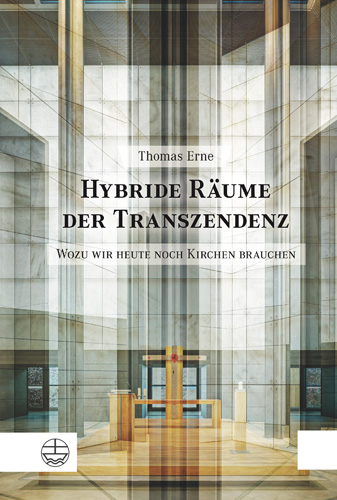
Hybride Raume der Transzendenz
Wozu wir heute noch Kirchen brauchen. Studien zu einer postsakularen Theorie des Kirchenbaus
by Thomas Erne
Paperback (Out of print)
(May 2017)
ISBN: 9783374048328
6.06 x 9.09 inches
Price: $44.00
In stock
English summary: Churches are visited frequently for their architectural impact and not only out of explicitly religious interest. They can be hybrid spaces and combine urban event culture (aesthetic transcendence) and a religious experience. Likewise, non-religious buildings of architectural interest can also support a form of spiritual contemplation, evoking or reinventing a religious effect. Both forms of reception convey a mutual need for self-transcendence, this transformation being achieved by religious and/or aesthetic means. Bringing these different ways in which spaces are perceived together, various (church) interiors and art events are referred to: Art – in its individuality, as an enhancement to a room or as a complete installation provides, by means of its exceptional appeal, the possibility to extend perception, thereby is an aesthetic experience of transcendence of oneself. German description: Kirchen sind der Ort, an dem sich sonntags eine christliche Gemeinde zum Gottesdienst versammelt. Gleichzeitig besucht jedes Jahr ein Millionenpublikum die Kirchen, um unabhangig von den Gottesdiensten einfach die besondere Atmosphare der Raume zu erleben. Die religiose Erfahrung der Transzendenz, die ein Gemeindemitglied in der Liturgie des Gottesdienstes erlebt, wird so uberlagert von den asthetischen Erfahrungen, die ein Besucher im Kirchenraum macht. Kirchen sind hybride Raume der Transzendenz. Es kann dort ein charmanter Ubergang von asthetischer zu religioser Transzendenz stattfinden. Es kann aber auch ein Grenzkonflikt entstehen, wenn sich Religion und Kunst voneinander abgrenzen. Beides, Kontinuitat und Diskontinuitat, gleitende Ubergange und harte Bruche eroffnet eine Kirche, sofern es in ihr Transzendenz im Plural gibt als Ereignis der Kunst und als Ereignis der Liturgie. Fur diese Erfahrung hybrider Formen der Transzendenz brauchen wir auch heute noch Kirchen. Das ist die Leitthese dieses Buches.
English summary: Churches are visited frequently for their architectural impact and not only out of explicitly religious interest. They can be hybrid spaces and combine urban event culture (aesthetic transcendence) and a religious experience. Likewise, non-religious buildings of architectural interest can also support a form of spiritual contemplation, evoking or reinventing a religious effect. Both forms of reception convey a mutual need for self-transcendence, this transformation being achieved by religious and/or aesthetic means. Bringing these different ways in which spaces are perceived together, various (church) interiors and art events are referred to: Art – in its individuality, as an enhancement to a room or as a complete installation provides, by means of its exceptional appeal, the possibility to extend perception, thereby is an aesthetic experience of transcendence of oneself. German description: Kirchen sind der Ort, an dem sich sonntags eine christliche Gemeinde zum Gottesdienst versammelt. Gleichzeitig besucht jedes Jahr ein Millionenpublikum die Kirchen, um unabhangig von den Gottesdiensten einfach die besondere Atmosphare der Raume zu erleben. Die religiose Erfahrung der Transzendenz, die ein Gemeindemitglied in der Liturgie des Gottesdienstes erlebt, wird so uberlagert von den asthetischen Erfahrungen, die ein Besucher im Kirchenraum macht. Kirchen sind hybride Raume der Transzendenz. Es kann dort ein charmanter Ubergang von asthetischer zu religioser Transzendenz stattfinden. Es kann aber auch ein Grenzkonflikt entstehen, wenn sich Religion und Kunst voneinander abgrenzen. Beides, Kontinuitat und Diskontinuitat, gleitende Ubergange und harte Bruche eroffnet eine Kirche, sofern es in ihr Transzendenz im Plural gibt als Ereignis der Kunst und als Ereignis der Liturgie. Fur diese Erfahrung hybrider Formen der Transzendenz brauchen wir auch heute noch Kirchen. Das ist die Leitthese dieses Buches.
- By (author) Thomas Erne
Similar Books
 ‘For You I Study, For You I Work, For You I Live, For You I Am Ready To Even Give My Life’
Essays in Honour of Francis (Frank) J Moloney, SDB
 A Collaborative Tapestry in Honour of Shirley Ann Brown / Une fresque brodée en l’honneur de Shirley Ann Brown
The Bayeux Tapestry Seen by her Colleagues and Friends / La Tapisserie de Bayeux vue par ses collègues et amis





 Ars Prophetica
Theology in the Poetry of Twentieth-Century Hebrew Poets Avraham Halfi, Shin Shalom, Amir Gilboa, and T. Carmi
 As Messianism Turns to Heresy
The Regenstein Chair Lectures On Lurianic Kabbalah and Shabbatai Tzevi at Hebrew Union College - Cincinnati

 Balthasar Caymox of Nuremberg
Early Modern German Print Publishers: Popular Prints of the Seventeenth Century

 Behind the Scenes of Medieval Roofs
An Overview of the Roofing Systems of Italian Churches
Volume 90


 Circulation, Use, Impact
The Consumption of Architectural Books in the Early Modern Eastern Adriatic
Volume 1


 Drunk the Potion, No Whit Charmed
The Doctrine of Pure and Perfect Souls from Iamblichus to Damascius





 Extracanonical Traditions and the Holy Land
Texts, Rituals, and Material Culture in Late Antique Palestine
 Fear, Fear of God, God-Fearers
Philological and Historical Perspectives on the World of Ancient Judaism and Christianity


