
Holy Beauty
Prolegomena to an Orthodox Philokalic Aesthetics
by Chrysostomos Stamoulis
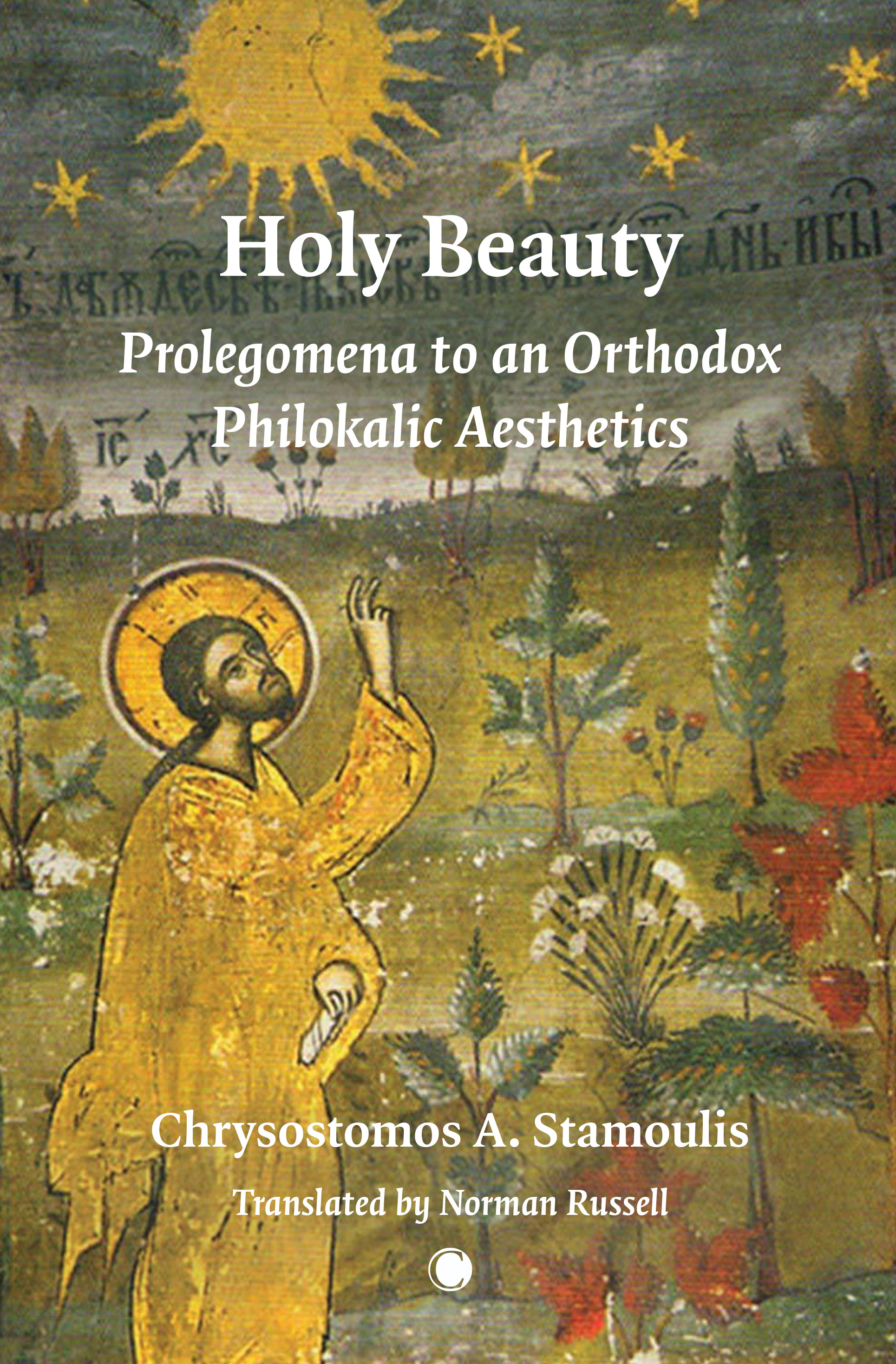
Reconciling contrasting philosophical strands to unify aesthetics and philokalia in Orthodox theology
The philosophical and theological study of aesthetics has a long and rich history, stretching back to Platos identification of ultimate goodness and beauty, together representing the eternal form. Recent trends in aesthetic theory, however, characterised by a focus on the beautiful at the expense of the good, have made it an object of suspicion in the Orthodox Church. In its place, Greek theologians have sought to emphasise philokalia as a truer theological discipline. Seeking to reverse this trend, Chrysostomos Stamoulis brings into conversation a plethora of voices, from Church fathers to contemporary poets, and from a Marxist political theorist to a literary critic. Out of this dialogue, Stamoulis builds a model for the re-appropriation of Orthodoxys patristic and Byzantine past that is no longer defined in antithesis to the Western present. The openness he proposes allows us to perceive afresh the world shot through with divinity, if only we can lift our gaze to see it. Dismantling the false dichotomy, philokalia or aesthetics, is the first step.
Translator's Introduction Author's Preface Part I. Philokalia or Aesthetics? The 'Dilemma' of Contemporary Orthodoxy 1. Kostas Zouraris: 'What We Call "Philokalia" Is Not the Same as Western Good Taste' 2. Father Alexander Schmemann: 'One Cannot Banish the Senses' 3. Nikos Matsoukas: 'Aesthetics Is a Lasting Victory over Distraction and Fragmentation' Part II. Orthodoxy's Philokalic Aesthetics: The 'Both Together' of Patristic Teaching 4. 'Supra-Substantial Good': Dionysius the Areopagite and the Church Fathers on the Holy Trinity 5. 'Where Has Your Beauty Gone?': Anthropological Notes on the Beauty Lost by the Fall 6. 'The Heavens Tell of the Glory of God': The Orthodox Doctrine of Creation and the Problem of the Environment Part III. 'Unutterable Beauty': Examples of a Philokalic Reading of Ecclesial Life 7. Nikos Gabriel Pentzikis: A Walk 'by the Seashore' and the Boundaries of the Church 8. The Elder Sophrony of Essex: The Remembrance of Death and the 'Conflict' with a Passion for Painting 9. The Elder Porphyrios, the Nightingale and the Current Debate on Aesthetics: Parallel Readings of the Elder's Discourses and Theodor W. Adorno's Aesthetic Theory Afterword: Saints and Poets Perhaps Who's Who Select Bibliography Index
Chrysostomos Stamoulis is Professor of Dogmatic and Symbolic Theology at the Aristotle University of Thessaloniki, and has lectured across Europe, Asia and the United States. He is interested in the relation of Orthodox theology to a range of contemporary issues, and his previous publications include What Business has the Fox at the Bazaar? Essays on the Dialogue of Orthodoxy with Politics, Culture and the City (2016), and Love and Death: An Essay on the Incarnation (2019). Norman Russell, an Orthodox translator and patristic scholar of partial Greek descent, is an Honorary Research Fellow of St Stephen’s House, University of Oxford, and Professor of Patrology at the Istituto Teologico ‘Santa Eufemia di Calcedonia’, Bologna. His publications include The Doctrine of Defication in the Greek Patristic Tradition (2004) and Gregory Palamas and the Making of Palamism in the Modern Age (2019).
- By (author) Chrysostomos A. Stamoulis
- Translated by Norman Russell
"An important and very engaging book that reads as a deep intellectual dialogue. Stamoulis has re-aligned the philosophical and theological debate around aesthetics with a delightfully fresh stance re-presenting Byzantine Orthodox traditions in a way that is neither obscurantist or triumphalist but energised in a presentation that shows the Christian ancients as significant heirs of Aristotle, and the moderns as acute conversational partners with Marx." Prof. John A. McGuckin, Faculty of Theology, Oxford University "Stamoulis' work is a window into an Orthodox vision of philokalic aesthetics, in which beauty is tethered to dogmatic theology. He also, however, welcomes non-Orthodox theologians to the discussion table of ancient and modern voices. They, too, may pull up a chair and glean from observations regarding a beauty which is united to truth and goodness and is revealed in the grandeur of creation." Dr Paul A. Hartog, Professor of Theology, Faith Baptist Seminary "Holy Beauty is a profound and intricate presentation of a holistic Eastern Orthodox understanding of aesthetics. Refusing false dialectics - aesthetics vs philokalia, East vs West - this study critically searches in the Fathers of the Church to rediscover a full picture of divine beauty, anchored in the goodness of creation, and presents a fascinating survey of contemporary writers and artists who exemplify how a theology of divine beauty may be expressed today. A precious gift to all." Dr Daniel Keating, Professor of Theology, Sacred Heart Major Seminary, Detroit MI
—
Similar Books
 ‘For You I Study, For You I Work, For You I Live, For You I Am Ready To Even Give My Life’
Essays in Honour of Francis (Frank) J Moloney, SDB

 A Connecting Polemic in the Medieval Mediterranean
The Correspondence of Leo III and ʿUmar II
Volume 6





 Ars Prophetica
Theology in the Poetry of Twentieth-Century Hebrew Poets Avraham Halfi, Shin Shalom, Amir Gilboa, and T. Carmi
 As Messianism Turns to Heresy
The Regenstein Chair Lectures On Lurianic Kabbalah and Shabbatai Tzevi at Hebrew Union College - Cincinnati


 Creating the Woman in Antiquity
Proceedings of the 16th Melammu Workshop, Innsbruck, 2–3 June 2022
Volume 13
 Cultic Kisses
Fruitful Encounters Between Deities and Humans. Festschrift for Angelika Berlejung on the Occasion of Her 65th Birthday
 De/colonizing Theologies
Glocal Histories, Contemporary Challenges, Theoretical Reflections
Volume 4
 Drunk the Potion, No Whit Charmed
The Doctrine of Pure and Perfect Souls from Iamblichus to Damascius




 Extracanonical Traditions and the Holy Land
Texts, Rituals, and Material Culture in Late Antique Palestine
 Fear, Fear of God, God-Fearers
Philological and Historical Perspectives on the World of Ancient Judaism and Christianity


 Gender and Iconography in Antiquity
Femininities, Masculinities, Ambiguities, and Beyond in the Ancient Levant, Near East, and Mediterranean


 Hoghe minne es deen vor dander
Essays on the Christian Mystical Tradition in Honour of Rob Faesen SJ
Volume 122

 International Comparison and Transfer in Religious Education
The Projects “RE at Schools in Europe” and “International Knowledge Transfer” in Dialogue
 Isaiah in the Fourth Gospel
Use of the Citations of Isaiah in John’s Gospel in Comparison to the Synoptics and Other Places in the New Testament