
German Jews beyond Judaism
by George L Mosse
Paperback (Out of print)
(May 1997)
ISBN: 9780878200535
Price: $16.95
On back order
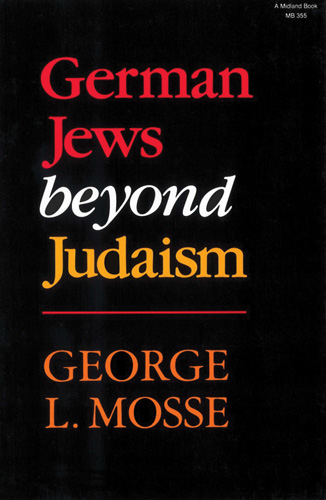
Jews were emancipated at a time when high culture was becoming an integral part of German citizenship. German Jews felt a powerful urge to integrate, to find their Jewish substance in German culture and craft an identity as both Germans and Jews. In this reprint edition, based on the 1983 Efroymson Memorial Lectures given at Hebrew Union College-Jewish Institute of Religion in Cincinnati, George Mosse argues that they did this by adopting the concept of Bildung-the idea of intellectual and moral self-cultivation-and combining it with key Enlightenment ideas such as optimism about human potential, individualism and autonomy, and a connection between knowledge and morality through aesthetics. Personal friendships could be devoted to common pursuit of Bildung and become a means of overcoming differences, becoming a means for integration into German society. Mosse traces how Jewish artists, writers, and thinkers actively sought to participate in German culture and communicate these ideals through popular culture, scholarship, and political activity. From the historical biographies, novels, and short stories of Stefan Zweig and Emil Ludwig; to the psychoanalysis of Freud, which sought to subject irrationality to reason; to the revolutionary thought of Walter Benjamin-Jews sought to influence a mass political culture that was fast drifting into irrationality. As individualism was subsumed into nationalism, and eventually the German political right’s racist version of nationalism, German-Jewish dialogue became more difficult. Jews remained idealistic as German society became less rational, their ideas corresponded less and less to the realities of German life, and they drifted out of the mainstream into an intellectual isolation. Yet out of this German-Jewish dialogue, what had once been part of German culture became a central Jewish heritage. The ideal of cultivating a personal identity beyond religion and nationality, the liberal outlook on society and politics, and the desire to transcend history by stressing what united rather than divided individuals and nations infiltrated Jewish life became an inspiration for many men and women searching to humanize their society and their own lives. Mosse’s lectures trace the emergence of a form of Jewishness which resisted cultural ghettoization in favor of the pursuit of that which is universally human.
- By (author) George L Mosse
Similar Books


 Ars Prophetica
Theology in the Poetry of Twentieth-Century Hebrew Poets Avraham Halfi, Shin Shalom, Amir Gilboa, and T. Carmi
 As Messianism Turns to Heresy
The Regenstein Chair Lectures On Lurianic Kabbalah and Shabbatai Tzevi at Hebrew Union College - Cincinnati
 Balthasar Caymox of Nuremberg
Early Modern German Print Publishers: Popular Prints of the Seventeenth Century


 Constitutional Conflict as Judicial Civil Disobedience and Conscientious Objection
Reconceptualising National Constitutional Court Rulings in the European Union Legal Space


 Extracanonical Traditions and the Holy Land
Texts, Rituals, and Material Culture in Late Antique Palestine
 Formulary apportionment in international tax law
An allocation method for the age of globalization and digitalization
Volume 210


 Hofmann oder Vorkämpfer der „philosophes“?
Deutsche Voltaire-Bildnisse und -Imaginationen im Zeitalter der Aufklärung

 Legal Unification through Case Law?
Supreme Courts and the Emergence of Uniform Law in the Modern Era
Volume 242

 Lobbying for Equality
Jacques Godard and the Struggle for Jewish Equality during the French Revolution


 The Biblical Tale of Judah and Tamar in Fourteenth-Century Iran
A Judeo-Persian Versified Account by Shāhīn with Scholarly Edition, Annotated Translation and Persian Transliteration
Volume 94, 951


 The Documentation of Historical Facts in Trial Judgments of the International Criminal Court
A Constitutional Theory of International Criminal Proceedings
Volume 66


 The Therapeutae as the Best Paradigm for the Contemplative Life
A Contextual Reading of Philo of Alexandria's De Vita Contemplativa

