
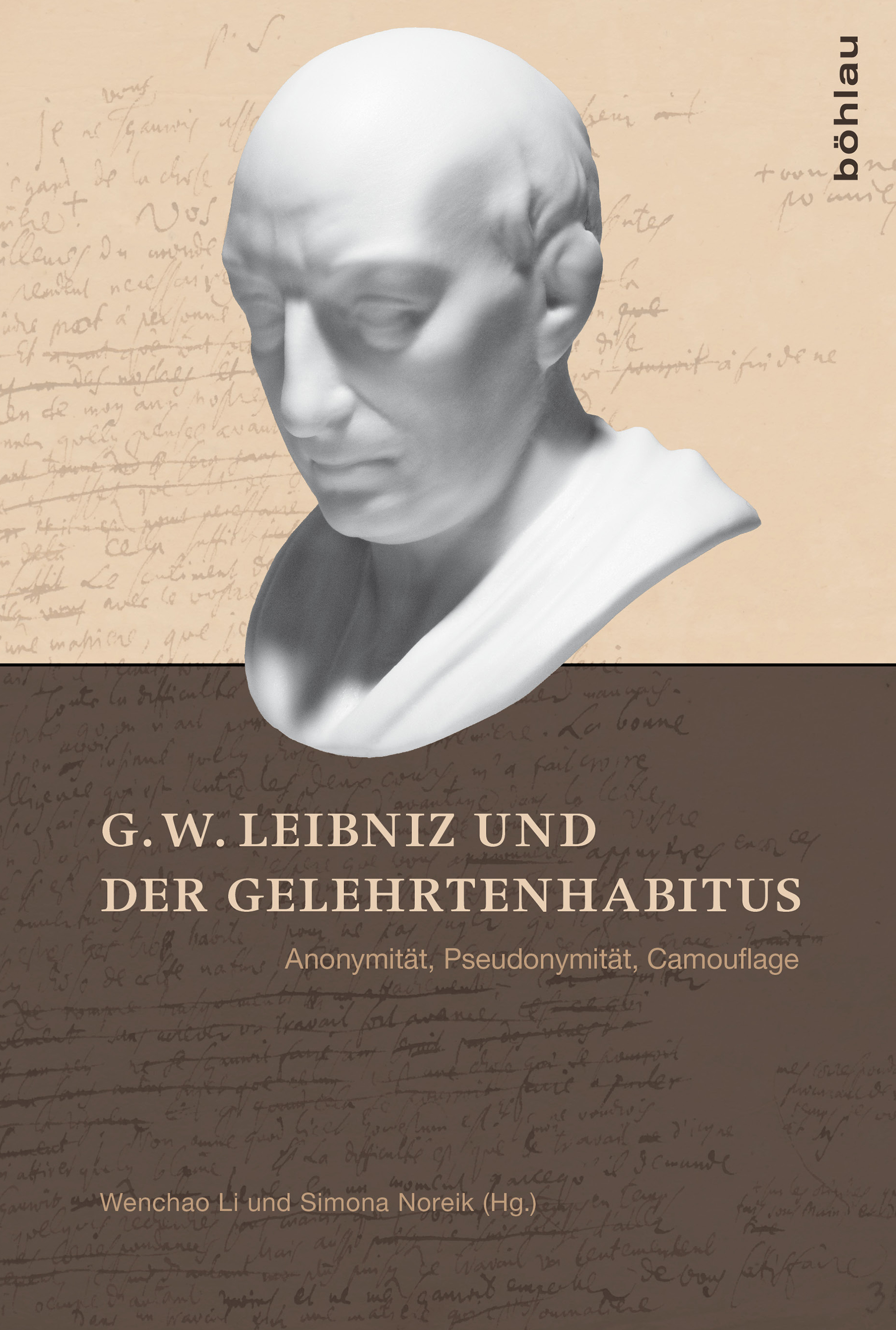
G. W. Leibniz und der Gelehrtenhabitus
Anonymität, Pseudonymität, Camouflage
Contributions by Volker Barth Contributions by Philip Beeley Contributions by Marian Füssel Contributions by Nora Gaedeke Contributions by Sebastian Kühn Contributions by Margherita Palumbo Contributions by Roberto Palaia Contributions by Jörg Paulus Contributions by Sabine Sellschopp Contributions by Charlotte Wahl Contributions by Stephan Waldhoff Edited by Wenchao Li Edited by Simona Noreik
Paperback (Published)
(July 2016)
ISBN: 9783412503758
6.1 x 9.09 inches
Price: $69.00
On back order
“Lithuanus”, “Caesarinus Furstenerius” und “de la Vallee” sind nur drei der Pseudonyme, unter denen Gottfried Wilhelm Leibniz reiste, korrespondierte und selbst politisch brisante Schriften publizierte. Dass es sich nicht um eine speziell Leibnizsche Praktik der Maskierung, sondern vielmehr um ein zentrales Muster des gelehrten Habitus um 1700 handelt, thematisieren die Beitrage dieses Sammelbandes. Sie rucken dabei die Kultur der Dissimulation, wie sie etwa in Deutschland, Grossbritannien oder Italien gepflegt wurde, ins Zentrum ihrer Betrachtung. Der thematische Bogen spannt sich dabei von Dechiffrierungstechniken uber Selbstrezensionen bis hin zu burokratischen Praktiken den Briefwechsel Leibniz’ betreffend.
“Lithuanus”, “Caesarinus Furstenerius” und “de la Vallee” sind nur drei der Pseudonyme, unter denen Gottfried Wilhelm Leibniz reiste, korrespondierte und selbst politisch brisante Schriften publizierte. Dass es sich nicht um eine speziell Leibnizsche Praktik der Maskierung, sondern vielmehr um ein zentrales Muster des gelehrten Habitus um 1700 handelt, thematisieren die Beitrage dieses Sammelbandes. Sie rucken dabei die Kultur der Dissimulation, wie sie etwa in Deutschland, Grossbritannien oder Italien gepflegt wurde, ins Zentrum ihrer Betrachtung. Der thematische Bogen spannt sich dabei von Dechiffrierungstechniken uber Selbstrezensionen bis hin zu burokratischen Praktiken den Briefwechsel Leibniz’ betreffend.
- Contributions by Volker Barth
- Contributions by Philip Beeley
- Contributions by Marian Füssel
- Contributions by Nora Gaedeke
- Contributions by Sebastian Kühn
- Contributions by Margherita Palumbo
- Contributions by Roberto Palaia
- Contributions by Jörg Paulus
- Contributions by Sabine Sellschopp
- Contributions by Charlotte Wahl
- Contributions by Stephan Waldhoff
- Edited by Wenchao Li
- Edited by Simona Noreik
Similar Books


 As Messianism Turns to Heresy
The Regenstein Chair Lectures On Lurianic Kabbalah and Shabbatai Tzevi at Hebrew Union College - Cincinnati
 Balthasar Caymox of Nuremberg
Early Modern German Print Publishers: Popular Prints of the Seventeenth Century
 Beyond Sovereign Courts
Agents and Practices in Early Modern Spanish and Habsburg Diplomacy
Volume 3



 Circulation, Use, Impact
The Consumption of Architectural Books in the Early Modern Eastern Adriatic
Volume 1

 Councils, Conflicts, Correspondence
Urban Diplomacy in Reval (Tallinn) and Lübeck (c. 1470–1570)
Volume 67


 European Drama and Performance Studies
Dramatisations politiques. Théâtre, politique et idéologie au XIXe siècle (1806-1914)
Volume 27
 Food Security under Armed Conflict
Global Knowledge Landscape and Public Attention to Social, Economic, and Humanitarian Dimensions


 Innovationes Lovanienses: Arts, Law and Theology at the University of Louvain (1425–1797)
Studium Lovaniense: Learning across Borders, 2
Volume 18


 Legal Visuality
Exegesis, Ambiguity, and Dissimulation of the Donation of Constantine in the Early Modern Period


 Modernization, Crises, Cultural Revolutions
Yugoslavia’s 1960s and 1970s through the amateur film lens
 Myths and Tales of the Inughuit
Erik Holtved's Polar Eskimo Texts Revised and Re-translated into Danish and English
Volume 475, 12

 Naples as Laboratory / Laboratorium Neapel
Style Options, Artistic Rivalry and Self Fashioning in Neapolitan Baroque Painting / Plurale Stilbildung, Kunstlerkonkurrenz und Self Fashioning in der neapolitanischen Barockmalerei


