
E mache tou Marathona
istorike kai topographike prosengise
by Christos Dionysopoulous
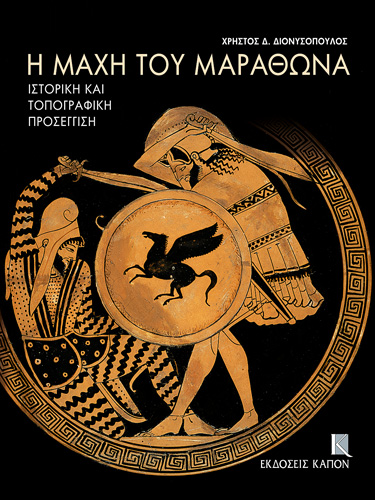
Historian Christos Dionysopoulos goes head-to-head with 669 authors and 913 articles and books, emerging triumphant with a detailed study casting new-light on this historic battle fought in 490BC. 112 colour illustrations. Greek language text.
Researchers’ interest in Marathon remains undiminished. From the seventeenth century to the present day, numerous distinguished scholars have been involved with the problems this important chapter in the history of mankind presents and have proposed solutions to them. But these proposals are frequently contradictory, because the ancient texts on which they are based leave a wide leeway for theorizing and speculation. Herodotus, who is the principal and most reliable source for research, gives a summary picture of the events and is reticent on certain fundamental details concerning the Battle of Marathon. In order to fill the gaps and shortcomings of the Herodotan narrative, scholars have relied on secondary sources. However, instead of these being used supplementarily, they have led some to arbitrary conclusions and transformed them into creators of imaginary scenarios, since their theories are in complete opposition to the primary source as well as, sometimes, to commonsense. In Herodotus, as in the other sources too, there are some words or phrases that, through erroneous evaluation, may lead us astray, and others that, on first glance, tell us nothing. However, on careful scrutiny we ascertain that their silence is apparent and that they conceal within them truths which are revealed to us, in some cases indeed in stentorian voice. In this book the author exposits the various theories that have been formulated, he studies the difficulties the issues present and proposes his own view, having as guideline, as far as the textual testimonies are concerned, mainly He evaluates and utilizes the secondary sources according to their credibility, to the degree that they are consistent with the Herodotan narrative and do not come into conflict with this.
- By (author) Christos D. Dionysopoulos
Similar Books

 Caesar’s Visions and Impact on the Roman Empire
Revisiting the Archaeological and Historical Record of the 40s BC
Volume 2


 Drunk the Potion, No Whit Charmed
The Doctrine of Pure and Perfect Souls from Iamblichus to Damascius

 Epiphanies of the Divine in the Septuagint and the New Testament
Fifth International Symposium of the Corpus Judaeo-Hellenisticum Novi Testamenti (CJHNT), 14-17 May 2015, Nottingham


 Etruscan and Roman Hellenistic Anatomical ex votos
Reassessing Popular Religious Expressions in Central Italy
Volume 8




 Invisible Labour in Antiquity
Visualizing Obscure Work in the Ancient Mediterannean and West Asia
Volume 1
 Language and Power in the Roman Empire and Early India
Hierarchy, Ambiguity, and the Art of Reading the Signs in Cosmopolitan Cultures
 Late Antique villae in the Balkans (3rd–7th c. AD): Current Research Questions and Perspectives
HAEMUS Companion to the Late Antique Balkans 1
Volume 4

 Nurturing the Elite
Representations of Drinking, Eating, and Religious Vessels in Palmyrene Funerary Iconography
Volume 13


 Portraying the Individual in the Roman East
Local–Imperial Entanglements in Sculpture, Mosaics, and Paintings (First–Fourth Centuries AD)
Volume 18

 Small Worlds and Relational Agencies: Local Societies in Early Medieval Iberia
Pequeños mundos y Agencias relacionales: Sociedades locales altomedievales en la Península Ibérica
 The Compositional History of the Book of Kings
An Analysis of the Evaluative Frameworks in 1 Kings 14–2 Kings 25

 The Iron Age Pottery from Tell Atchana / Ancient Alalakh
A Typological and Functional Analysis
Volume 8



 Writing in the Church of the Nativity in Bethlehem
Inscription and Graffiti in a Multilingual and Multigraphic Perspective
Volume 45
 Contesting Labeled Identities
The Sociology of Gentilics in Biblical and Northwest Semitic Literature


 After Life in Roman Paganism. L’Égypte des astrologues. Les Mages hellénisés
Introductions historiographiques
Volume 7

 Atlante tematico di topografia antica 36-2026
Urbanistica e monumenti, porti, Roma. Ricerche sui monti Aurunci
Volume 36
 Cerámica común romana y ciclo haliéutico
Análisis de los contextos de las cetariae de Iulia Traducta


 Diodor über den ersten Sklavenaufstand auf Sizilien
Ein philologischer und historischer Kommentar
Volume 67