
Die liturgischen Orte im Wandel der Zeit
Taufe – Beichte – Abendmahl – Predigt
By (author) Reiner Sörries
Paperback (Published)
(August 2021)
ISBN: 9783954904532
6.69 x 9.45 inches
Price: $74.00
In stock
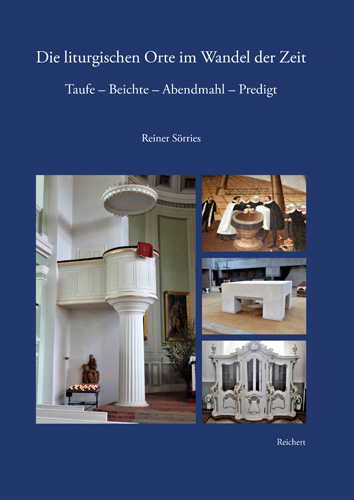
From antiquity to the present, the theological and art-historical development of the places where the sacraments of baptism, confession and the Lord’s Supper are administered and the sermon is presented on 300 pages and with over three hundred images. The archaeological and arthistorical highlights are used as examples, but also simple, folk designs are used. The book is aimed at readers who are interested in an overview, be they clergy, because they work in these places or because they will work in them as students, be they church visitors who, for their part, want to put what they in history see and marvel often enough.
English summary: The development of the liturgical places in the church is told across time and denominations on 300 pages and with over three hundred pictures. Altar, pulpit, baptismal font and confessional are visible expressions of the Lord’s Supper, sermon, baptism and confession. In the Protestant Church they are referred to as the four means of grace, in the Catholic Church there are four of the seven sacraments. If one looks at the liturgical places from antiquity to the present, they are not only subject to a formal change, but they also reflect the changes in the actions performed on them due to the history of theology. Among the objects cited as examples, many are named that have also found their way into art history, but also those that have not aroused the interest of art historians in simple village and country churches. But wherever they are to be found, they are testimonies of preaching and faith that have become form and image, sometimes highly complex, sometimes simple and popular. While examples in the area of the Roman Empire are used for the early Christian development, the selection concentrates on Central Europe and the German-speaking area as time progresses. In this sense, the book is aimed at readers who are interested in an overview, be they clergy, because they work in these places or because they will work in them as students, be they church visitors who, for their part, want to be part of history what they see and marvel at often enough. It is at the same time a contribution to the iconography of Protestant and Catholic statements of faith, because the liturgical places themselves explain in words and pictures the faith that is proclaimed and carried out in them. At the same time, they give an insight into the execution of the liturgy in their respective time with contemporary images. German description: Zeit- und konfessionsubergreifend wird die Entwicklung der liturgischen Orte im Kirchenraum auf 300 Seiten und mit uber dreihundert Bildern erzahlt. Altar, Kanzel, Taufstein und Beichtstuhl sind sichtbarer Ausdruck von Abendmahl, Predigt, Taufe und Beichte. Sie werden in der evangelischen Kirche als die vier Gnadenmittel bezeichnet, in der katholischen Kirche sind es vier der sieben Sakramente. Betrachtet man die liturgischen Orte von der Antike bis zur Gegenwart, so sind sie nicht nur einem formalen Wandel unterworfen, sondern sie spiegeln auch die theologiegeschichtlich bedingten Veranderungen der an ihnen vollzogenen Handlungen. Unter den exemplarisch angefuhrten Objekten werden viele genannt, die auch Eingang in die Kunstgeschichte gefunden haben, genauso aber solche, die in einfachen Dorf- und Landkirchen das Interesse der Kunsthistoriker nicht geweckt haben. Aber wo sie auch immer zu finden sind, sind sie form- und bildgewordene Zeugnisse von Verkundigung und Glaube, manchmal hoch komplex, manchmal schlicht und volkstumlich. Wahrend fur die fruhchristliche Entwicklung Beispiele im Gebiet des Romischen Reiches herangezogen werden, so konzentriert sich die Auswahl mit fortschreitender Zeit auf Mitteleuropa und den deutschsprachigen Raum. In diesem Sinn wendet sich das Buch an Leserinnen und Leser, denen an einem Uberblick gelegen ist, seien sie Geistliche, weil sie an diesen Orten agieren oder weil sie als Studierende an ihnen agieren werden, seien sie Kirchenbesucher, die ihrerseits in die Geschichte einordnen wollen, was sie sehen und oft genug bestaunen. Es ist zugleich ein Beitrag zur Ikonographie evangelischer und katholischer Glaubensaussagen, denn die liturgischen Orte erlautern selbst in Wort und Bild den an ihnen verkundeten und vollzogenen Glauben. Zugleich geben sie mit zeitgenossischen Bildern Einblick in den Vollzug der Liturgie in ihrer jeweiligen Zeit.
- By (author) Reiner Sörries
„[…] Das Buch empfiehlt sich nicht nur mit Blick auf den protestantischen Kirchenraum, sondern auch auf den katholischen. Denn die Darstellung nimmt die vor- wie nachreformatorischen Entwicklungen auf und zeigt Beziehungen sowie gegenseitige Bedingungen konfessioneller Prägungen auf. […] Besonders beachtenswert sind die Kapitel zu Beichtorten und Kanzeln, die eine hilfreiche Übersicht bieten. Mit vier kleineren Kapiteln schtießt das Buch<br/>und befragt die liturgischen Orten nach ihrem Bezug zur Gemeinde, weist ikonographische Gesetzmäßigkeiten<br/>aul blickt auf liturgisches Handeln außerhatb des Kirchenraums und stettt die Frage, wieweit die ,,Heitigkeit<br/>der Gnadenmittel" durch die liturgischen Orte verdeutlicht wird. lm Anhang finden sich Anmerkungen,<br/>ein kapitelweise gegliedertes Verzeichnis wichtiger Literatur sowie der Bitdnachweis mit lnternetlinks. ,,Den<br/>Often der Spendung der Gnadenmittel eine neue Aufmerksamkeit zu schenken" (S. foo), diesen Wunsch<br/>erlütlt Sörries Buch für mich ohne Zweifel.“<br/><br/>Von Christoph Schmitt<br/>In: Kirchenpädagogik, Ausgabe 22, S. 57
—
Similar Books
 ‘For You I Study, For You I Work, For You I Live, For You I Am Ready To Even Give My Life’
Essays in Honour of Francis (Frank) J Moloney, SDB





 Ars Prophetica
Theology in the Poetry of Twentieth-Century Hebrew Poets Avraham Halfi, Shin Shalom, Amir Gilboa, and T. Carmi
 As Messianism Turns to Heresy
The Regenstein Chair Lectures On Lurianic Kabbalah and Shabbatai Tzevi at Hebrew Union College - Cincinnati

 Behind the Scenes of Medieval Roofs
An Overview of the Roofing Systems of Italian Churches
Volume 90


 Circulation, Use, Impact
The Consumption of Architectural Books in the Early Modern Eastern Adriatic
Volume 1


 Drunk the Potion, No Whit Charmed
The Doctrine of Pure and Perfect Souls from Iamblichus to Damascius





 Extracanonical Traditions and the Holy Land
Texts, Rituals, and Material Culture in Late Antique Palestine
 Fear, Fear of God, God-Fearers
Philological and Historical Perspectives on the World of Ancient Judaism and Christianity



 Late Antique villae in the Balkans (3rd–7th c. AD): Current Research Questions and Perspectives
HAEMUS Companion to the Late Antique Balkans 1
Volume 4