
Die Grenzorganisation der spatantiken Kyrenaika
Studien zu den Militarreformen unter Anastasius I. (491-518 n. Chr.)
by Christian Barthel
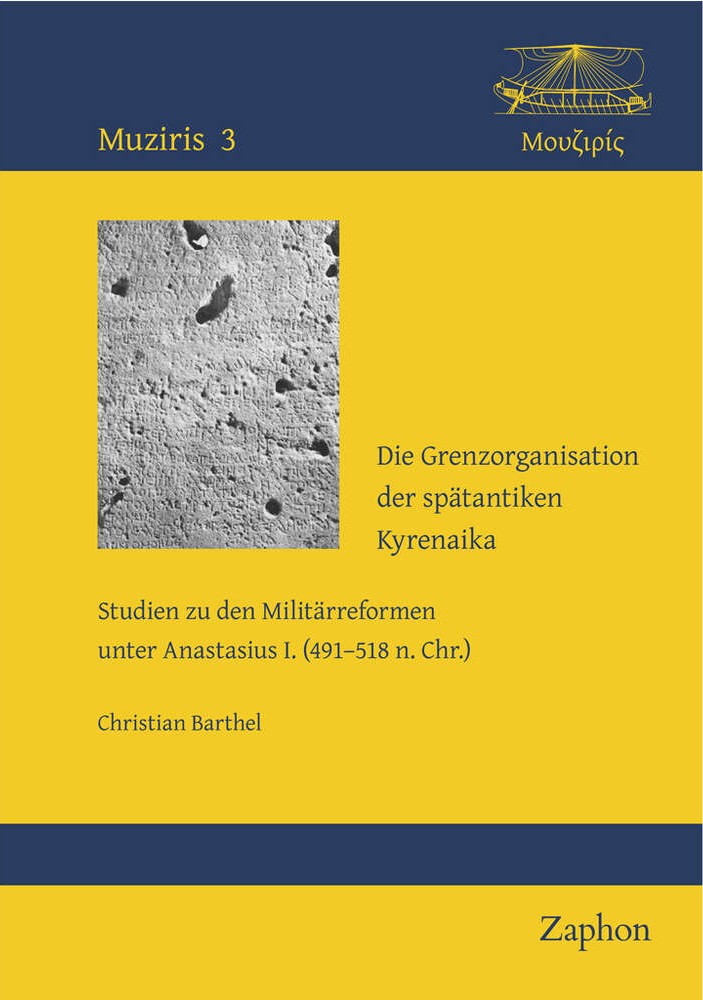
The focus of the study is the historical evaluation of a legal text comprising 14 provisions from the reign of Anastasius I (491-518 AD). This law, known in research under the title de rebus Libycis or de rebus Libyae Pentapolis denuo constituendis, was immortalized on stone and discovered in several cities in Cyrenaica, the eastern part of modern Libya. This region was located on the southwestern edge of the (Eastern) Roman Empire and was therefore viewed as a border area. One of the most important innovations of the late Roman period was the organization of such a border area in a ducat, which was placed under the authority of an official known as dux limitis. In this context, Anastasius’ provisions offer an excellent insight into an act of political communication between the imperial headquarters, its subordinate administrative bodies and the periphery of the area of rule in the form of the ducal administrative district. The aim of this study is to use a systematic analysis of the law to examine the organizational structures of the Libyan ducat, which were shaped by military requirements. The inscription preserved in Cyrenaica is an imperial constitution and thus a Roman state document. In recent decades, epigraphic research has adopted a fruitful approach of examining such documents and texts in isolation from their location, the public they are directly addressed to, the material used by the inscription bearer and, in individual cases, even the monument that adorned the respective inscription. Anastasius’ Libyan military decree was previously dated to 501 AD. However, this was based on an incorrect reading of the imperial title. As part of the investigation, the year 492 AD was determined as the new terminus post quem. Due to this new dating, it was possible to link the emperor’s regulations in the Pentapolis with the demand of the capital’s population for greater attention to the military interests of the empire, as recorded in the protocol of his accession to the throne. Anastasius complied with this demand in his comprehensive reform of the military. As the Libyan inscriptions now show in detail, this reform can be divided into two parts: In the first part, primarily empire-wide standards were established, reinforced and fine-tuned. In the second part, however, the special regulations for the respective area of application were laid down. It is these regulations that constituted the reform of the ducats. Building on the observations made in Cyrenaica, the other border areas of the Eastern Roman Empire were then examined. It became clear that another important component of the reforms was the expansion of the military infrastructure.
- By (author) Christian Barthel
Other Titles in this Series
 Trade and Seafaring in Antiquity
Red Sea - Persian Gulf - Indian Ocean. Proceedings of the 1st Muziris Workshop, Trier, 28th May 2021
Volume 1
 Ehre und Inklusion
Versorgungsleistungen, Solidaritat und Euergetismus im privaten Kultvereinswesen des hellenistischen Athen
Volume 4
Similar Books


 Caesar’s Visions and Impact on the Roman Empire
Revisiting the Archaeological and Historical Record of the 40s BC
Volume 2

 Construction Processes in Historical Western Societies (5th c. BC – 10th c. AD)
Case Studies on Techniques, Models, and Costs
 East Meets West: Justice, Law, and Politics
The 13th Kobe Lecture and the 2nd IVR Japan International Conference, Chiba, September 2023


 Etruscan and Roman Hellenistic Anatomical ex votos
Reassessing Popular Religious Expressions in Central Italy
Volume 8
 False Friends in Comparative Law
Advantages and Risks of Legal Transplants in Civil Law – the Polish-German Perspective




 Invisible Labour in Antiquity
Visualizing Obscure Work in the Ancient Mediterannean and West Asia
Volume 1

 Late Antique villae in the Balkans (3rd–7th c. AD): Current Research Questions and Perspectives
HAEMUS Companion to the Late Antique Balkans 1
Volume 4
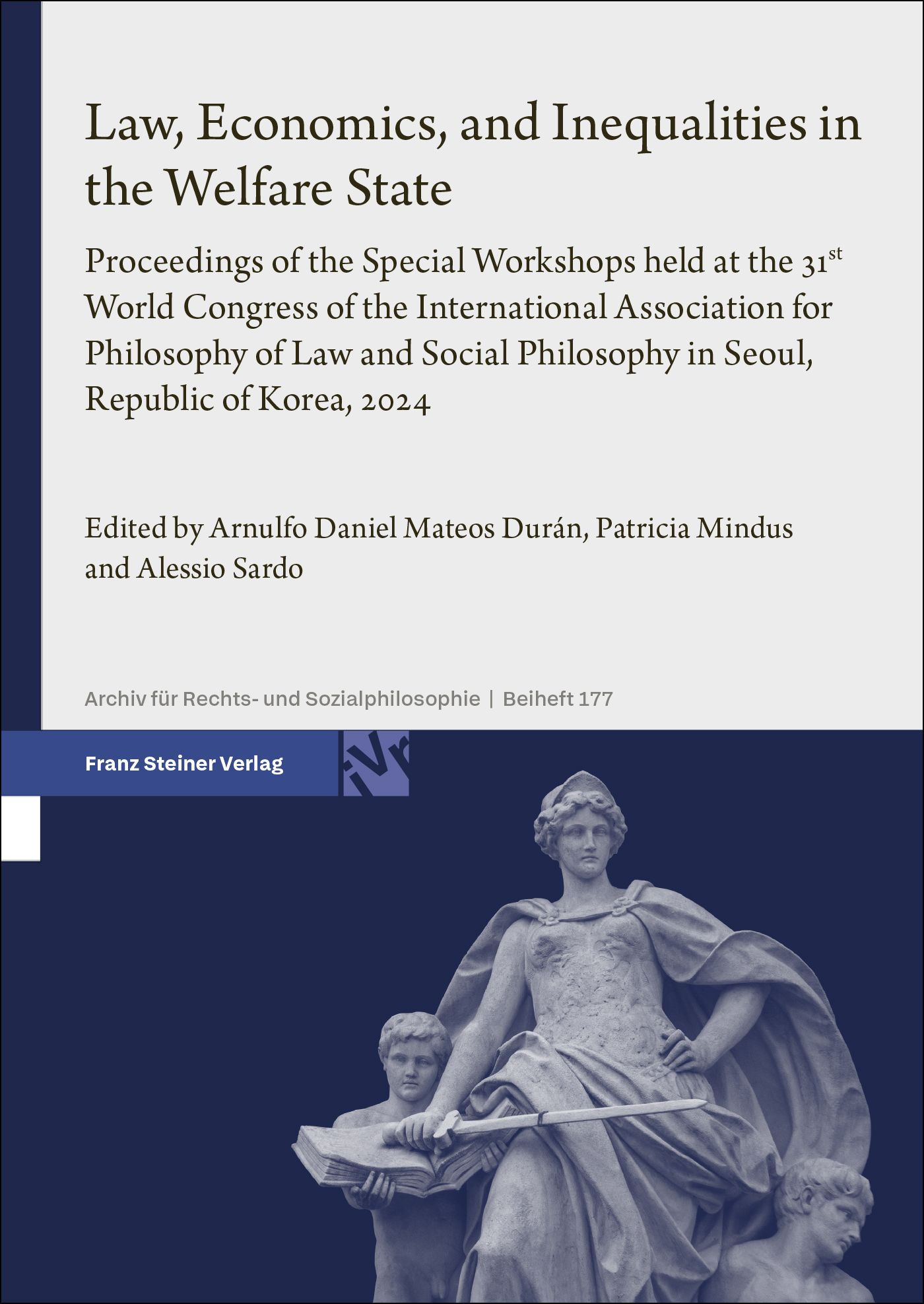 Law, Economics, and Inequalities in the Welfare State
Proceedings of the Special Workshops held at the 31st World Congress of the International Association for Philosophy of Law and Social Philosophy in Seoul, Republic of Korea, 2024
 Legal Pluralism and the Tajik Experience of Xinjiang
Between Custom and the Chinese State: An Ethnographic Perspective
 Liturgia semper reformanda
Adaptations and accommodations in the liturgy in light of canon 838 of the Code of Canon Law





 Portraying the Individual in the Roman East
Local–Imperial Entanglements in Sculpture, Mosaics, and Paintings (First–Fourth Centuries AD)
Volume 18


 Roman Copies, Collecting, and Culture in the Bay of Naples and Beyond
Papers in Honor of Eugene J. Dwyer
 Small Worlds and Relational Agencies: Local Societies in Early Medieval Iberia
Pequeños mundos y Agencias relacionales: Sociedades locales altomedievales en la Península Ibérica
 SOMA 2023: Proceedings of the 24th Symposium on Mediterranean Archaeology
Ideas that Travelled by the Sea, Udine, 2-4 February, 2023


 The EPPO/OLAF Compendium of National Procedures: Estonia
Desktop codes on the procedural law of the Member States with annotations by national experts
 The EPPO/OLAF Compendium of National Procedures: Greece
Desktop codes on the procedural law of the Member States with annotations by national experts