
Corpus Vasorum Antiquorum Osterreich. Graz, Originalsammlung des Instituts fur Archaologie der Karl-Franzens-Universitat, Band 1
adapted by Maria Christidis, Stephan Karl, Gabriele Koiner and Gerda Schwarz

English summary: The first volume of the Corpus Vasorum Antiquorum- Graz contains a total of 93 objects, which originated from workshops in the region of the Greek east and Cyprus as well as the Greek mainland and southern Italy. The pieces, which for the most part are presented here for the first time in a scholarly fashion, span not only regional boundaries but also periods of time, and offer a broad spectrum of various types of ancient ceramics. The vases presented in this work are part of the original collection of the Archeological Institute of the Karl-Franzens-University in Graz, which has operated as a collection for scholarly study since 1865. This volume presents nearly wholly-intact vessels from Bronze Age Cyprus (c.2000 BCE), which are presented for the first time, with the exception of a beak-spouted jug that appeared in the fundamental work The Middle Cypriote Bronze Age (The Swedish Cyprus Expedition IV 1 b, Lund 1972.) Among the geometrically decorated vessels, some are particularly noteworthy as they are derived from the Kerameikos of Athens. In particular, among these specimens is a fragment from workshop of the Dipylon Master, which matches fragments in Gottingen and Athens and which leads to further considerations regarding the affiliation of Dipylon vessels. Among the Corinthian ceramics, two alabastra (or small vessels) from the luxury group are presented here, which are notable not only for their ornamental painting but also for their origin in the princely tomb of the Fourteen Bridges in Capua. The most prominent form of decoration, though, is doubtless the Attic red-figure style from the 5th century, whose progression is documented through a hydria (a water-carrying vessel) of a Berlin painter, three amphorae from Nola, Italy and a series of kylixes (drinking vessels). Attic lusterware as well as Boeotic and Etruscan products are also presented in this volume as well as southern Italian vases from Apulian, Campanian, Sicilian, and Lucanian workshops. Of particular importance among this group, on the basis of its frieze-like, narrative representation, but also because of the high quality of its decoration, is a lid to a pyxis from Campania. Even a collection like that of the Institute in Graz, which was assembled less for its aesthetic highlights and more for academic purposes, is able to give insight into the various enigmas, which as engagement with ancient ceramics still offers us. German description: Der erste Band des CVA Graz enthalt insgesamt 93 Objekte, die von Werkstatten im Raum griechischer Osten uber Zypern und griechisches Mutterland bis Unteritalien stammen. Die Werkstucke, die der Fachwelt zu einem grossen Teil erstmals vorgestellt werden, spannen aber nicht nur raumlich, sondern auch zeitlich einen grossen Bogen und bieten ein breites Spektrum unterschiedlichster Gattungen antiker Keramik. Die prasentierten Vasen sind Teil der Originalsammlung des Instituts fur Archaologie der Karl-Franzens-Universitat Graz, die aus einer bereits 1865 ins Leben gerufenen Lehrsammlung hervorgegangen ist.Der Band legt sechs fast komplett erhaltene Gefasse der zyprischen Bronzezeit des 2. Jahrtausends v. Chr. vor, die mit Ausnahme einer Schnabelkanne, welche bereits in dem Grundlagenwerk “The Middle Cypriote Bronze Age” (The Swedish Cyprus Expedition IV 1 b, Lund 1972) aufscheint, erstmals gezeigt werden.Unter den geometrischen Gefassen sind besonders Objekte hervorzuheben, die aus dem Kerameikos von Athen stammen, darunter ein Fragment der Dipylon-Werkstatt, das an Fragmente in Gottingen und Athen anpasst und zu weiteren Uberlegungen bezuglich Zusammengehorigkeiten von Dipylon-Gefassen fuhrt. Bei der korinthischen Keramik treten zwei Alabastra der Luxus-Gruppe hervor, die nicht nur aufgrund ihrer Bemalung auffallen, sondern auch aufgrund ihrer Herkunft aus der Tomba principesca dei Quattordici Ponti bei Capua.Am prominentesten vertreten ist zweifellos der attisch-rotfigurige Stil des 5. Jahrhunderts, dessen Entwicklung durch eine Hydria des Berliner Malers, drei nolanische Amphoren sowie eine Reihe von Kylikes dokumentiert wird. Attische Glanzton-Ware sowie bootische und etruskische Erzeugnisse sind ebenso prasent wie unteritalische Vasen aus apulischen, kampanischen, sizilischen und lukanisch-apulischen Werkstatten. Von besonderer Bedeutung ist – aufgrund seiner friesartigen, narrativen Darstellung, aber auch wegen der hohen Qualitat der Bemalung – ein kampanischer Pyxis-Deckel.Gerade eine Sammlung wie die des Grazer Instituts, die weniger nach asthetischen Gesichtspunkten als vielmehr zu didaktischen Zwecken zusammengestellt wurde, vermag Einblick zu geben in die vielfaltigen Ratsel, die die Beschaftigung mit antiker Keramik noch fur uns bewahrt hat.
- Adapted by Maria Christidis
- Adapted by Stephan Karl
- Adapted by Gabriele Koiner
- Adapted by Gerda Schwarz
Other Titles in this Series


 Corpus Vasorum Antiquorum – Osterreich – Innsbruck, Sammlungen der Universitat Innsbruck und Tiroler Landesmuseum Ferdinandeum – Band 1
Attisch Rotfigurige Keramik
Volume 8
Similar Books


 Caesar’s Visions and Impact on the Roman Empire
Revisiting the Archaeological and Historical Record of the 40s BC
Volume 2

 Construction Processes in Historical Western Societies (5th c. BC – 10th c. AD)
Case Studies on Techniques, Models, and Costs


 Etruscan and Roman Hellenistic Anatomical ex votos
Reassessing Popular Religious Expressions in Central Italy
Volume 8




 Invisible Labour in Antiquity
Visualizing Obscure Work in the Ancient Mediterannean and West Asia
Volume 1

 Late Antique villae in the Balkans (3rd–7th c. AD): Current Research Questions and Perspectives
HAEMUS Companion to the Late Antique Balkans 1
Volume 4





 Portraying the Individual in the Roman East
Local–Imperial Entanglements in Sculpture, Mosaics, and Paintings (First–Fourth Centuries AD)
Volume 18


 Roman Copies, Collecting, and Culture in the Bay of Naples and Beyond
Papers in Honor of Eugene J. Dwyer
 Small Worlds and Relational Agencies: Local Societies in Early Medieval Iberia
Pequeños mundos y Agencias relacionales: Sociedades locales altomedievales en la Península Ibérica
 SOMA 2023: Proceedings of the 24th Symposium on Mediterranean Archaeology
Ideas that Travelled by the Sea, Udine, 2-4 February, 2023


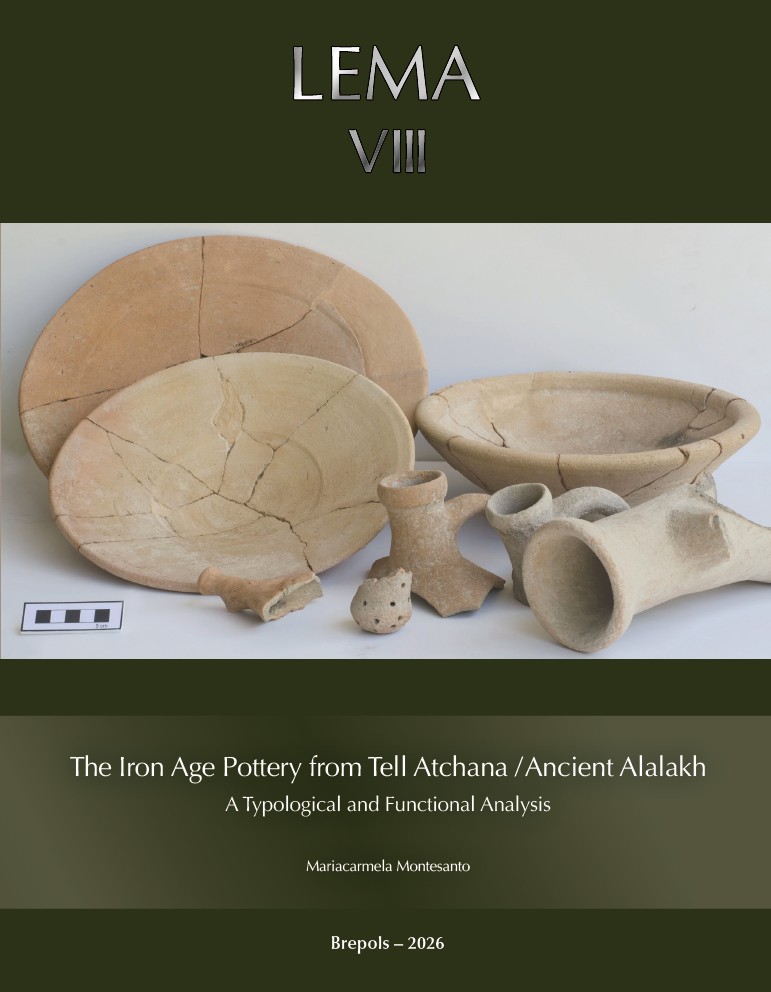 The Iron Age Pottery from Tell Atchana / Ancient Alalakh
A Typological and Functional Analysis
Volume 8


 Writing in the Church of the Nativity in Bethlehem
Inscription and Graffiti in a Multilingual and Multigraphic Perspective
Volume 45
 Zooarchaeology of Ancient Greek Sanctuaries in Southwestern Sicily
Faunal Analysis from Selinus and Akragas as Evidence of Differences in the Treatment of Animals for Ritual Purposes

