
Concerning the Eternal Predestination of God
by John Calvin, translated by John Kelman Sutherland Reid
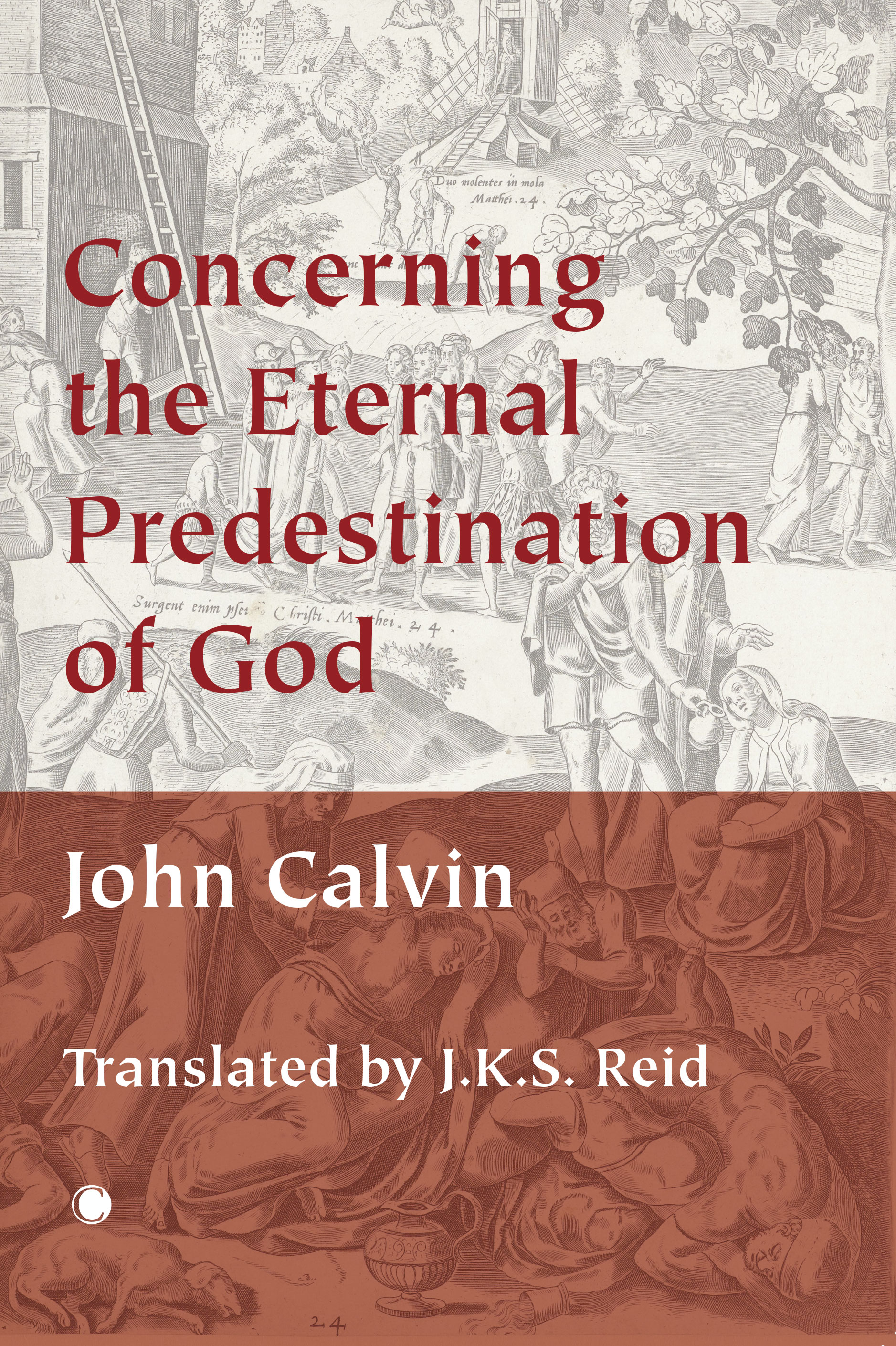
Calvin’s most well-known doctrine in his own words, with a critical introduction.
Although he wrote comprehensively on a wide range of doctrinal issues, it is Predestination with which Calvin is most associated today. In this, his definitive text on the subject, he outlines fully a doctrine he feels has been wilfully misinterpreted to the detriment of the Church. Readers will witness Calvin masterfully arguing his points, wrestling with the scriptures, and fully engaging in the polemical world of sixteenth-century theological debate as he refutes the views of three of his chief detractors. J.K.S. Reid’s widely praised translation preserves the nuances of Calvin’s thought and the strength of his rhetoric, while his introduction offers a critical examination of Calvin’s theological argument.
Translator's Preface Translator's Introduction Concerning the Eternal Predestination of God Title-page Table of Contents Author's Introduction Text Index
John Calvin (1509-1564) is widely considered the most important figure in the second generation of the Protestant Reformation. Having first encountered the ideas of Martin Luther while studying in Paris, he pursued the Reformed faith himself following a conversion experience in 1533. Eventually settling in Geneva, Calvin established a Protestant city government, while his landmark text, the Institutes of the Christian Religion, helped codify Protestant theology for Churches across Europe. Concerning the Eternal Predestination of God was published in 1552 after almost a decade of vigorous debate around the doctrine. J.K.S. Reid (1910-2002) was a noted twentieth-century Scottish theologian. He studied in Edinburgh, Heidelberg and Marburg, and spent time as a military chaplain during the World War Two. He was appointed Professor of Theology at the University of Leeds in 1952, and Professor of Systematic Theology at the University of Aberdeen in 1961. Alongside several monographs and significant ecumenical work, one of his chief accomplishments was co-founding with T.F. Torrance the Scottish Journal of Theology.
- By (author) John Calvin
- Edited by J.K.S. Reid
Similar Books
 ‘For You I Study, For You I Work, For You I Live, For You I Am Ready To Even Give My Life’
Essays in Honour of Francis (Frank) J Moloney, SDB

 A Connecting Polemic in the Medieval Mediterranean
The Correspondence of Leo III and ʿUmar II
Volume 6





 Ars Prophetica
Theology in the Poetry of Twentieth-Century Hebrew Poets Avraham Halfi, Shin Shalom, Amir Gilboa, and T. Carmi
 As Messianism Turns to Heresy
The Regenstein Chair Lectures On Lurianic Kabbalah and Shabbatai Tzevi at Hebrew Union College - Cincinnati



 Creating the Woman in Antiquity
Proceedings of the 16th Melammu Workshop, Innsbruck, 2–3 June 2022
Volume 13
 Cultic Kisses
Fruitful Encounters Between Deities and Humans. Festschrift for Angelika Berlejung on the Occasion of Her 65th Birthday
 De/colonizing Theologies
Glocal Histories, Contemporary Challenges, Theoretical Reflections
Volume 4
 Drunk the Potion, No Whit Charmed
The Doctrine of Pure and Perfect Souls from Iamblichus to Damascius




 Extracanonical Traditions and the Holy Land
Texts, Rituals, and Material Culture in Late Antique Palestine
 Fear, Fear of God, God-Fearers
Philological and Historical Perspectives on the World of Ancient Judaism and Christianity


 Gender and Iconography in Antiquity
Femininities, Masculinities, Ambiguities, and Beyond in the Ancient Levant, Near East, and Mediterranean


 Hoghe minne es deen vor dander
Essays on the Christian Mystical Tradition in Honour of Rob Faesen SJ
Volume 122

 International Comparison and Transfer in Religious Education
The Projects “RE at Schools in Europe” and “International Knowledge Transfer” in Dialogue
 Isaiah in the Fourth Gospel
Use of the Citations of Isaiah in John’s Gospel in Comparison to the Synoptics and Other Places in the New Testament