
Bohemian and Moravian Graduals (1420-1620)
By (author) Barry Graham
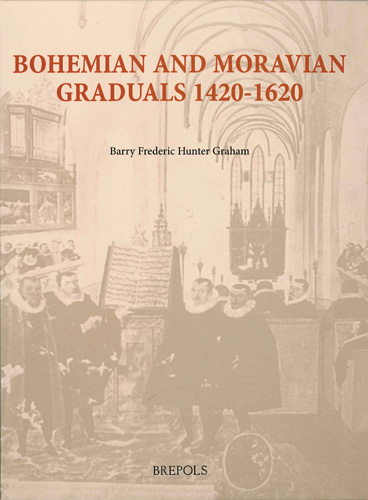
This book is primarily a catalogue of those nearly-intact extant books containing the full music of the Mass made between the date of the Bohemian Revolution (July 1419) and the Battle of the White Mountain (November 1620). Two principal religious factions were active in Bohemia and Moravia during the period. The larger, the Utraquists, took communion in both bread and wine. The Roman Catholics, fewer but still numerous, followed the then relatively recent practice of using bread only. While graduals are important sources for the liturgy practised by Utraquists and Roman Catholics, many of them are also of great interest artistically and historically. Some of the more beautiful books were produced for use by the literary societies, later incorporated as guilds, which were responsible for the music in their churches. The information the books contain about the membership of the guilds, containing as it did most of the social strata of the towns, gives important information about the contemporary social structure and about the strength of Utraquism. Individual guild members often sponsored a page at the beginning of a mass set which was profusely decorated. The quality of the art and the evolution in the iconography can be appreciated in the book’s 50 colour plates.
This book is primarily a catalogue of those nearly-intact extant books containing the full music of the Mass made between the date of the Bohemian Revolution (July 1419) and the Battle of the White Mountain (November 1620). Two principal religious factions were active in Bohemia and Moravia during the period. The larger, the Utraquists, took communion in both bread and wine. The Roman Catholics, fewer but still numerous, followed the then relatively recent practice of using bread only. While graduals are important sources for the liturgy practised by Utraquists and Roman Catholics, many of them are also of great interest artistically and historically. Some of the more beautiful books were produced for use by the literary societies, later incorporated as guilds, which were responsible for the music in their churches. The information the books contain about the membership of the guilds, containing as it did most of the social strata of the towns, gives important information about the contemporary social structure and about the strength of Utraquism. Individual guild members often sponsored a page at the beginning of a mass set which was profusely decorated. The quality of the art and the evolution in the iconography can be appreciated in the book’s 50 colour plates.
- By (author) Barry Graham
Similar Books
 «Solazoxa festa, stradolze e stracomplia»
Festschrift für Raymund Wilhelm zum 65. Geburtstag mit Beiträgen zu Diskurstraditionen und mittelalterlicher Philologie
Volume 249
 A Collaborative Tapestry in Honour of Shirley Ann Brown / Une fresque brodée en l’honneur de Shirley Ann Brown
The Bayeux Tapestry Seen by her Colleagues and Friends / La Tapisserie de Bayeux vue par ses collègues et amis



 Balthasar Caymox of Nuremberg
Early Modern German Print Publishers: Popular Prints of the Seventeenth Century

 Behind the Scenes of Medieval Roofs
An Overview of the Roofing Systems of Italian Churches
Volume 90

 Beyond Sovereign Courts
Agents and Practices in Early Modern Spanish and Habsburg Diplomacy
Volume 3

 Cahiers de recherches médiévales et humanistes – Journal of Medieval and Humanistic Studies
Volume 51

 Circulation, Use, Impact
The Consumption of Architectural Books in the Early Modern Eastern Adriatic
Volume 1




 Councils, Conflicts, Correspondence
Urban Diplomacy in Reval (Tallinn) and Lübeck (c. 1470–1570)
Volume 67





 Homo-Politicus in the Balkans
Early Modern Southeast European History in Imperial and Regional Context

 Innovation and Medieval Communities
The Circulation of Ideas and Practices in and out of the Town (1200-1500)
Volume 63
 Innovationes Lovanienses: Arts, Law and Theology at the University of Louvain (1425–1797)
Studium Lovaniense: Learning across Borders, 2
Volume 18
 John Dunstaple Reading Boethius
John Dunstaple’s Annotations to Boethius’s “De institutione musica” in the Manuscript Oxford, Corpus Christi College Library, MS 118
 Legal Visuality
Exegesis, Ambiguity, and Dissimulation of the Donation of Constantine in the Early Modern Period

 Medieval Debates on Foreknowledge: Future Contingents, Prophecy, and Divination
Acts of the XXVII Annual Colloquium of the SIEPM, Trento 12-15 September 2023
Volume 31

 Medieval Yeghegis, Armenia
History, Archaeology, Society. Local Multiplicities and Global Connections of a Rural Centre on the Silk Road(s)