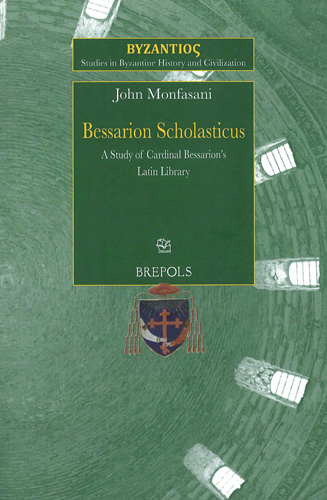
Bessarion Scholasticus
A Study of Cardinal Bessarion's Latin Library
By (author) John Monfasani
Bessarion (d. 18 November 1472) first made a name for himself as one of the Greek spokesmen at the Council of Ferrara-Florence in 1438-39. After becoming a cardinal, he several times entered conclaves as a serious candidate for the papacy. The library he bequeathed to the Republic of Venice, destined to become the historic core of the modern Biblioteca Marciana, is justly famous for its extraordinary collection of Greek manuscripts. Celebrated in his own time for his patronage of humanists, he was also Italy’s leading Platonist before the emergence of Marsilio Ficino. He always held in reverence his teacher in Greece, the Neoplatonist philosopher George Gemistus Pletho, and his In Calumniatorem Platonis, printed in Rome in 1469, was a pivotal text in the Plato-Aristotle controversy of the Renaissance. Nonetheless, Bessarion was a great admirer of medieval scholasticism and especially of Thomas Aquinas. ‘Bessarion Scholasticus’ examines Bessarion’s relationship with Latin culture as evidenced by his library, personal relations, and writings. It examines his humanist collection, his scholastic collection, his Thomism, and the circle of scholars associated with his household, called Bessarionea Academia by contemporaries. Half of ‘Bessarion Scholasticus’ is a catalogue raisonne of scholastic texts and manuscripts in Bessarion’s library. The volume offers the first edition of Bessarion’s autograph listing of the differences between Scotists and Thomists as well as first editions of prefaces by various authors addressed to Bessarion. In addition, the appendices include statistical tables of Bessarion’s holdings of Latin classical authors and of texts in civil and canonical law and a register of the members of his cardinalitial famiglia before he became cardinal legate in Bologna in 1450.
Bessarion (d. 18 November 1472) first made a name for himself as one of the Greek spokesmen at the Council of Ferrara-Florence in 1438-39. After becoming a cardinal, he several times entered conclaves as a serious candidate for the papacy. The library he bequeathed to the Republic of Venice, destined to become the historic core of the modern Biblioteca Marciana, is justly famous for its extraordinary collection of Greek manuscripts. Celebrated in his own time for his patronage of humanists, he was also Italy’s leading Platonist before the emergence of Marsilio Ficino. He always held in reverence his teacher in Greece, the Neoplatonist philosopher George Gemistus Pletho, and his In Calumniatorem Platonis, printed in Rome in 1469, was a pivotal text in the Plato-Aristotle controversy of the Renaissance. Nonetheless, Bessarion was a great admirer of medieval scholasticism and especially of Thomas Aquinas. ‘Bessarion Scholasticus’ examines Bessarion’s relationship with Latin culture as evidenced by his library, personal relations, and writings. It examines his humanist collection, his scholastic collection, his Thomism, and the circle of scholars associated with his household, called Bessarionea Academia by contemporaries. Half of ‘Bessarion Scholasticus’ is a catalogue raisonne of scholastic texts and manuscripts in Bessarion’s library. The volume offers the first edition of Bessarion’s autograph listing of the differences between Scotists and Thomists as well as first editions of prefaces by various authors addressed to Bessarion. In addition, the appendices include statistical tables of Bessarion’s holdings of Latin classical authors and of texts in civil and canonical law and a register of the members of his cardinalitial famiglia before he became cardinal legate in Bologna in 1450.
- By (author) John Monfasani
Other Titles in this Series


Similar Books
 A Collaborative Tapestry in Honour of Shirley Ann Brown / Une fresque brodée en l’honneur de Shirley Ann Brown
The Bayeux Tapestry Seen by her Colleagues and Friends / La Tapisserie de Bayeux vue par ses collègues et amis
 Behind the Scenes of Medieval Roofs
An Overview of the Roofing Systems of Italian Churches
Volume 90



 Drunk the Potion, No Whit Charmed
The Doctrine of Pure and Perfect Souls from Iamblichus to Damascius


 Epiphanies of the Divine in the Septuagint and the New Testament
Fifth International Symposium of the Corpus Judaeo-Hellenisticum Novi Testamenti (CJHNT), 14-17 May 2015, Nottingham



 Innovation and Medieval Communities
The Circulation of Ideas and Practices in and out of the Town (1200-1500)
Volume 63
 John Dunstaple Reading Boethius
John Dunstaple’s Annotations to Boethius’s “De institutione musica” in the Manuscript Oxford, Corpus Christi College Library, MS 118
 Language and Power in the Roman Empire and Early India
Hierarchy, Ambiguity, and the Art of Reading the Signs in Cosmopolitan Cultures
 Late Antique villae in the Balkans (3rd–7th c. AD): Current Research Questions and Perspectives
HAEMUS Companion to the Late Antique Balkans 1
Volume 4
 Linguistic and Cultural Dynamics in a Frontier Society
New Perspectives on Northeastern Bavaria and Western Bohemia in the Early Middle Ages
Volume 9
 Medieval Debates on Foreknowledge: Future Contingents, Prophecy, and Divination
Acts of the XXVII Annual Colloquium of the SIEPM, Trento 12-15 September 2023
Volume 31
 Medieval Yeghegis, Armenia
History, Archaeology, Society. Local Multiplicities and Global Connections of a Rural Centre on the Silk Road(s)
 Nurturing the Elite
Representations of Drinking, Eating, and Religious Vessels in Palmyrene Funerary Iconography
Volume 13