
Art as History, History as Art
Jheronimus Bosch and Pieter Bruegel the Elder. Assembling knowledge not setting puzzles
By (author) Stephen Hitchins
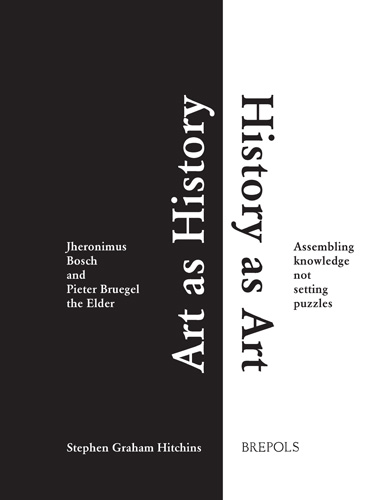
This book challenges many of the assumptions about Jheronimus Bosch and Pieter Bruegel the Elder. The academic contest to unravel these two has never abated. What exactly is the meaning of their work is one of art history’s blood sports. The answer lies in the cultural relationship between the artwork and its audience. Both artists demonstrate social, economic and political resonances in paintings that are numbingly familiar yet still poorly understood. There is social, religious, and political motivation in their art, an art that is frequently described in art historical isolation. For Bosch the image was a morality play about the paucity of good in a world teeming with evil monsters. For Bruegel it was frequently a reference to political events. Far from producing puzzle pictures they were assembling knowledge as part of a visual culture that was central to the life of society. It relates to the knowledge of the world at a particular time and two artists’ experiences of it. It stretches from the sexuality and spirituality of Bosch to secular satisfaction in Bruegel at a time of social upheaval and a great turning point of world history – the beginning of the modern world and the end of the Middle Ages.
This book challenges many of the assumptions about Jheronimus Bosch and Pieter Bruegel the Elder. The academic contest to unravel these two has never abated. What exactly is the meaning of their work is one of art history’s blood sports. The answer lies in the cultural relationship between the artwork and its audience. Both artists demonstrate social, economic and political resonances in paintings that are numbingly familiar yet still poorly understood. There is social, religious, and political motivation in their art, an art that is frequently described in art historical isolation. For Bosch the image was a morality play about the paucity of good in a world teeming with evil monsters. For Bruegel it was frequently a reference to political events. Far from producing puzzle pictures they were assembling knowledge as part of a visual culture that was central to the life of society. It relates to the knowledge of the world at a particular time and two artists’ experiences of it. It stretches from the sexuality and spirituality of Bosch to secular satisfaction in Bruegel at a time of social upheaval and a great turning point of world history – the beginning of the modern world and the end of the Middle Ages.
- By (author) Stephen Hitchins
Similar Books
 A Collaborative Tapestry in Honour of Shirley Ann Brown / Une fresque brodée en l’honneur de Shirley Ann Brown
The Bayeux Tapestry Seen by her Colleagues and Friends / La Tapisserie de Bayeux vue par ses collègues et amis





 Balthasar Caymox of Nuremberg
Early Modern German Print Publishers: Popular Prints of the Seventeenth Century


 Beyond Sovereign Courts
Agents and Practices in Early Modern Spanish and Habsburg Diplomacy
Volume 3


 Circulation, Use, Impact
The Consumption of Architectural Books in the Early Modern Eastern Adriatic
Volume 1


 Councils, Conflicts, Correspondence
Urban Diplomacy in Reval (Tallinn) and Lübeck (c. 1470–1570)
Volume 67


 ENTANGLED AFRICA
Intra-African Relations Between Rain Forest and Mediterranean from Around 4,000 BCE to 1,500 CE


 Gold, Silver and Glass: Power Networks, Cultural Identities, Technology Transfers and Agency across the Old World (7th Century BC – 1st Century AD)
Proceedings of a Conference Held at the British Museum, 16–18 June 2023


 Homo-Politicus in the Balkans
Early Modern Southeast European History in Imperial and Regional Context

 Innovationes Lovanienses: Arts, Law and Theology at the University of Louvain (1425–1797)
Studium Lovaniense: Learning across Borders, 2
Volume 18
 Legal Visuality
Exegesis, Ambiguity, and Dissimulation of the Donation of Constantine in the Early Modern Period
 Listening to the Swan Song
More-than-Human Beings and Sounds in Literature and Culture Through the Ages


 Monastic Manuscripts from the Eastern Mediterranean (Sinai, Jerusalem, Antioch)
Production, Use, and Contexts


 Naples as Laboratory / Laboratorium Neapel
Style Options, Artistic Rivalry and Self Fashioning in Neapolitan Baroque Painting / Plurale Stilbildung, Kunstlerkonkurrenz und Self Fashioning in der neapolitanischen Barockmalerei

 Nurturing the Elite
Representations of Drinking, Eating, and Religious Vessels in Palmyrene Funerary Iconography
Volume 13

