
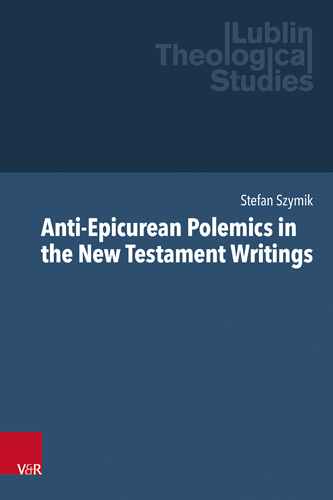
Anti-Epicurean Polemics in the New Testament Writings
By (author) Stefan Szymik Series edited by Adam Kubiś Series edited by Nicholas Adams Series edited by Marek Jagodziński Series edited by Pawel Mąkosa Consultant editor Pawel Mąkosa Consultant editor Zdzisław Kijas Consultant editor Juan Luis Lorda Consultant editor David Fagerberg Consultant editor Klaus Baumann Consultant editor Carl-Maria Sultana Consultant editor Ilaria Ramelli Consultant editor Łukasz Popko Consultant editor Dalia Marx
Hardback (Published)
(October 2023)
ISBN: 9783525500224
6.34 x 9.25 inches
Price: $175.00
In stock
About the presence of Epicurean philosophical concepts in the New Testament writings
Stefan Szymik analyses New Testament texts in terms of polemic and anti-Epicurean rhetoric. To what extent and how did Epicurus and his philosophical thought influence the first Christian Churches? How did Christians react to Epicureanism? Although the New Testament only includes one account of an encounter between the Apostle Paul and the Epicureans (Acts 17:18), the probability of their contacts was high, given the popularity of Epicureanism in the Roman Empire in the first century CE. As a vital component of Hellenistic-Roman culture, Epicureanism should be taken into account in research on the New Testament, becoming a point of reference and part of the content of comparative analyses.
- By (author) Stefan Szymik
- Series edited by Adam Kubiś
- Series edited by Nicholas Adams
- Series edited by Marek Jagodziński
- Series edited by Pawel Mąkosa
- Consultant editor Pawel Mąkosa
- Consultant editor Zdzisław Kijas
- Consultant editor Juan Luis Lorda
- Consultant editor David Fagerberg
- Consultant editor Klaus Baumann
- Consultant editor Carl-Maria Sultana
- Consultant editor Ilaria Ramelli
- Consultant editor Łukasz Popko
- Consultant editor Dalia Marx
Other Titles in this Series
 The Church in the Face of Crises and Challenges over the Centuries
Selected Issues from the History of the Church

 Isaiah in the Fourth Gospel
Use of the Citations of Isaiah in John’s Gospel in Comparison to the Synoptics and Other Places in the New Testament

 Bloodshed by King Manasseh, Assyrians and Priestly Scribes
Theological Meaning and Historical-Cultural Contextualization of 2 Kings 21:16, 24:3-4 in Relation to the Fall of Judah


 The Christological Metaphors of Wine, Water, and Bread in the Gospel of John in Relation to Their Sapiential Background
An Intertextual Study
 Religious and National Identity of Polish Emigrants in Great Britain
Catechetical and Pastoral Implications

 Man in Metanoiacal Dialogue with God
The Biblical and Hesychastic Message of the Great Canon of St. Andrew of Crete
Similar Books


 Athanasius of Alexandria, Epistula ad episcopos Aegypti et Libyae
Old Slavonic Version and English Translation
Volume 261




 Contesting Labeled Identities
The Sociology of Gentilics in Biblical and Northwest Semitic Literature

 Cyril of Alexandria’s Christological Exegesis
Explorations of Partitive Exegesis in the Dialogues on the Trinity
Volume 70

 Drunk the Potion, No Whit Charmed
The Doctrine of Pure and Perfect Souls from Iamblichus to Damascius


 Epigraphic “Shades” from Hellenistic Thrace
Contextualizing Inscriptions in Greek from Thracian Tombs

 Epiphanies of the Divine in the Septuagint and the New Testament
Fifth International Symposium of the Corpus Judaeo-Hellenisticum Novi Testamenti (CJHNT), 14-17 May 2015, Nottingham


 Éthique, politique, religions
Superstition (XVIIe - XXIe siècles). Sémantique, histoires et cultures


 Extracanonical Traditions and the Holy Land
Texts, Rituals, and Material Culture in Late Antique Palestine


 From Joseph to Jesus
The Joseph Narrative as a Compositional Template from Old Greek Esther to the Gospel of Luke
Volume 125
