
An Analytical Bibliography of New Iranian Languages and Dialects
Based on Persian publications since ca. 1980
Von Ludwig Paul With the cooperation of Pejman Firoozbakhsh
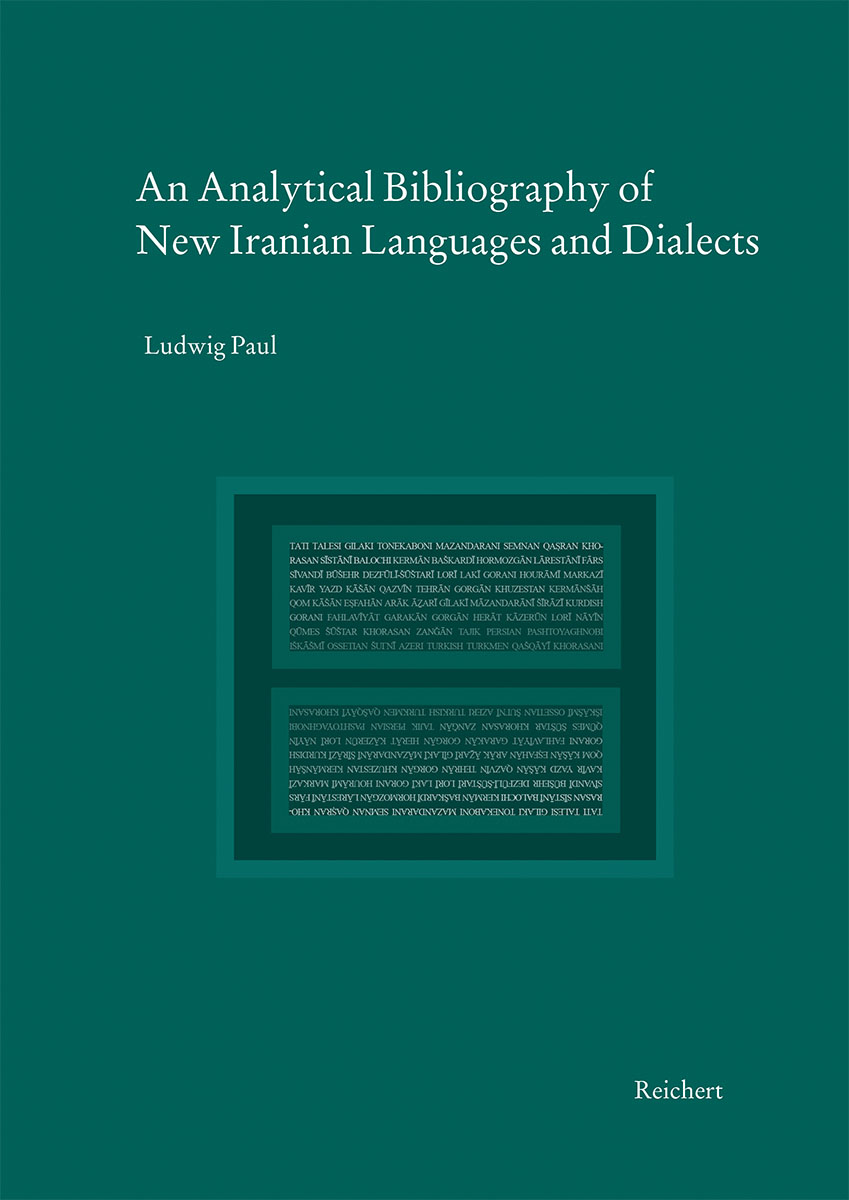
Hardback (Published)
(March 2022)
ISBN: 9783752006087
6.69 x 9.49 inches
Price: $147.00
In stock
This bibliography is a collection of ca. 3,600 publications on new West Iranian languages and dialects (except Persian) that have been published in Iran since the revolution of 1979. It includes works on languages and dialects, e.g., grammars, dictionaries, and articles from linguistic journals, and provides the first comprehensive account of Iranian research on the subject. In addition, it also contains works written in local idioms, e.g., dialect poems, proverbs, riddles, children’s songs, etc. By collecting approximately 900 such dialect publications, together with folkloristic studies on dialect literature, this is also the first comprehensive and systematic bibliography of Iranian dialect folklore studies. The entries are presented following a genetic-geographical system that is explained in the introduction. For each entry, either an English translation of the title is added or an explanation of the publications’ contents.
In this book, the author presents the first inventory of research done in Persian on Iranian languages and dialects (excluding Persian). Aside from linguistic works, it also includes publications in Iranian languages and dialects, i.e., local dialect poetry and folklore and publications on these. Since Iranian national dialectology has seen an enormous upsurge during the last two or three decades, and because publications from before 1980 are sufficiently known to international scholarship, this work concentrates on books and articles published after 1980 and contains approximately 3,600 titles. Most of these concern Iranian languages and dialects spoken in Iran, such as Taleshi, Gilaki, Semnani, Kurdish or Lori (altogether, 27 languages or dialect groups). Aside from this, local varieties of Persian, historical dialects such as that of the Fahlaviyyat poetry, and non-Iranian minority languages and dialects such as Azeri Turkic or Arabic are also covered. Iranian languages and dialects spoken in Afghanistan and Tajikistan, or works published there, are also considered, but constitute only a small part of the publications. The volume aims to make accessible to international scholarship the diversity and richness of Persian publications on and in Iranian languages and dialects. The arrangement of the 27 linguistic groups follows a combination of genetic and areal/regional features that is explained in the introduction. The publications relating to each of these groups are divided into generalities, phonology, morphology/syntax, lexicon, and literature, sometimes with additional subdivisions. Each title is translated, or its main contents are summarized. The systematic part of the bibliography is supplemented by an alphabetical inventory (according to the authors’ names). The introduction also offers an account of Iranian dialectology, with its history and main concepts, and is followed by an overview of recent non-Persian scholarship on Iranian languages and dialects. The volume concludes with an index of all names of places, tribes, and languages that occur in it.The work presented here is the first of its kind and breaks new ground in Iranian dialectology and bibliography. It aims to provide a reference work for all disciplines that are interested in the languages spoken in Iran: Iranian, Turkic, Semitic and Kurdish studies. The comprehensive coverage of literature in minority languages and dialects also has the potential to provide new impulses to literary and folklore studies in these disciplines.
Ludwig Paul<br/><br/>1963 Born in Munich<br/>1985-86 Studying Linguistics and Islamic Studies at Bonn University<br/>1985-95 Studying Iranian Studies and Linguistics in Bonn, Göttingen, Peshawar (Pakistan)<br/> and Tehran (Iran); PhD in Iranistik, University of Göttingen<br/>1995-96 Post-doc fellow at the Van Leer Institute (Jerusalem)<br/>1996-2003 Assistant Professor, University of Göttingen<br/>2002 Post-doctoral degree (Habilitation) in Iranistik, University of Göttingen<br/>2003- Professor of Iranian Studies, University of Hamburg<br/>2011/16/21 Visiting Professorships in Jerusalem (Israel) and Yerevan (Armenia)<br/><br/>Main areas of research: 1. Iranian Historical Linguistics, with a focus on the history of Persian; 2. West Iranian Dialectology, with a focus on Kurdish and Kurdoid languages
- By (author) Ludwig Paul
Similar Books

 Deutsch als Fremdsprache nach Englisch an chinesischen Hochschulen
Eine empirische Forschung über Lernstrategien zum Wortschatzlernen


 Lectori vago. Manuscripts, Libraries, and Classical Scholarship from the Middle Ages to the Early Modern Period
Liber amicorum Luc Deitz
Volume 43


 Ein Schatzhaus indischer Erzählkunst –– Die Erzählliteratur der Jainas
Band 2: Ein „Lesebuch“ originalsprachlicher Texte zur jainistischen „Universalgeschichte“ samt eines Jaina-Māhārāṣṭrī-Wörterbuchs zu allen Text- und Lesestücken.
 Grimm Gotha Paris
Eine europaische Konstellation zur Zeit der Aufklarung / Une constellation europeenne au temps des Lumieres


 Conceptualisation as a Biocognitive Phenomenon and Part of the Faculty of Language
Cross-linguistic Evidence from the Preposition Category




 Language Assessment Across Cultures
From Intercultural Communicative Competence to Artificial Intelligence
 Linguistic Fragmentation and Cultural Inclusion in the Middle Ages
Translation, Plurilingualism, Multilingualism
Volume 22
 Love and the Danish Worldview
A Cognitive Ethnolinguistic Study of the Concept of Kærlighed ‘Love’ in Danish
 LSP Teaching / Fachbezogener Fremdsprachenunterricht
Practices, Innovations, Technology / Praxis, Innovation, Technologie


 Strategic Perspectives on the Reconstruction and Diachronic Interpretation of Stereotypical Theolinguistic Matrices in Religious-Popular Discourse
Insights from English, German, and Ukrainian within Indo-European and Nostratic Frameworks

 Translation – Didactics of Translation – Pedagogical Translation / Translation – Translationsdidaktik – Pädagogische Translation
Theoretical Concepts and Practical Suggestions / Theoretische Ansätze und Vorschläge für die Praxis
 Varietate delectamur
Multifarious Approaches to Synchronic and Diachronic Variation in Latin: Selected Papers from the 14th International Colloquium on Late and Vulgar Latin (Ghent, 2022)
Volume 1

 Aspektmarkierung im Mittelhochdeutschen
Untersuchungen zur prafixgesteuerten Perfektivierung und verbalen Paarigkeit

 Das Bild des Flüchtlings im Deutschen und im Polnischen
Lexikographische Erfassung und Presseberichterstattung 2016–2017
 Der spatmittelalterliche Kanzleibrief in Nurnberg
Zur Beschreibung von historischem Textmusterwissen


 Die Sprache(n) der Wissenschaft
Eine empirische Studie unter Wissenschaftlerinnen und Wissenschaftlern in Osterreich vor dem Hintergrund sprach- und kommunikationswissenschaftlicher Befunde
Volume 941

 Grammatische Kategorien und ihre Funktionen
Ein Beitrag zur Synchronie, Diachronie und Genealogie des Formensystems der deutschen Sprache

