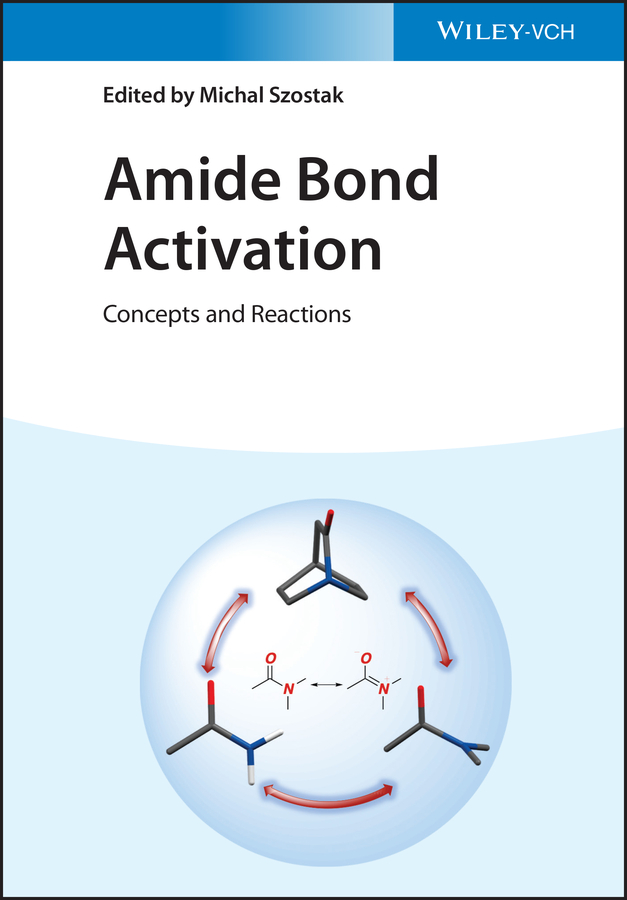
Amide Bond Activation
Concepts and Reactions
Edited by Michal Szostak
Hardback (Published)
(November 2022)
ISBN: 9783527348312
6.69 x 9.65 inches
Price: $219.00
On back order
Provides a thorough overview of the pivotal role of the amide bond in organic synthesis – an indispensable source of information for researchers in academia and industry!
1) Bridged Lactams as Model Systems for Amidic Distortion
2) Modification of Amidic Resonance Through Heteroatom Substitution at Nitrogen - Anomeric Amides
3) Amide Bond Activation by Twisting and Nitrogen Pyramidalization
4) Transition-Metal-Free Reactions of Amides by Tetrahedral Intermediates
5) Electrophilic Amide Bond Functionalisation
6) Transamidation of Carboxamides and Amide Derivatives: Mechanistic Insights, Concepts, and Reactions
7) Amide Bond Esterification and Hydrolysis
8) Activation of Amide C-N Bonds by Nickel Catalysis
9) Pd-NHC Catalysis in Cross-Coupling of Amides
10) Cross-Coupling of Amides through Decarbonylation
11) Transition Metal-Catalyzed Radical Reactions of Amides
12) Weinreb Amide as a Multifaceted Directing Group in C-H Activation
13) Computational Studies of Amide C-N Bond Activation
14) Esters as Viable Acyl Cross-Coupling Electro-Philes
15) Cross-Coupling of Aromatic Esters by Decarbonylation
Michal Szostak is currently a Professor of Chemistry at Rutgers University, Newark, USA. He received his Ph.D. from the University of Kansas (USA) with Prof. Jeffrey Aubé in 2009. After postdoctoral stints at Princeton University (USA) with Prof. David MacMillan and at the University of Manchester (UK) with Prof. David Procter, in 2014, he joined the faculty at Rutgers University. His research group is focused on the development of new synthetic methodology based on transition-metal-catalysis, amide bond activation, conformational preferences of amides, transition-metal-mediated free-radical chemistry, C-H activation, and application to the synthesis of biologically-active molecules.
- Edited by Michal Szostak
Similar Books




 Diagnostic Techniques in Public Health
Analytical and Chemometric Approaches in Disease Detection and Management







 Medicinal Chemistry of Plant-Derived Natural Products
A Chemical Exploration of Plants as a Source of Modern Drugs