Anode-Free Rechargeable Batteries
Design, Performance, and Upscaling
Edited by Hua Wang
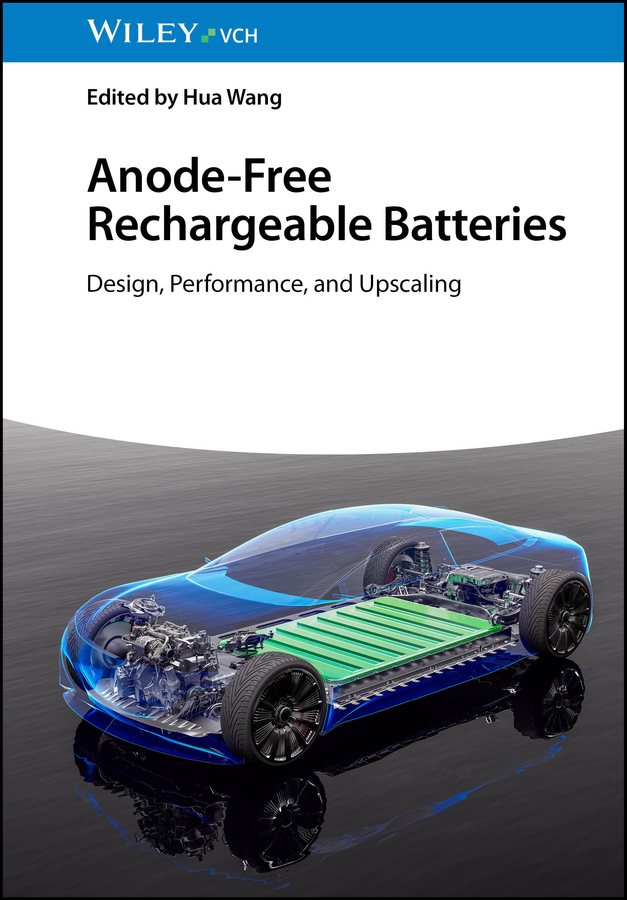
Hardback (Published)
(October 2026)
ISBN: 9783527357321
6.69 x 9.65 inches
Price: $174.00
On back order
Advance anode-free battery development from fundamentals to cell upscaling
Anode-free configurations of rechargeable batteries eliminate initial metal inventory at the anode side, yielding high energy density and simplified manufacturing. Anode-Free Rechargeable Batteries: Design, Performance, and Upscaling focuses on anode-free battery technology spanning lithium, sodium, zinc, and other-metal chemistries. The book integrates relevant fundamental operating principles, materials selection, interphase engineering and holistic battery design into a comprehensive reference for researchers and engineers working in energy storage.
Coverage progresses from electrochemistry fundamentals to advanced topics include electrolyte regulation, current collector modification, and failure mechanism analysis. Performance-comparison tables and illustrated examples enable direct evaluation across competing chemistries. A unified benchmarking framework establishes standardized test protocols and a practical roadmap for scaling from coin cells to pouch cells under real-world manufacturing constraints.
The book also covers:
* In-depth coverage of anode-free sodium and zinc battery systems alongside emerging post-lithium chemistries and their specific design challenges
* Interphase engineering strategies addressing dendrite formation, Coulombic efficiency losses, and cycle life degradation in anode-free configurations
* Practical design rules linking electrolyte formulation, current collector surface treatment, and cell architecture to measurable electrochemical performance metrics
* A commercialization roadmap addressing cost reduction, safety assessment protocols, and manufacturing scalability for transitioning laboratory results to production
* Systematic comparison of lithium, sodium, and zinc-based battery systems using standardized metrics clarifying trade-offs in energy density and longevity
Designed for electrochemists, materials scientists, physical chemists, and solid-state chemists working in energy storage, this reference equips researchers and engineers with the benchmarking tools, design principles, and scaling strategies needed to advance anode-free battery systems from laboratory concept to commercial deployment.
Foreword
Preface
1 INTRODUCTION FOR ANODE-FREE BATTERIES
1.1 Development of Rechargeable Batteries
1.2 Fundamentals of AFBs
1.3 The Issues and Strategies of AFBs
1.4 Progress in Upscaling of AFBs
2 ANODE-FREE LITHIUM BATTERIES
2.1 Introduction
2.2 Fundamentals of Anode-Free Lithium Batteries (AFLBs)
2.3 Performance Optimization Strategies and Research Progress
2.4 Summary and Perspectives
3 ANODE-FREE SODIUM BATTERIES
3.1 Introduction
3.2 Fundamentals of AFSBs
3.3 Performance Optimization Strategies and Research Progress
3.4 Summary and Perspectives
4 ANODE-FREE ZINC BATTERIES
4.1 Introduction
4.2 Fundamentals of AFZBs
4.3 Optimization Strategies
4.4 Electrolyte Engineering
4.5 Conclusion and Outlook
5 OTHER ANODE-FREE BATTERY SYSTEMS
5.1 Anode-Free Potassium Metal Batteries
5.2 Anode-Free Aluminum Metal Batteries
5.3 Anode-Free Magnesium Metal Battery
5.4 Anode-Free Tin Metal Battery
6 PERSPECTIVES FOR ANODE-FREE RECHARGEABLE BATTERIES
6.1 The Status of AFBs
6.2 Outlooks of AFBs
6.3 Conclusions
Index
Hua Wang is a professor at the Beihang University in Beijing, China. Having obtained his academic degrees from Beihang University, he conducted his postdoctoral research at Singapore Nanyang Technological University before taking up his present appointment at Beihang University. Professor Wang has authored over 140 scientific publications with 12,000+ citations. He is mainly engaged in the controlled preparation of nanomaterials, energy materials, secondary batteries and other related research. He is also a fellow of the Royal Society of Chemistry and a recipient of the NSFC Excellent Young Scientist Fund. He currently serves as a Deputy Editor-in-Chief of eChem and an editorial board member of Rare Metals.
- Edited by Hua Wang
Similar Books





 Ernst Haeckel: Ausgewählte Briefwechsel. Historisch-kritische Ausgabe. Bd. 22
Korrespondenz zu Weltanschauung, Kunst und Literatur. Österreich und Schweiz August 1894 – August 1914

 Soft Seats and Blisters
Zur Geschichte von Parkways, Panoramastraßen, Trails und Wanderwegen in der Hochmoderne


 Human Societies Facing Climate Change: Volume 3
Determinisms in Prehistoric Societies: Climate Changes, Environments, Functional Constraints and Cultural Tradition
 Joseph Francis Rock (1884-1962). Travel diaries of a botanist and ethnographer from Lanzhou to Koko Nor (Qinghai) 1925 and from Chone to Songpan 1927 (Eastern Tibet / West China)
Edited from Rock's revised manuscripts by Hartmut Walravens
Volume 136


 Fuente Alamo
Arqueozoologia, arqueobotanica y artefactos macroliticos.Ignacio Bize Font, Cristina Cabrera Taravillo, Marina Eguiluz Valentini, Andreas G. Heiss, Corina Liesau von Lettow-Vorbeck, Arturo Morales Muniz, Roberto Risch, Hermanfrid Schubart, Hans-Peter
Volume 42



 The Risala Dhat al-kursi attributed to Ptolemy
A Treatise on the Celestial Globe with Stand
Volume 3
 Verbindende Mechanismen
Disziplinenübergreifende Erforschung biochemischer und biophysikalischer Vorgänge im frühen 20. Jahrhundert

 Fires in GunaiKurnai Country
Landscape Fires and their Impacts on Aboriginal Cultural Heritage Places and Artefacts in Southeastern Australia
 From Breeding & Feeding to Medicalization
Animal farming, veterinarization and consumers in the 20th c. Western Europe
Volume 17