
Seleucid Nysa-Scythopolis in the Framework of Hellenistic Foundations in the Levant

Hardback (Published)
(October 2026)
ISBN: 9783963273469
Price: $188.00
The region of the southern Levant and the period have special relevance for Hellenistic foundations because they incorporate the framework in which early Judaism had crystalized and from which Christianity also emerged. The impact of Hellenism on Judaism is regarded as a crucial encounter in influencing later developments and a differentiated understanding of this period and region is needed. To date, a systematic analysis of the material culture of the Hellenistic southern Levant, and particularly, the most visible agent of Hellenization – the foundation of cities – is lacking. This volume seeks to close this research gap. The Seleucid foundation Nysa-Scythopolis is taken as a starting point for the investigation. The Seleucid city was founded on a mound near biblical Beth She’an, which was occupied under Ptolemaic rule. However, the 2nd century BCE Seleucid settlement was not founded on the Ptolemaic occupied site, but rather on a neighboring hill, known today as Tell Iẓṭabba. With its foundation under Antiochos IV the settlement became home to a Seleucid community until 107 BCE when the city was destroyed by the expanding Hasmonean state and never to be rebuilt at the same site. The Early Roman city was reestablished in the 1st century BCE at a different location, closer to the biblical mound, encompassing the area of its southern foothills. Subsequently Tell Iẓṭabba was not rebuilt until the Byzantine period, when the tell was crossed by the Byzantine city walls and parts of it were covered by intra and extra mural ecclesiastical structures. This situation made Tell Iẓṭabba and Seleucid Nysa-Scythopolis the ideal place to zoom into a newly founded Seleucid city in the southern Levant. Many of the other Seleucid foundations in the region such as Gadara, Gerasa or Hippos were massively covered by later Roman and late antique (Byzantine and Early Islamic) phases. Therefore, Nysa-Scythopolis plays a crucial role in understanding Seleucid settlement dynamics in the Levant. The current body of work illuminates new dimensions of the site and its urban form, sociopolitical dynamics, religious expressions, and regional networks situating the town more firmly within both the cosmopolitical Hellenistic world and the traditional ancient Near East. The present volume is conceived as an investigation into the phenomenon of royal city foundations in the southern Levant, with particular attention to the case of Nysa-Scythopolis. Structured thematically and methodologically across a series of interconnected sections, the book moves from broad contextual considerations to focused analyses of material, social, and cultural life, before widening the lens again to contrast Seleucid strategies with those of local dynasts and concludes with theoretical reflections on the Hellenistic world. This structure allows readers to grasp both the local specificity of Nysa-Scythopolis and the broader patterns of Hellenistic urbanization, kingship, and cultural interaction in the Eastern Mediterranean.
The region of the southern Levant and the period have special relevance for Hellenistic foundations because they incorporate the framework in which early Judaism had crystalized and from which Christianity also emerged. The impact of Hellenism on Judaism is regarded as a crucial encounter in influencing later developments and a differentiated understanding of this period and region is needed. To date, a systematic analysis of the material culture of the Hellenistic southern Levant, and particularly, the most visible agent of Hellenization – the foundation of cities – is lacking. This volume seeks to close this research gap. The Seleucid foundation Nysa-Scythopolis is taken as a starting point for the investigation. The Seleucid city was founded on a mound near biblical Beth She’an, which was occupied under Ptolemaic rule. However, the 2nd century BCE Seleucid settlement was not founded on the Ptolemaic occupied site, but rather on a neighboring hill, known today as Tell Iẓṭabba. With its foundation under Antiochos IV the settlement became home to a Seleucid community until 107 BCE when the city was destroyed by the expanding Hasmonean state and never to be rebuilt at the same site. The Early Roman city was reestablished in the 1st century BCE at a different location, closer to the biblical mound, encompassing the area of its southern foothills. Subsequently Tell Iẓṭabba was not rebuilt until the Byzantine period, when the tell was crossed by the Byzantine city walls and parts of it were covered by intra and extra mural ecclesiastical structures. This situation made Tell Iẓṭabba and Seleucid Nysa-Scythopolis the ideal place to zoom into a newly founded Seleucid city in the southern Levant. Many of the other Seleucid foundations in the region such as Gadara, Gerasa or Hippos were massively covered by later Roman and late antique (Byzantine and Early Islamic) phases. Therefore, Nysa-Scythopolis plays a crucial role in understanding Seleucid settlement dynamics in the Levant. The current body of work illuminates new dimensions of the site and its urban form, sociopolitical dynamics, religious expressions, and regional networks situating the town more firmly within both the cosmopolitical Hellenistic world and the traditional ancient Near East. The present volume is conceived as an investigation into the phenomenon of royal city foundations in the southern Levant, with particular attention to the case of Nysa-Scythopolis. Structured thematically and methodologically across a series of interconnected sections, the book moves from broad contextual considerations to focused analyses of material, social, and cultural life, before widening the lens again to contrast Seleucid strategies with those of local dynasts and concludes with theoretical reflections on the Hellenistic world. This structure allows readers to grasp both the local specificity of Nysa-Scythopolis and the broader patterns of Hellenistic urbanization, kingship, and cultural interaction in the Eastern Mediterranean.
Other Titles in this Series
 Change, Order, Remembrance
Crisis and Religion in the Ancient Near East: Proceedings of the Workshop held at the 18th EASR Conference, Pisa, August 30th - September 3rd 2021
Volume 13
 talugaes wittes
Ancient Near Eastern Studies Presented to Stefano de Martino on the Occasion of his 65th Birthday
Volume 2
 Gesiegelt – Versiegelt – Entsiegelt
Studien zum Siegel(n) als Kulturtechnik von der Antike bis zum fruhen Mittelalter
Volume 7
 Gestaltung, Funktion und Bedeutung antiker Treppenanlagen
Multiperspektivische Analyse einer transkulturellen Konstante
Volume 11

 Israel und Phonizien im 9. und 8. Jahrhundert v. Chr.
Studien zu Beziehungen und Handel zwischen den phonizischen Stadten und Israel unter den Nimsiden unter besonderer Berucksichtigung des Fundortes Kuntillet 'Agrud
Volume 9
 Uber das Alte Testament hinaus
Exegetische, religionsgeschichtliche und archaologische Beitrage. Festschrift fur Herbert Niehr
Volume 12
 Literaturkontakte Ugarits
Wurzeln und Entfaltungen: Internationale Tagung, Munster, 13-15. Oktober 2015
Volume 5

 Heilige Orte der Antike
Gesammelte Studien im Anschluss an eine Ringvorlesung des Exzellenzclusters Religion und Politik in den Kulturen der Vormoderne und der Moderne an der Universitat Munster im Wintersemester 2013/2014
Volume 1
 Die ‘Zwei Korper des Konigs’ in den westsemitischen Kulturen
Ugarit, aramaische Konigreiche, Phonizien, Ammon, Moab, Israel und Juda
Volume 4
 Dying and Rising Gods
The History of a Mythologem in West Asia of the Second Millennium BCE
Volume 10
 Mithras – Miθra – Mitra
Der romische Gott Mithras aus der Perspektive der vergleichenden Religionsgeschichte
Volume 3
Similar Books




 Connecting the Dots: Counting, Writing, and the Beginnings of Civilization
The Secret Lives of Clay Tokens: A Memoir
 Contesting Labeled Identities
The Sociology of Gentilics in Biblical and Northwest Semitic Literature


 Drunk the Potion, No Whit Charmed
The Doctrine of Pure and Perfect Souls from Iamblichus to Damascius

 Epiphanies of the Divine in the Septuagint and the New Testament
Fifth International Symposium of the Corpus Judaeo-Hellenisticum Novi Testamenti (CJHNT), 14-17 May 2015, Nottingham


 Exploring Gender Dynamics across the Ancient Near East
Collected Essays of Gender and Methodology in the Ancient Near East (GeMANE) 4 and 5
Volume 7


 Ḫattušaš utnē išḫameški
Hittite and Other Ancient Near Eastern Studies Presented to Piotr Taracha on the Occasion of His 65th Birthday


 Language and Power in the Roman Empire and Early India
Hierarchy, Ambiguity, and the Art of Reading the Signs in Cosmopolitan Cultures
 Late Antique villae in the Balkans (3rd–7th c. AD): Current Research Questions and Perspectives
HAEMUS Companion to the Late Antique Balkans 1
Volume 4
 New Research on Old Collections in Southwest Asian Archaeology
Proceedings of the Workshop Held at the British Museum, London, 31 July – 2 August, 2023
 Nurturing the Elite
Representations of Drinking, Eating, and Religious Vessels in Palmyrene Funerary Iconography
Volume 13
 Old Aramaic Inscriptions and their Contexts
An Epigraphic, Archaeological, and Historical Synthesis
Volume 63


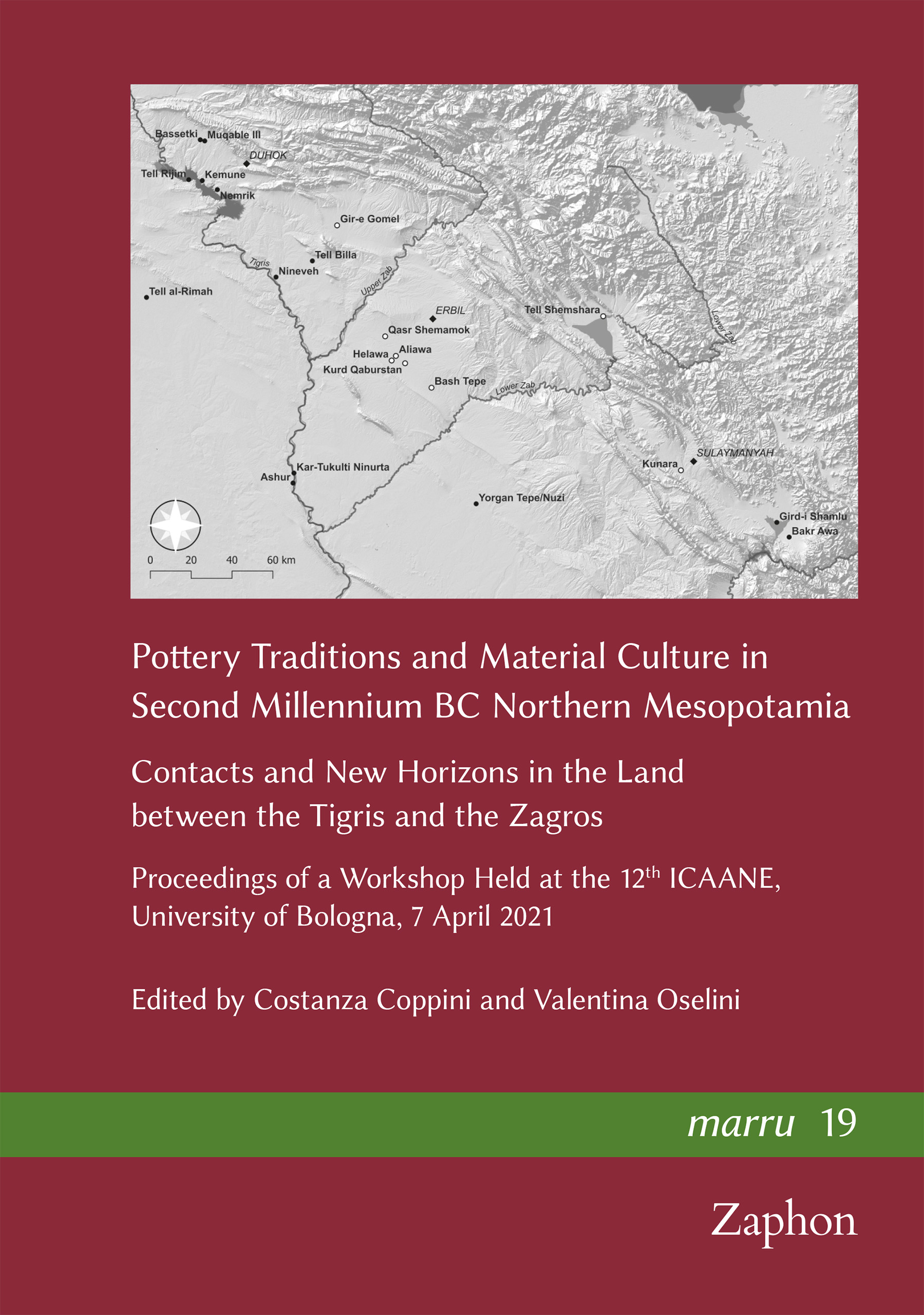 Pottery Traditions and Material Culture in Second Millennium BC Northern Mesopotamia
Contacts and New Horizons in the Land between the Tigris and the Zagros. Proceedings of a Workshop Held at the 12th ICAANE, University of Bologna, 7 April 2021
Volume 19
 Punning in Odd or Elegant Constructions in Jeremiah
The Convergence of Linguistics, Rhetoric, and Textuality in the Hebrew Text of Jeremiah

 Shame in the Worlds of the Hebrew Bible and Akkadian Texts
A Linguistic Study and Its Implications
Volume 33
 Telling Contexts
Archaeological and Textual Studies in Honor of Elizabeth Bloch-Smith and Mark S. Smith
 The Body
Lived, Cultured, Adorned: Essays on Dress and the Body in the Bible and Ancient Near East in Honor of Nili S. Fox
 The Compositional History of the Book of Kings
An Analysis of the Evaluative Frameworks in 1 Kings 14–2 Kings 25
 The Discourse of Rites
Shaping and Reshaping the (Counter-)Priestly Rituals Conducted Outside the Tabernacle