
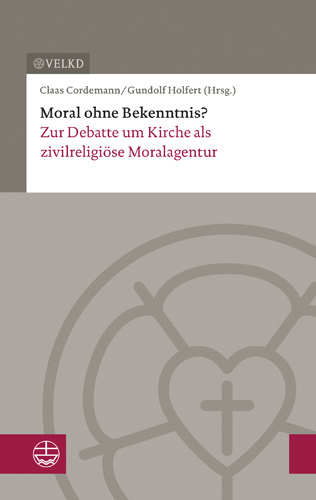
Moral ohne Bekenntnis?
Zur Debatte um Kirche als zivilreligiose Moralagentur. Dokumentation der XVII. Konsultation Kirchenleitung und wissenschaftliche Theologie
edited by Claas Cordemann and Gundolf Holfert
Paperback (Published)
(September 2017)
ISBN: 9783374051588
4.72 x 7.44 inches
Price: $20.00
On back order
In social discourse and medial perception church and theology are predominantly present when it comes to the moral foundations of communal life. Regarding these topics they make public statements, publish social papers or memoranda. Recent examples are the debates on the migration crisis, euthanasia, sexual ethics, climate change, and financial capitalism. In view of this trend the churches should give less prominence to behavioural norms and advocate more the individual capacity to form a personal judgement on ethical issues. It is a self-misunderstanding when churches understand themselves as moral agencies. The contributions in this volume want to answer questions like: What is the relationship between the truth claim of the Gospel and the endeavour to convey social values? Is there the temptation for the churches to compensate the loss of relevance of faith in the public space through activities in the field of ethics? Do they run the risk of secularising themselves and levelling the Christian message?
In social discourse and medial perception church and theology are predominantly present when it comes to the moral foundations of communal life. Regarding these topics they make public statements, publish social papers or memoranda. Recent examples are the debates on the migration crisis, euthanasia, sexual ethics, climate change, and financial capitalism. In view of this trend the churches should give less prominence to behavioural norms and advocate more the individual capacity to form a personal judgement on ethical issues. It is a self-misunderstanding when churches understand themselves as moral agencies. The contributions in this volume want to answer questions like: What is the relationship between the truth claim of the Gospel and the endeavour to convey social values? Is there the temptation for the churches to compensate the loss of relevance of faith in the public space through activities in the field of ethics? Do they run the risk of secularising themselves and levelling the Christian message?
- Edited by Claas Cordemann
- Edited by Gundolf Holfert
Similar Books
 ‘For You I Study, For You I Work, For You I Live, For You I Am Ready To Even Give My Life’
Essays in Honour of Francis (Frank) J Moloney, SDB
 A Connecting Polemic in the Medieval Mediterranean
The Correspondence of Leo III and ʿUmar II
Volume 6





 Ars Prophetica
Theology in the Poetry of Twentieth-Century Hebrew Poets Avraham Halfi, Shin Shalom, Amir Gilboa, and T. Carmi
 As Messianism Turns to Heresy
The Regenstein Chair Lectures On Lurianic Kabbalah and Shabbatai Tzevi at Hebrew Union College - Cincinnati


 Creating the Woman in Antiquity
Proceedings of the 16th Melammu Workshop, Innsbruck, 2–3 June 2022
Volume 13

 Drunk the Potion, No Whit Charmed
The Doctrine of Pure and Perfect Souls from Iamblichus to Damascius






 Extracanonical Traditions and the Holy Land
Texts, Rituals, and Material Culture in Late Antique Palestine
 Fear, Fear of God, God-Fearers
Philological and Historical Perspectives on the World of Ancient Judaism and Christianity




 Legal Visuality
Exegesis, Ambiguity, and Dissimulation of the Donation of Constantine in the Early Modern Period
 Liturgia semper reformanda
Adaptations and accommodations in the liturgy in light of canon 838 of the Code of Canon Law