
Les Grecs face aux catastrophes naturelles
Savoirs, histoire, mémoire
By (author) L. Thély

Paperback (Published)
(December 2016)
ISBN: 9782869582781
Price: $85.00
On back order
Throughout Antiquity, natural disasters, seen as exceptional and tragic moments in the history of ancient communities, never ceased to evoke astonishment, irrationality and fear. They were the subject of debates between the defenders of rational opinions founded on an understanding of the world’s harmony and excess, and those who were puzzled by the violence of such phenomenas and held the gods responsible for them. Nevertheless, it is a surprise to discover that the Greeks did not have a word for ‘natural disaster’. This study therefore has as its basis a contemporary definition and paradigm, the study of the social implications of random natural events on societies. Instead of giving way to fatalism, human communities were able to adapt gradually to the constraints of their environments, drew lessons on desirable behaviour from these experiences, and took effective measures to overcome devastating events. People’s reactions also demonstrate the variety of different attitudes shown towards catastrophes, including acts of bravery and religious piety, evacuations of damaged areas, appeals to neighbourhood networks, and the reconstruction of ruined buildings. These responses to disasters make clear daily realities in Greek cities. In this way catastrophes did not constitute a break in people’s lived experience but rather became part of a long-term historical process.
Throughout Antiquity, natural disasters, seen as exceptional and tragic moments in the history of ancient communities, never ceased to evoke astonishment, irrationality and fear. They were the subject of debates between the defenders of rational opinions founded on an understanding of the world’s harmony and excess, and those who were puzzled by the violence of such phenomenas and held the gods responsible for them. Nevertheless, it is a surprise to discover that the Greeks did not have a word for ‘natural disaster’. This study therefore has as its basis a contemporary definition and paradigm, the study of the social implications of random natural events on societies. Instead of giving way to fatalism, human communities were able to adapt gradually to the constraints of their environments, drew lessons on desirable behaviour from these experiences, and took effective measures to overcome devastating events. People’s reactions also demonstrate the variety of different attitudes shown towards catastrophes, including acts of bravery and religious piety, evacuations of damaged areas, appeals to neighbourhood networks, and the reconstruction of ruined buildings. These responses to disasters make clear daily realities in Greek cities. In this way catastrophes did not constitute a break in people’s lived experience but rather became part of a long-term historical process.
- By (author) L. Thély
Other Titles in this Series

 La cité des Delphiens
Une communauté politique à l'ombre d'Apollon (VIe-Ier siecle av. J.-C.)
Volume 416

Similar Books


 Caesar’s Visions and Impact on the Roman Empire
Revisiting the Archaeological and Historical Record of the 40s BC
Volume 2


 Etruscan and Roman Hellenistic Anatomical ex votos
Reassessing Popular Religious Expressions in Central Italy
Volume 8




 Invisible Labour in Antiquity
Visualizing Obscure Work in the Ancient Mediterannean and West Asia
Volume 1

 Late Antique villae in the Balkans (3rd–7th c. AD): Current Research Questions and Perspectives
HAEMUS Companion to the Late Antique Balkans 1
Volume 4


 Portraying the Individual in the Roman East
Local–Imperial Entanglements in Sculpture, Mosaics, and Paintings (First–Fourth Centuries AD)
Volume 18


 Small Worlds and Relational Agencies: Local Societies in Early Medieval Iberia
Pequeños mundos y Agencias relacionales: Sociedades locales altomedievales en la Península Ibérica

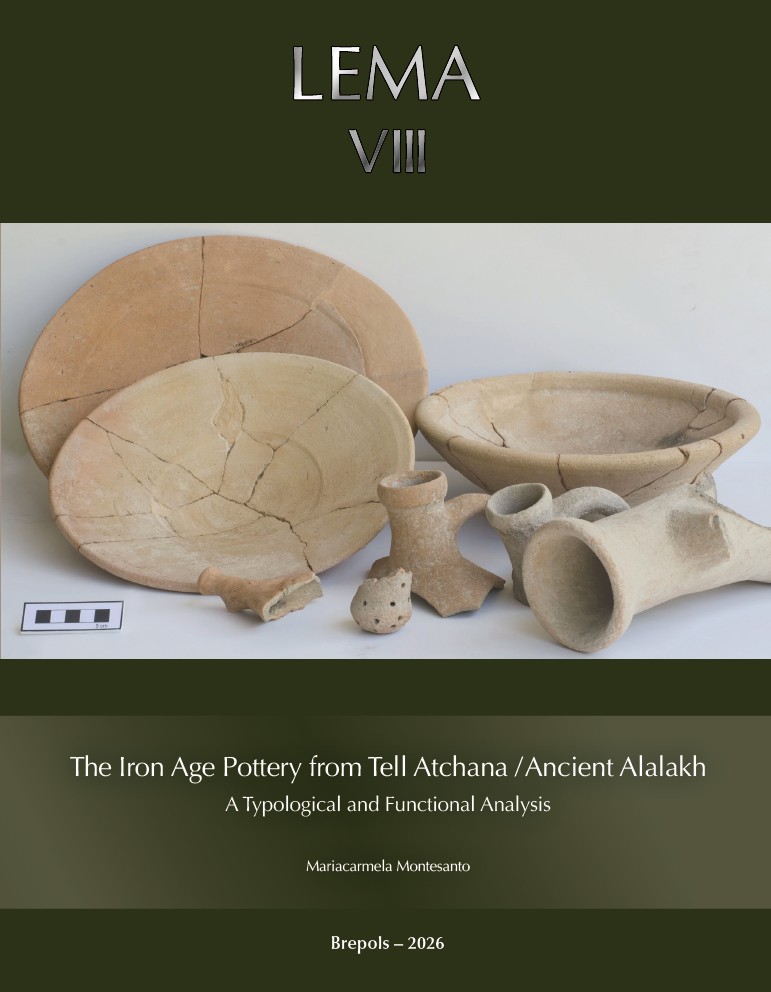 The Iron Age Pottery from Tell Atchana / Ancient Alalakh
A Typological and Functional Analysis
Volume 8

 Writing in the Church of the Nativity in Bethlehem
Inscription and Graffiti in a Multilingual and Multigraphic Perspective
Volume 45
 Zooarchaeology of Ancient Greek Sanctuaries in Southwestern Sicily
Faunal Analysis from Selinus and Akragas as Evidence of Differences in the Treatment of Animals for Ritual Purposes


 Roman Copies, Collecting, and Culture in the Bay of Naples and Beyond
Papers in Honor of Eugene J. Dwyer


 Atlante tematico di topografia antica 36-2026
Urbanistica e monumenti, porti, Roma. Ricerche sui monti Aurunci
Volume 36
 Cerámica común romana y ciclo haliéutico
Análisis de los contextos de las cetariae de Iulia Traducta

 Nuove scoperte e progressi nelle metodologie di rilievo e analisi dell’arte rupestre post-paleolitica in Italia
New discoveries and progress in the tracing and analysis methodologies of the post-Paleolithic rock art in Italy

